3 August 2026 · Telegram Ban Service · 9 min read
Telegram report service: what one files, what it cannot promise
A Telegram report service files abuse cases on your behalf through Telegram's own routes: the in-app Report button, [email protected], [email protected] and the EU's illegal-content form. It cannot ban anyone directly. Telegram's moderators decide, and no desk can promise a result they do not control.
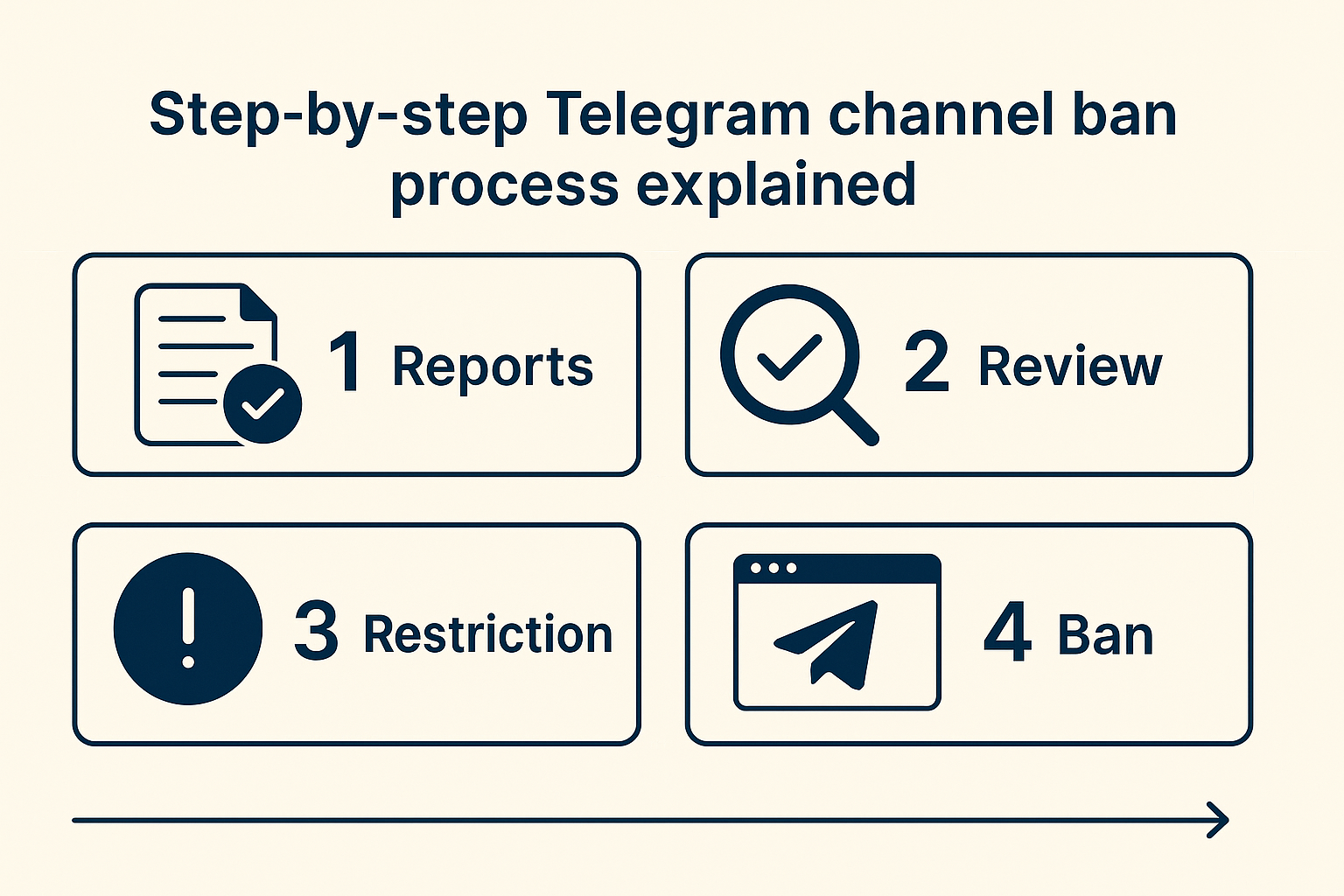
What are you actually buying from a Telegram report service?
Casework, not access. Every route a paid desk uses is one you can open yourself for free, and none of them is a back channel. Telegram's moderation page spells the gesture out plainly: "To report a message, tap it on Android, hold it on iOS, or right-click it on Desktop or Web, then select 'Report.'" What you are paying for is the work around that tap: deciding which of Telegram's doors the case belongs behind, proving you have standing to complain, assembling evidence a reviewer can verify in one pass, and filing again when the operator reappears under a new handle. Any vendor selling it as leverage over Telegram is selling something that does not exist.
How to ban someone on Telegram: four different jobs, four different answers
Four unrelated tasks share one phrase, which is why so many searches end in the wrong place. Search results for how to ban someone on Telegram, and for how to ban someone Telegram account, come back almost entirely admin-side: videos about removing a member from a group you run. Those results answer a real question, just rarely the one a fraud victim is asking. Separate them before you spend anything.
| What you mean | Who can do it | What it actually changes |
|---|---|---|
| Ban a member from your own group or channel | You, as admin | Restriction flags inside that one chat; their account is untouched elsewhere |
| Restrict rather than remove them | You, as admin | Selected permissions switched off, optionally with an expiry date |
| Block them personally | Any user | They can no longer message or call you; nobody else is affected |
| Get the account itself banned | Telegram only, after a report | The account is limited or banned platform-wide |
The first two are not really bans in the sense buyers mean. Telegram's own API documentation is unusually clear about this: core.telegram.org/api/rights describes an admin ban as a set of chatBannedRights flags written against one user in one chat: view_messages, send_messages, send_media, invite_users, pin_messages, plus an until_date expiry. Nothing in that structure reaches their account. They keep their username, their other groups and their ability to open a fresh chat with you the moment you unblock. Only the fourth row ends someone's presence on the platform, and only Telegram can write it. If the person harming you isn't in a chat you control, admin tools are irrelevant to your problem; you need a report, which is the ground covered in our guide to getting an account banned on Telegram.
Is there a Telegram report tool that actually works?
There are three things sold under that name, and they carry very different risks. A search for a Telegram report tool surfaces open-source repositories, panel vendors quoting per-target prices, and reporting desks. Only one of the three keeps the exposure off your account.
| What it is | What it needs from you | Where the risk lands |
|---|---|---|
| Open-source auto-report script | Your api_id and api_hash from my.telegram.org, plus phone-verified sessions | On you — the traffic is yours, and stored session files are live credentials |
| Paid mass-report panel | Payment, a target link, sometimes account access | On you if you hand over access; the coordinated pattern is also the easiest kind to discount |
| Reporting desk filing official routes | Evidence and proof of standing | On the desk's own process; your account never files anything unusual |
The first row is the one people underestimate. Those scripts run on the MTProto client API, so they authenticate as you, and the session file sitting on the operator's disk is a working key to your account rather than a config setting. The second row fails on a different axis. It is built on the premise that report volume moves the needle, and no Telegram page publishes a report count that triggers anything; the moderation page describes a pipeline combining "user reports with proactive monitoring powered by machine learning". That is also why we price casework rather than volume, and why our Telegram mass report bot page says the same.
Why the wrong report route kills a valid case
Picking the wrong door is the most common reason a legitimate complaint dies quietly. Telegram runs separate intake paths, and they are narrower than most guides admit. The one people misuse most is @notoscam: Telegram's FAQ points there for the specific case of a scammer pretending to be you, so it is an impersonation channel rather than a general abuse line, and generic fraud reports sent there are aimed at the wrong reviewer. Copyright is stricter still. The DMCA route at [email protected] is scoped to bots, channels, sticker sets and other content forming part of Telegram's public platform, which is why a Telegram DMCA takedown needs individual message links rather than a channel name. Illegal public content goes to [email protected] with t.me links attached. EU users get a fifth door most people never find: Telegram's DSA guidance page states "You can report content as illegal on this page" and names @EURegulation as its single point of contact under the Digital Services Act. Matching violation to door is most of the skill.
How long does it take, and what will Telegram tell you?
Nobody can give you a date, and the honest ranges are wide. Telegram publishes no review-time target anywhere. Its spam FAQ does say a confirmed account limit lasts "a few days or so" at first, and that "Repeated offences will result in longer periods". That is a sanction duration, not a queue time. Vendors quoting 24 to 72 hours conflate the two.
The volume behind the queue is real: Telegram's own live counter showed 21,923,934 groups and channels blocked during 2026 when we read it on 3 August, including 336,357 tied to child sexual abuse material and 155,114 to terrorism. Set against that, expect silence rather than a verdict. Telegram does not email reporters an outcome, so you find out by watching the channel: flagged, gone, or unchanged. One outside measure is worth knowing before you pay anyone for speed. On 23 July 2026 the EU's statement-of-reasons database held roughly 12,000 Telegram moderation decisions for the prior 180 days, against more than 194,000 for WhatsApp Channels, per Tech Policy Press. Its authors caution that a bigger number can mean heavier over-removal as easily as better protection. Read it as a reason to file precisely, not as a scoreboard.
How do you tell a real reporting desk from a scam?
Start with what they ask you for. A desk that needs your login code, your phone number or an exported session is not reporting anything; it is collecting an account. The rest of the tells are just as legible:
- A guaranteed ban, or a guaranteed timeframe. Both are promises about a decision Telegram makes.
- A success percentage with no method behind it. Nobody in this market publishes a denominator.
- Per-report pricing, which only makes sense if volume works. It doesn't.
- An offer to remove content from secret chats, or to unban an account "instantly".
- First contact by unsolicited DM after you posted publicly about being scammed.
That last one has a name. On 20 July 2026 the FBI's Internet Crime Complaint Center issued alert I-072026-PSA, warning that criminals impersonate its own staff to run recovery schemes against people already defrauded. The alert is about IC3 impersonation rather than takedown vendors, but its two operative lines transfer directly: IC3 "does not investigate crimes or recover funds through Facebook, Telegram, or similar platforms", and you should not send money or cryptocurrency to anyone you have met only online.
On the last impersonation case we took in, the first thing we sent back was the evidence. The client had cropped every screenshot down to the offending message, neatly, with the @username cut off above the frame. That reads as the tidy way to hand over proof, and it left us nothing to file, because a reviewer cannot tie an unattributed message to an account. We asked for the same captures again: full frame, profile header and timestamps visible, plus a permanent t.me link to each post. Cropping is the single most common reason we hand a file back before it ever reaches Telegram.
When you should skip the service and file it yourself
Most single-incident cases you should file yourself, today, for free. One scam message, one fake account wearing your photo, one channel reposting your video: open the app, use the Report control, pick the reason that matches, and you have done what any desk would do on your behalf. Our walkthroughs on reporting a message, reporting a group or channel and reporting abuse cover the per-device menus, and deleting a channel you own takes seconds. Hire someone when the case has scale or legal weight: a network of mirrors, dozens of infringing links, an extortion or counterfeit operation, a fraud case you also need documented for police, or a channel takedown that keeps re-spawning and needs re-filing every time. Otherwise keep your money. If you are not sure which bracket yours falls into, the rest of our Telegram reporting solutions break the routes down case by case, our reporting desk reads cases before quoting anything, and you can send the links over for a straight answer on whether filing is worth your time.
Sources
- Telegram FAQ: report routes, [email protected], @notoscam for impersonation, copyright scope (retrieved 3 Aug 2026)
- Telegram Spam FAQ: moderator review, limits lasting "a few days or so", @SpamBot appeals
- Telegram Moderation: report gestures, machine-learning monitoring, live 2026 block counter
- Telegram API: chatBannedRights flags defining what an admin ban actually restricts
- Telegram: user guidance for the EU Digital Services Act, @EURegulation contact
- Tech Policy Press (31 July 2026): Telegram's DSA statement-of-reasons volume vs WhatsApp Channels
- FBI IC3 alert I-072026-PSA (20 July 2026): impersonation and advance-payment recovery scams
FAQ
Is banning someone from my group the same as getting their Telegram account banned?
No, and the two run on different machinery. An admin ban writes restriction flags against that user inside your chat only, so they keep their account and can carry on everywhere else on Telegram. An account-level ban is Telegram's decision, taken on a reported violation of its Terms of Service.
How many reports does it take to ban a Telegram channel?
Telegram has never published a number, on the FAQ, the spam FAQ or the moderation page. Any vendor quoting fifty or five hundred reports is quoting a figure that exists nowhere in Telegram's own documentation.
Can filing reports or hiring a report service get my own account restricted?
Filing honest reports through the app will not. Running a mass-report tool can. Those scripts need your api_id and api_hash from my.telegram.org and a phone-verified session, so the automated traffic is attributable to your account rather than to the vendor's.
Will the person know that we reported them?
Telegram sends no notification naming the reporter and exposes no sender. Two leaks sit outside its control: in a one-to-one chat the other party can often infer who filed, and emails to [email protected] or [email protected] arrive from your own address. Crop your @username out of screenshots.
How long does Telegram take to act on a report?
There is no published deadline. Telegram's spam FAQ says a first limit lasts a few days or so, and that repeated offences bring longer periods. That describes the sanction, not the queue. The widely repeated 24 to 72 hours figure appears in no Telegram policy at all.
Can you get content removed from a private Telegram group?
Sometimes. Telegram's FAQ now says its Report buttons let you flag illegal content for moderators in a few taps, without limiting that to public chats. Copyright is the firm exception: the DMCA route is scoped to bots, channels, sticker sets and other content that forms part of Telegram's public platform.
What happens if the banned channel comes back under a new name?
You file again against the new @username and t.me links, because Telegram acts on the specific object you cite rather than on a name or a person. Persistent operators seed backups before a ban lands, which turns enforcement into monitoring.
Can a Telegram report service guarantee a ban?
No. The decision belongs to Telegram's moderators, so a guarantee is a claim about someone else's ruling. An honest desk commits to what it controls: correct route selection, a defensible evidence pack, re-filing against clones, and telling you when a case is not actionable.