25 November 2026 · Telegram Ban Service · 17 min read
Telegram channels selling account bans: what they sell and how to report them
Telegram channels selling account bans take payment to flood a target with reports, yet no seller controls the outcome. Telegram, Instagram or WhatsApp moderators decide each case against their own rules, so volume buys nothing. Some of these sellers keep the fee and deliver nothing, and the channels themselves can be reported to Telegram.
What are Telegram channels selling account bans?
Telegram channels selling account bans are public storefronts that offer to get someone else's account removed on Instagram, TikTok, WhatsApp or Telegram itself. The offer arrives in one of three shapes. It can be a pinned price list, a bot with a Start button or an admin who takes orders in private messages. The seller wants the money before anything else happens.
Telegram Ban Service is an independent content reporting and takedown service that sits on the other side of that trade. We gather proof on channels like these and send it through Telegram's official routes. Telegram's moderators decide whether anything gets restricted, and we can't speed them up or overrule them.
If you came here because a channel was hired against you, skip to the section on what to do when you're the target.
What does a ban listing promise, and what does each line leave out?
A ban listing promises a removed account for a fee, but every line on it skips the step where a platform reviewer reads real evidence. Here is how the common claims compare with what the platforms publish.
| Line in the listing | What it wants you to believe | What the platform says |
|---|---|---|
| "Ban any account in 24 hours" | Speed can be bought | Reports go to moderators for review, and no seller sets their queue |
| "500 reports from aged accounts" | The count decides | Moderators review the reported messages; a count is not a ruling |
| "Proof video after delivery" | The ban can be shown | A screen recording proves nothing about who decided what |
| Buy account ban Telegram channel listing | Telegram removes accounts on order | Telegram's terms bar using the service to scam users |
| "Full refund if no ban" | The seller carries the risk | Crypto sent to a stranger has no chargeback |
The second row is the one sellers hope you won't check. Telegram's spam FAQ sends flagged messages to human moderators for a check, so 500 reports buy a look at what the account posted, not a ban.
Some ban storefronts also list Instagram report floods, and public scripts for those exist. A dated review of the most-starred Instagram mass report bot on GitHub reads its script line by line. It also counts the complaints its own users filed as issues. It's the next read if the listing in front of you was an Instagram mass reporter rather than a Telegram one.
The buyer's side of those Instagram offers, from deposit to delivery, is set out in the buyer's view of Instagram mass report services. The WhatsApp versions sold through the same channels are covered in WhatsApp mass report bot offers checked against WhatsApp's rules.
Telegram ban sellers scam patterns: where does the money go?
In a Telegram ban sellers scam, the money goes to the seller and stays there, because nothing being sold can be checked or reclaimed later. Watch for these five patterns.
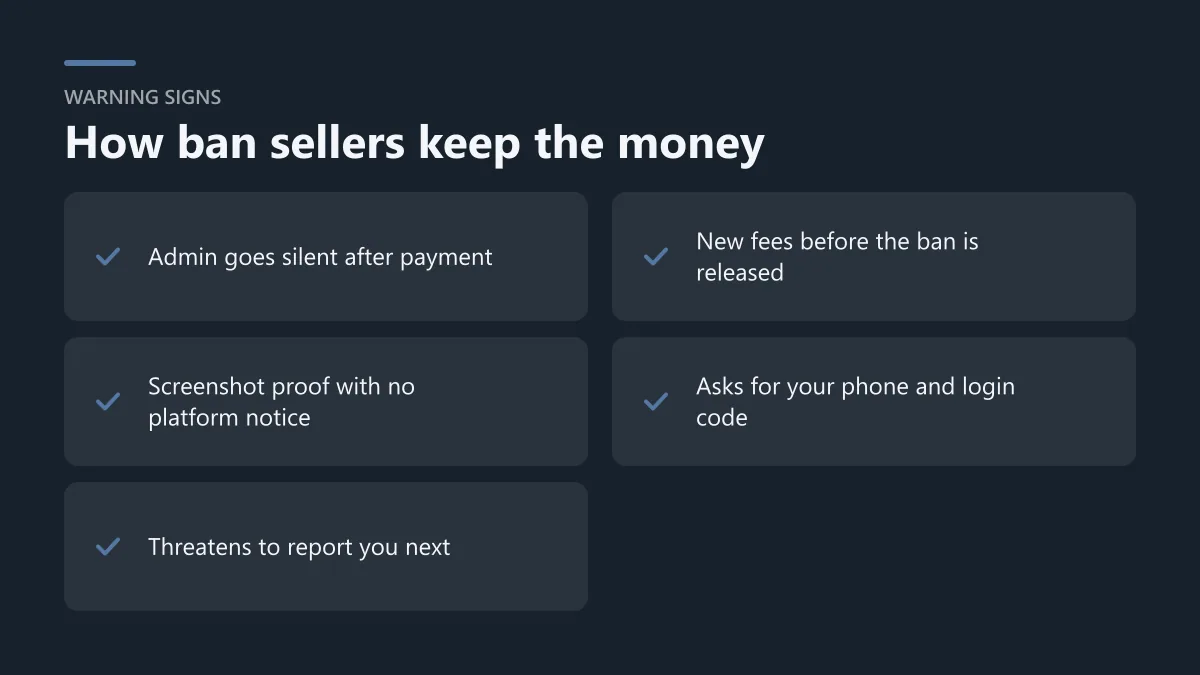
- The silent admin. Payment lands, the chat goes quiet, and the admin blocks you or wipes the channel.
- The fee ladder. A "server fee" follows the deposit, then a "priority fee", then an "unlock fee" before the ban is "released".
- The staged proof. You get a screenshot of a "banned" page that no platform notice backs up.
- The login grab. A "verification" step asks for your phone number and the code Telegram just sent you. Telegram's FAQ tells users to keep that code to themselves and never hand it to an outside app or service.
- The turnaround. The seller threatens to report you, or to tell the target who paid, unless you pay again.
Getting money back depends on how you paid. Telegram Stars sales are final, according to the Stars terms. There's one exception. If a purchase isn't delivered "as advertised", the Stars terms let the bot's developer refund it, and bots should answer the /paysupport command. If the developer refuses, Telegram lets you open a dispute. You'll need the transaction ID, found under Settings and Your Stars.
Crypto is harder. The FTC's guide to crypto scams explains that a crypto refund depends on the person you paid choosing to return it. A ban seller has no reason to do that. Before paying any bot, run the checks worth doing on a Telegram report bot.
Do ban-selling channels break Telegram's own rules?
Yes, a ban-selling channel breaks Telegram's rules when it takes money for something it can't deliver. Telegram's Terms of Service rule out using it to "send spam or scam users".
Telegram has labels for exactly this. Its API reference for channel objects carries a scam flag, described as "probably a scam". A second flag, fake, means the channel drew many user reports calling it fake or a scam. In the app these show as a SCAM or FAKE badge next to the name.
Sellers who run report farms face another rule. Telegram's API terms say that using its API for flooding or spamming gets the developer "banned forever". Scripted mass reports are flooding by another name.
Enforcement is visible in Telegram's own numbers. As of 25 November 2026, Telegram's moderation page counted 30,977,922 groups and channels blocked in 2026. On 23 September 2026 the same counter read 26,338,546. That's about 4.64 million more in 63 days, or roughly 73,600 a day. The counter doesn't say how many were ban sellers, so treat it as a sign of scale only.
Report counts don't drive those blocks, which is why report volume isn't a verdict on Telegram. For where else a ban can come from, see the four sources of a Telegram ban.
How do you report a channel that sells bans?
You report a ban-selling channel from inside Telegram with the Report option, and then flag the worst posts individually so moderators see the actual offer.
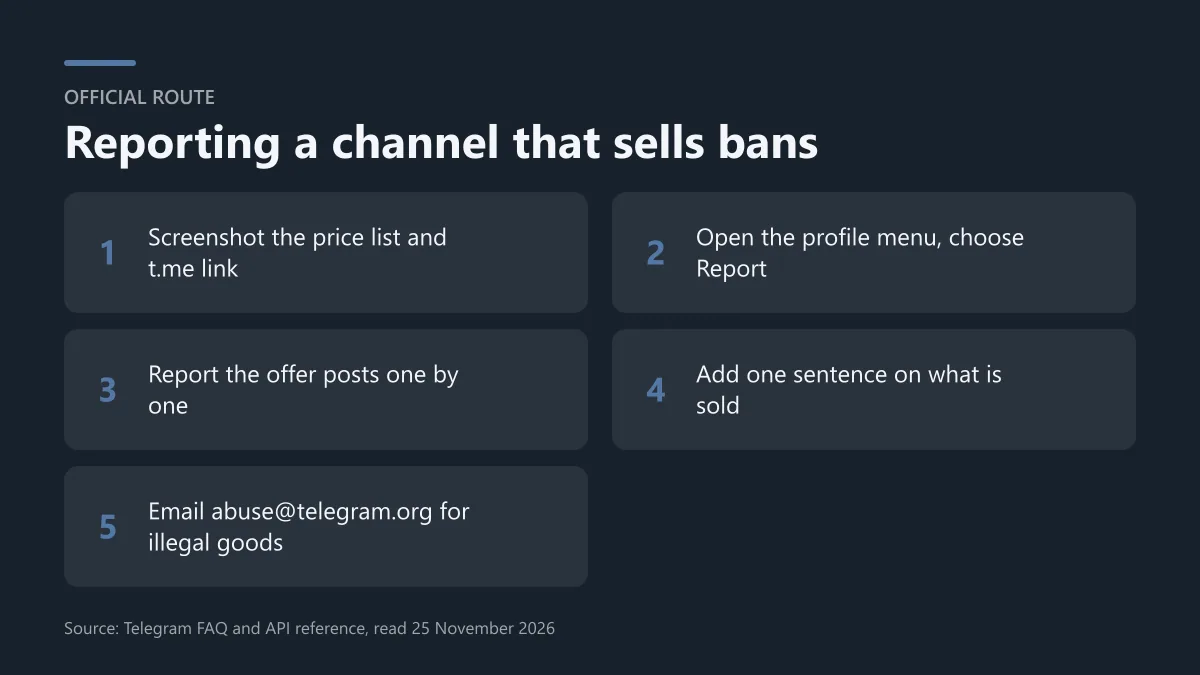
- Save evidence first. Take screenshots of the price list, the payment request and the channel's t.me link. Channels that sense trouble delete posts.
- Report the channel. Tap the channel's name at the top, find Report in the menu that opens and pick the reason closest to what the posts show.
- Report single posts. Long-press the price list or a "proof" post and choose Report. A whole-channel report through account.reportPeer has no field for message IDs, so it carries no posts. A post report does.
- Add a short note. Say what the channel sells and that it takes payment for it. One clear sentence beats a paragraph.
- Use email for illegal content. Telegram's FAQ names abuse@telegram.org as its takedown address. Use it when the channel also sells illegal goods or posts someone's private data.
Three things make a report on a ban seller go nowhere, and Telegram Ban Service checks for each before it files:
- Only the channel is reported, with no post reports, so moderators get no posts to read.
- The reason picked doesn't match what the posts show.
- The posts are deleted before anyone saved screenshots.
Telegram Ban Service follows the same five steps when it files a report, and the outcome still sits with Telegram. If the channel copies your name or your brand to sell bans, the FAQ points impersonation cases to @notoscam. The longer walk-through for reporting an entire Telegram channel covers private channels and invite links.
What if someone paid a channel to ban your account?
Keep using your account normally, because a paid report flood only asks for a review, and Telegram's moderators check reports before limiting anyone. Telegram's spam FAQ describes reported messages landing with moderators who review them. Group admins can flag spammers as well, and a person reviews those flags.
Limits do happen. While limited, an account can reach only contacts who have its number stored, according to the Telegram FAQ. How long? For a first limit, the spam FAQ answers "a few days or so". Each repeat stretches the block. If you think it's a mistake, appeal through @SpamBot.
Lock the account down while you wait. Turn on Settings > Privacy and Security > 2-Step Verification, then open Settings > Devices and close every session you can't account for. If someone already got in, follow the steps for a hijacked Telegram account. A threat against your WhatsApp is a separate case, and the limits of any WhatsApp ban service shows why nobody outside WhatsApp can order one.
FAQ
Should you buy account ban Telegram channel offers?
No. A channel that sells account bans is selling something it doesn't control. Every platform that matters here, Telegram included, sends reports to its own moderators, and they judge the reported content against written rules. Hundreds of reports from people who never saw a violation give them nothing to act on. Telegram's terms bar using the service to scam users, which is what a seller does when the paid ban never comes. The buyer also carries the risk: crypto payments can't be pulled back, and a seller who knows what you ordered can use that against you later. If the account you wanted gone really breaks the rules, one well-documented report filed in the platform's own form does more than any package of paid reports.
What does a Telegram ban sellers scam look like after you pay?
It starts with silence or a new bill. In a Telegram ban sellers scam, the admin either goes quiet once the payment lands or invents a reason to ask for more. The new charge might be a server fee, a priority fee or an unlock fee. Some sellers send a screenshot of a "banned" profile as proof, yet no platform notice stands behind it. Others ask for your phone number and the login code Telegram sends you, which hands them your account. Telegram warns that the code is meant for nobody but you. The last stage is pressure: a threat to report you, or to tell the target who paid. None of these steps brings the ban closer. If you've reached any of them, stop paying, save the chat and the channel link, and report the channel from inside Telegram. If you shared a login code, change your security settings first.
Is a refund possible after paying a ban seller?
Only in narrow cases, and it depends on how you paid. Telegram's Stars terms say that sales of Stars are final. If a purchase isn't delivered as advertised, the Stars terms let the bot's developer refund it, and bots should answer the /paysupport command. If the bot's developer refuses, you can open a dispute with the transaction ID, which sits in Settings under Your Stars. That route doesn't cover crypto, bank transfers or gift cards sent to an admin. The FTC's crypto guidance says a refund there depends on the person you paid choosing to return it. A seller who took payment for a fake ban has no reason to do that. Keep the receipts and the chat anyway. They support a report to Telegram, and in the U.S. they back up a complaint to the FTC at ReportFraud.ftc.gov.
What can make Telegram ban an account?
Telegram bans or limits accounts that break its Terms of Service, and the reason has to be in what the account did. The terms list sending spam, scamming users, promoting violence on public channels, posting illegal pornographic content in public and selling illegal goods or services. Telegram's API terms add a separate rule for developers: a developer who floods, spams or fakes channel counters through the API is banned for good. Reports matter because they bring an account to the moderators' attention. They don't decide the outcome. Telegram's spam FAQ says a person, not a counter, looks at reported messages, and reports filed by group admins get the same human check. So a channel that sells bans is, by its own business model, closer to a breach than many of the accounts it targets. It takes money for a promise it can't keep, and it may run automated accounts to look busy.
Are Telegram bans permanent?
Some are and some aren't. A spam limit is the mildest step. Telegram's spam FAQ says a limit like that lifts after "a few days or so". Repeat offenders wait longer. Contacts who saved the number can still get messages in the meantime. Appeals go through @SpamBot, which is the only official way to ask for a review of a spam limit. Channels and groups are a different matter. A blocked public channel shows a notice that it can't be displayed. Telegram's moderation page keeps a running count of those blocks for the year. It doesn't publish how many were later restored. Developer accounts that abuse the API face the hardest line, because Telegram's API terms say flooding or spamming through the API gets them banned forever.
Someone hired a ban seller against me. Will my account be banned?
Not because of the order alone. A hired report flood can make moderators look at your account, but they review what you actually posted and sent. If none of it breaks Telegram's rules, the flood has nothing to work with. The risk is higher if a report lands on something that does break the rules, so check your public channels and groups for posts you wouldn't want reviewed. Then secure the account. Turn on 2-Step Verification under Settings, then Privacy and Security, and look through Settings, then Devices, ending any login you can't place. If you do get a spam limit, you'll be able to message only saved contacts for a while, and you can appeal through @SpamBot. Save any threat the seller or the buyer sent you. A threat to get your account banned unless you pay is extortion, and that message is evidence for a report about them, not about you.
How do you tell a ban-selling channel from a real reporting service?
Compare what each one wants from you with what it promises. A ban-selling channel promises an outcome, such as a ban by tomorrow, and asks for payment before it has seen any evidence. It names a number of reports, as if the count decided anything. It may take crypto only and has no address, no terms and no way to complain. A legitimate reporting service starts from the other end. It asks what the account did and for the links and screenshots that show it. It says which rule was broken and which official form or button it will use. It tells you plainly that the platform decides, and it turns down requests aimed at accounts that haven't broken any rule. It has no use for your password or a login code. Telegram Ban Service works that way, and that's the test to apply to anyone offering to report an account for you.