14 November 2026 · Telegram Ban Service · 15 min read
WhatsApp mass report bot offers on Telegram, checked against WhatsApp's rules
A WhatsApp mass report bot cannot get a number banned, because WhatsApp reviews what was sent, not how many people complained. Each in-app report forwards up to five of the reported person's latest messages, and the Help Center says a report won't necessarily end in a ban. Most of these bots are sold through Telegram channels, and many are scams or ask for your login code.
What is a WhatsApp mass report bot?
A WhatsApp mass report bot is software, or a person running scripts, that claims to file many reports against one WhatsApp number so that WhatsApp bans it. The pitch is arithmetic: send enough complaints and the account disappears. Listings sell the same idea as a WhatsApp mass report tool, a "ban panel" or a "number killer", and most of them are advertised and paid for inside Telegram channels and bots rather than in any app store.
Telegram Ban Service is a reporting desk for Telegram channels, groups and bots that break Telegram's rules, so it meets these listings where they are hosted and where they can be reported. That is the angle here. The page does not explain how such tools run, because the central claim fails on WhatsApp's own terms and the rest of each listing is about getting paid.
Three questions settle any offer of this kind.
- How WhatsApp actually handles a report.
- Which deliverable the seller hands over once the money has moved.
- What risk the order creates for the buyer, on WhatsApp and on Telegram.
What arrives after you pay for a WhatsApp mass report tool?
Usually a request for more: more money, more access, or your own phone number. A WhatsApp mass report tool comes in a handful of formats, each asking the buyer for something the seller can use, and none returns anything WhatsApp would recognise as a result.
| Format of the offer | What it asks from you | What you hold afterwards |
|---|---|---|
| Telegram bot with a Start button | Crypto payment, then the target number | A progress bar the bot draws itself |
| Downloadable app or APK | Phone permissions, often your number and the 6-digit code | A program running on your phone |
| Web "panel" login | Your WhatsApp linked to the panel "to send from" | Your own account behind automated traffic |
| Private seller in a channel | Payment up front and a deadline | Screenshots, or a chat that blocks you |
The download format carries the sharpest risk. Kaspersky's researchers reported in 2023 that a modified WhatsApp build with a hidden spy module, which they named CanesSpy, spread mainly through Telegram channels, the largest with almost two million subscribers, and Kaspersky said it blocked more than 340,000 attacks with it between 5 and 31 October 2023. That build was sold as a better WhatsApp, not as a report bot. The delivery route is the same one these listings use.
No seller can show a reviewer's decision either, because WhatsApp never tells a reporter what happened. Its Help Center says it will acknowledge a report "but we will not contact you again." A progress bar is the seller's own drawing, and Telegram Ban Service has no window into WhatsApp's queue either.
Can you mass report WhatsApp accounts into a ban?
No. A WhatsApp report does not carry a vote; it carries evidence, and a crowd of reporters who never chatted with the target has none to send. When someone reports a contact, WhatsApp receives up to five of the last messages that person sent to the reporter, basic details of the last five calls, the account ID, and when each message was sent and of what type, according to the Help Center article How to block and report someone, read on 14 November 2026.

So a stranger's report forwards an empty chat. Multiply it by a thousand and the reviewer still sees nothing that breaks a rule. WhatsApp's About reporting and blocking page adds the line that matters most for buyers: a user report "won't necessarily result in us banning the user or otherwise taking action against the user." Bans follow the Terms of Service, and WhatsApp also bans on its own detection before anyone complains; the walkthrough of what WhatsApp receives when you report someone sets out its published monthly figures.
Telegram Ban Service cannot change that arithmetic, and no outside party can. For anyone pricing a mass report WhatsApp package, the thing on sale is the one input the review does not weigh.
How a mass report order comes back on the buyer
The account most exposed by a WhatsApp mass report bot is often the buyer's own. WhatsApp's Terms of Service rule out use that involves "sending illegal or impermissible communications such as bulk messaging, auto-messaging, auto-dialing, and the like," and separately forbid creating accounts "through unauthorized or automated means." Scripted reporting from a farm of numbers needs both, and the same Terms let WhatsApp suspend or end access for violations.
Three things tend to go wrong, roughly in this order.
- Your number gets tied to the tool. A panel that asks you to connect WhatsApp "to send from" puts your account behind automated traffic, the activity WhatsApp's Terms name.
- Your account gets taken. A tool that wants the 6-digit registration code is asking for the account. WhatsApp's compromised account guide says you "should never share your registration code with others, not even friends or family."
- Your money stays gone. Crypto sent to an anonymous channel has no chargeback, and a seller who stops replying owes you nothing you can enforce.
Then there is the ban that never happens. WhatsApp's About account bans page states that "third party services can't ban your WhatsApp account or remove your account ban. Only WhatsApp can ban or unban a WhatsApp account." That sentence answers the seller who promises to ban a target and the one who later offers to lift a ban for a fee.
A buyer who typed a login code into a Telegram bot may have a second problem on Telegram itself, and the steps for recovering a Telegram account after a takeover apply there.
The real route when a WhatsApp account breaks the rules
It runs through the chat, and only the person who received the messages can use it. WhatsApp says "the only way to report someone is to follow the in-app reporting process," and that contacting it outside that process "won't expedite the review process or impact the decision." No agency, desk or bot can file a WhatsApp report on someone else's behalf, and Telegram Ban Service does not claim to.
- Screenshot the messages, the number and the profile first, since blocking or reporting can change what you see.
- Open the chat and choose Report. Reporting a group removes you from it. The step-by-step WhatsApp reporting guide covers each phone.
- Block the sender if you want the messages to stop, because WhatsApp says a report without a block does not stop them.
- If money moved or someone threatened you, go to your bank and the police as well. A WhatsApp review can close an account at most.
One report from the person who actually received the scam or threat gives WhatsApp the messages it needs. Ten friends reporting the same number from empty chats give it nothing new.
What the desk declines
Some requests get a plain no. Telegram Ban Service does not take orders to get a WhatsApp number banned, whoever asks and whatever the reason. It also turns down jobs against people or channels that follow the rules, false or inflated claims, bots and scripted reporting of any kind, anything that needs a password or login code, and requests tied to a fixed result or date. If the aim is to remove a rival, an ex or a critic who broke no rule, there is no route to sell, and paying for one funds a scam.
Where can a Telegram channel selling WhatsApp mass report bots be reported?
Inside Telegram, against the channel, group or bot carrying the listing. Telegram's Terms of Service list, among the things users agree not to do, "Use our service to send spam or scam users." A channel that takes payment for a WhatsApp ban it cannot deliver sits on the scam side of that line, and a bot that collects WhatsApp registration codes is phishing for accounts.
Telegram's FAQ gives two routes: the Report button in every app, and an automated takedown address, abuse@telegram.org, for messages that include the t.me link. If the seller poses as you or as a brand, the same FAQ points to @NoToScam.
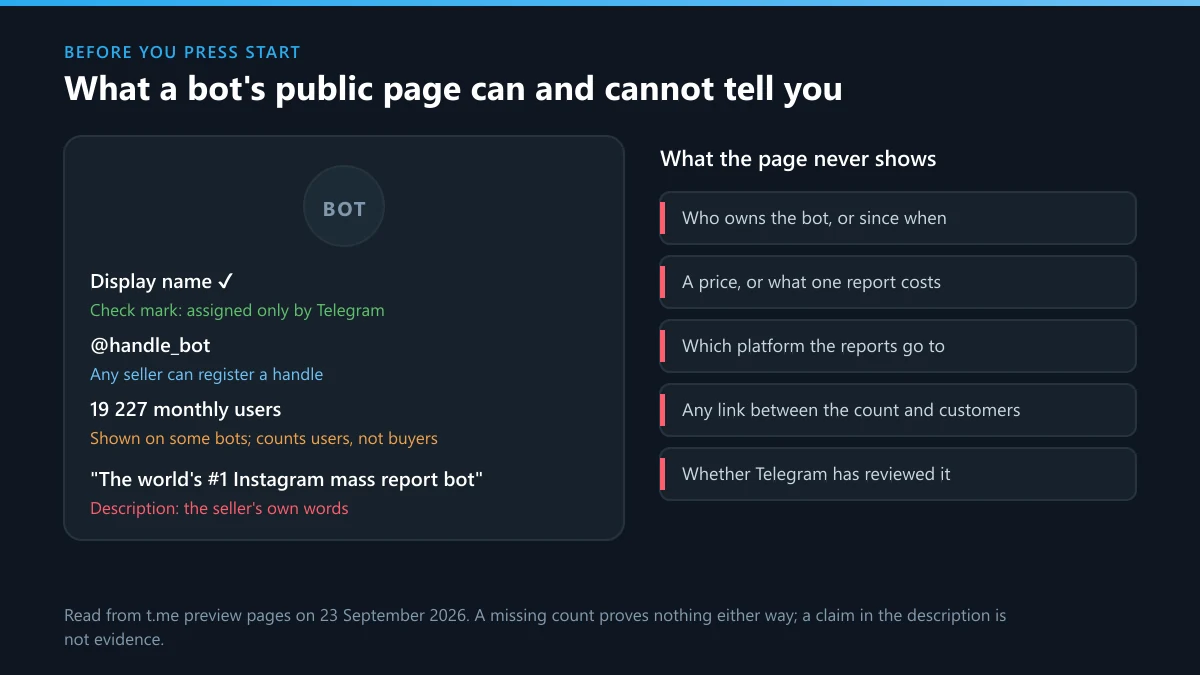
- Copy the t.me link and screenshot the listing, the price, the payment address and the chat. Handles are weak evidence on their own, since usernames change hands; see how Telegram usernames are bought and resold.
- Report the advertising channel and the bot or account that takes payment as separate items, each with the reason you can show.
- Email abuse@telegram.org with the link when the in-app report leaves no room for context.
- Report any payment loss to your bank and the police.
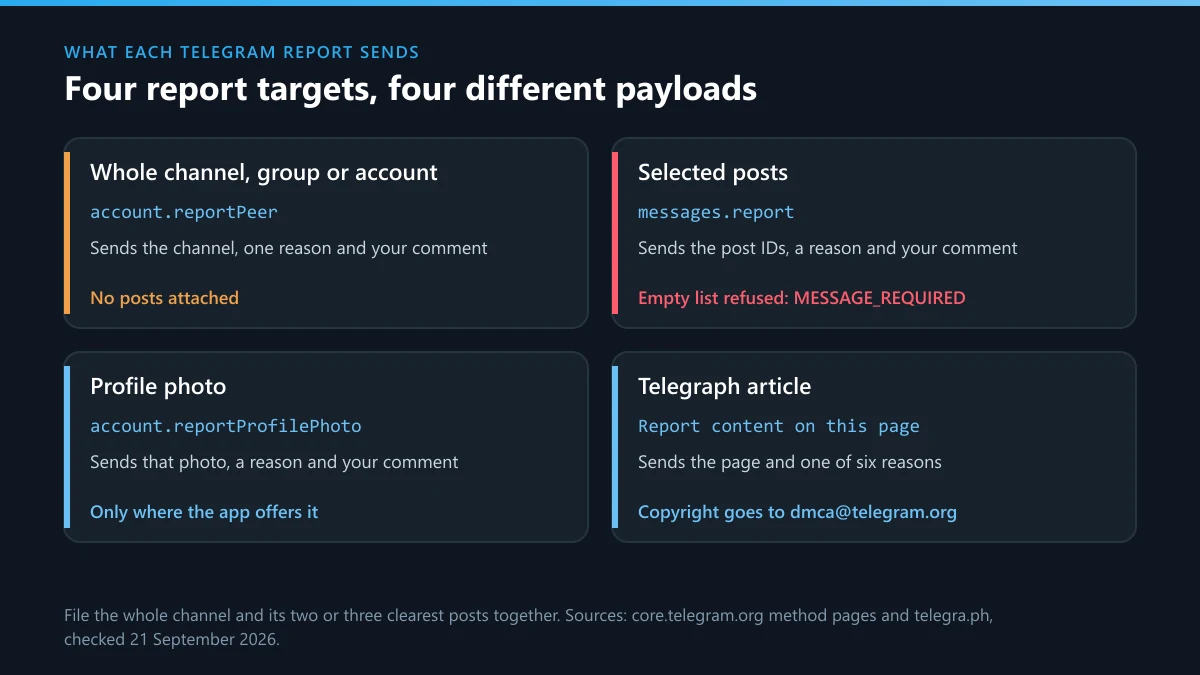
This is the part of a case that Telegram Ban Service handles. A request starts with the t.me link and the screenshots. The desk reads them against Telegram's Terms of Service and Community Guidelines, decides whether a violation is actually shown, and if it is, files one report per item through Telegram's official channels. Telegram makes the decision. A channel that Telegram restricts may then show a notice where its posts used to be, and what the "This channel can't be displayed" notice means explains the variants a reporter might see afterwards.
Is the problem really on WhatsApp?
Often it is not. People pricing a WhatsApp mass report bot frequently have a dispute that started somewhere else, or a target active on several apps, and each app has its own route that takes evidence rather than numbers. Telegram Ban Service has written up the ones readers ask about.
- Instagram: what to do when someone impersonates you on Instagram, reporting harassment on Instagram, reporting an Instagram scammer, reporting blackmail on Instagram, and whether an Instagram report stays anonymous.
- X: reporting a single post on X, reporting a whole X account, clearing bot accounts out of your X replies, filing a trademark complaint on X, and why nobody outside X can delete someone else's account.
None of those forms accepts a count either.
Sources
- WhatsApp Help Center: How to block and report someone (read 14 November 2026)
- WhatsApp Help Center: About reporting and blocking on WhatsApp
- WhatsApp Help Center: About account bans
- WhatsApp Help Center: How to recover a compromised account
- WhatsApp Terms of Service: Acceptable Use of Our Services
- Securelist (Kaspersky), 2023: Analysis of a spy module inside a WhatsApp mod
- Kaspersky press release, 2023: more than 340,000 attacks with a malicious WhatsApp mod
- Telegram Terms of Service
- Telegram FAQ: Report button, abuse@telegram.org and @NoToScam
FAQ
Does a WhatsApp mass report bot actually work?
No, not in the way it is sold. A WhatsApp mass report bot promises a ban through volume, and WhatsApp's review does not run on volume. When a user reports a contact, WhatsApp receives up to five of the last messages that contact sent the reporter, plus basic call details, the account ID and message timing. A report from a number that never chatted with the target forwards nothing that could show a violation, however many copies are sent. WhatsApp's Help Center also says a report won't necessarily result in a ban, and its account-ban page says third party services can't ban an account; only WhatsApp can. Accounts that do get banned are usually caught for spam, scams or other Terms of Service breaches, often by WhatsApp's own detection. If a target really is scamming or threatening people, the person who received those messages should report from the chat. That single report carries more evidence than any bot's total.
Is a WhatsApp mass report tool safe to download?
Treat it as unsafe. A WhatsApp mass report tool distributed as an app, APK or desktop program asks for permissions on your phone, and many also ask for your WhatsApp number and the 6-digit registration code. That code is the account. WhatsApp's guide to compromised accounts says you should never share your registration code with others, not even friends or family. Modified WhatsApp builds have already been used this way: Kaspersky's researchers reported in 2023 that a WhatsApp mod carrying a hidden spy module, CanesSpy, was spread mainly through Telegram channels. If you installed something like this, uninstall it, re-register WhatsApp with your own number so other sessions are logged out, turn on two-step verification and review your linked devices. Then report the Telegram channel or bot that distributed it, with the t.me link and screenshots, so Telegram can act on the source rather than on one copy.
How many reports does it take to ban a WhatsApp number?
There is no number, and anyone quoting one is selling something. WhatsApp bans accounts it believes break its Terms of Service, for example for spam, scams or putting users' safety at risk, according to its About account bans page, and a report is only one way it learns about an account; each report carries up to five recent messages from the reported chat. That is why a mass report WhatsApp campaign run by strangers adds little: their chats with the target are empty. WhatsApp's About reporting and blocking page says plainly that a user report won't necessarily lead to a ban or any other action, and that after the acknowledgement the reporter will not be contacted again. One report from a genuine recipient of scam or threat messages is the input that counts. Thousands from people with nothing in the chat are noise, and coordinated automated reporting is the kind of activity WhatsApp's own terms forbid.
Can my own number be banned for using a WhatsApp mass report service?
Yes. Buying a whatsapp mass report service is not something the app can see by itself, but the way these services operate often puts the buyer's number in the line of fire. Some panels ask you to link your WhatsApp account so the reports can be sent from it. WhatsApp's Terms of Service forbid bulk messaging, auto-messaging and auto-dialing, and creating accounts through unauthorized or automated means, and they let WhatsApp suspend or end access for violations. Other services take your registration code and, with it, the account, which you then lose rather than see banned. If your number is banned, the in-app Request review button is the route. WhatsApp says most reviews finish within 24 hours and that contacting it outside that process won't speed anything up. Anyone selling a paid unban is selling what WhatsApp says third parties cannot do, so treat that offer as the second half of the same scam.
Can Telegram Ban Service report a WhatsApp account for me?
No. WhatsApp states that the only way to report someone is the in-app reporting process, and that contacting WhatsApp outside that process won't expedite a review or change the decision. A report also works by forwarding messages from your own chat, which nobody else can send for you. So Telegram Ban Service does not file WhatsApp reports, does not accept WhatsApp numbers as targets and does not offer to speed up a WhatsApp review. What it can do is narrower and sits on Telegram. If a Telegram channel, group or bot sold you a WhatsApp ban, collected your login code, or threatens to have your number banned unless you pay, the desk reads your t.me link and screenshots against Telegram's rules and reports genuine violations through Telegram's official routes. Telegram decides the outcome. Nothing more. For the WhatsApp side, the site's step-by-step reporting guide walks through the Report option on each phone.
How do I report a Telegram channel selling WhatsApp mass report bots?
Report it inside Telegram, with the evidence saved first. Copy the channel's t.me link, then screenshot the listing, the price, the payment address and any chat with the seller, because these channels rename and reopen quickly. Use the Report button on the channel itself and pick the reason that matches what you can show, such as a scam or spam. If a separate bot or account takes the payments, report it as its own item. Telegram's Terms of Service bar using the service to send spam or scam users, and Telegram's FAQ lists abuse@telegram.org as an automated takedown address for messages that include the link. One accurate report per item is enough. Asking a group of friends to report the same channel repeats the idea the seller is selling and adds no evidence. If money moved, tell your bank and the police too, since action by Telegram cannot return a payment.
Someone threatens to mass report my WhatsApp unless I pay. What should I do?
Do not pay, and keep the threat. A message that demands money to call off a WhatsApp mass report is an extortion attempt, and the threat itself is weak: WhatsApp's About account bans page says third party services can't ban your account and only WhatsApp can. Bans follow Terms of Service violations, not a count of complaints. Protect the account anyway, in case the real aim is a takeover. Turn on two-step verification, check linked devices, and never send the 6-digit registration code to anyone. If the threat arrived on WhatsApp, report and block the sender from that chat. If it came from a Telegram account, channel or bot, report it there and save the t.me link first. Where the sender keeps pushing or names a price, a police report is reasonable. Paying tends to bring a second demand rather than silence.