11 October 2026 · Telegram Ban Service · 12 min read
Twitter trademark infringement: what X counts and how to report it
Twitter trademark infringement means using someone's registered mark on X in a way that may confuse people about who runs an account. Only the trademark holder or an authorized representative can report it, through X's trademark form, with a registration number. X may then suspend the account or ask it to change.
A shop account turns up with your logo as its avatar and your product name in the handle, and customers start tagging it with delivery complaints. That is the textbook Twitter trademark case, and it is also the one people most often report the wrong way: through the Report button, as spam, from a personal account. X ignores trademark complaints that arrive like that. It has one form for them, it reads only filings from the owner of the mark or someone acting for the owner, and it wants a registration number before anything else. We opened that form signed out on 11 October 2026 and went through each branch without submitting it. What follows is what the policy counts, what the form asks, and where a brand complaint belongs when trademark turns out to be the wrong label.
What counts as Twitter trademark infringement under X's policy?
One sentence carries the whole rule. The X trademark policy says that using another's trademark "in a way that may mislead or confuse people about your affiliation" may be a violation. So the test is confusion about who is behind the account, not the mere appearance of a brand name. The Twitter trademark policy overview still carries an April 2023 date, and the text matched what we had read nine days earlier.
The same page lists two things that are not violations. One is use outside the scope of the registration, meaning a different territory or a different class of goods or services. The other is nominative or fair use: naming a brand to review it, compare it, criticize it or say you repair it. People looking for the Twitter trademark infringement policy usually expect a longer rulebook. There isn't one. X trademark guidelines amount to that confusion test plus those two carve-outs, and everything else is decided case by case.
| What the account does with the mark | How the policy reads it |
|---|---|
| Uses your registered name and logo to sell the same kind of goods | Likely violation: confusing use inside your class |
| Calls itself your "official support" and answers your customers | Likely violation, and impersonation as well |
| Has your brand word as a handle but posts about an unrelated trade in another country | Outside the registration's scope; not a violation |
| Reviews, mocks or compares your product by name | Nominative or fair use; not a violation |
| Sells fakes of your product | Counterfeit goods; a separate branch of the same form |
| Reposts your photos or videos | Copyright, not trademark |
Who can file a Twitter trademark infringement report?
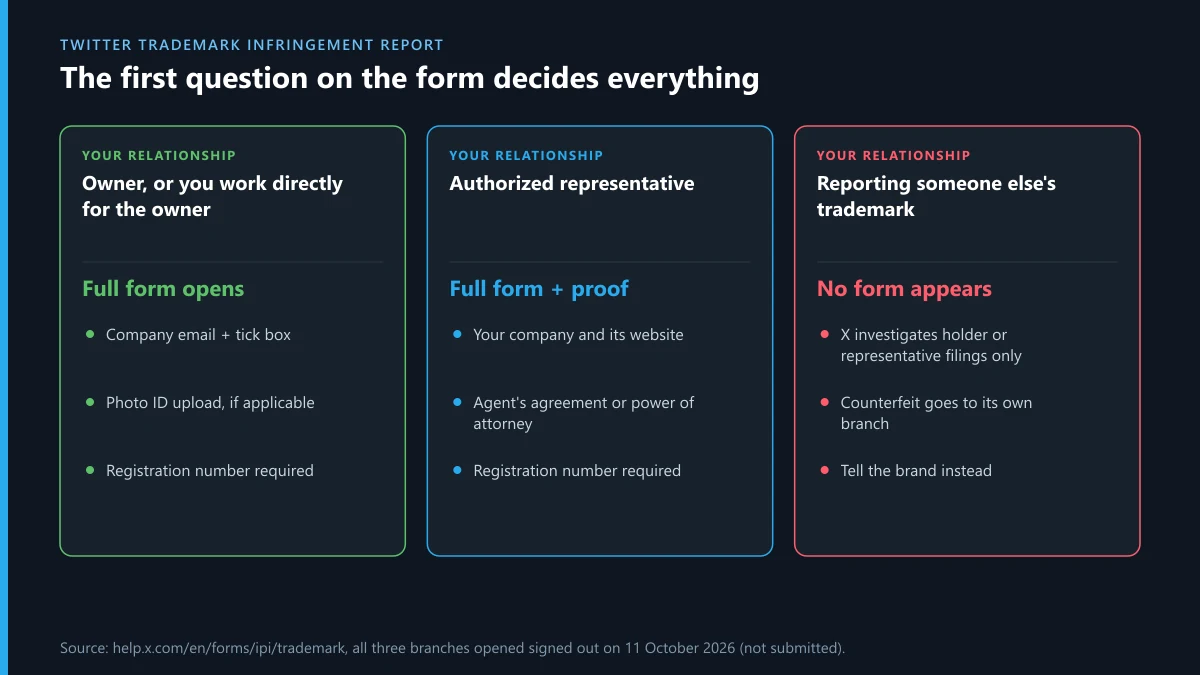
Only the trademark holder or an authorized representative. The form makes you choose your relationship to the owner before it shows a single field, and the three choices lead to three different places.
- Owner, or you work directly for the owner. The full form opens. It asks you to tick a box saying you're reporting from your company's email address, and a government photo ID upload is offered "if applicable".
- Authorized representative. The same form, plus your company, your company website and a required upload proving authority. X names an agent's agreement or a power of attorney as examples.
- Reporting misuse of someone else's trademark. No form appears at all. The page answers that X "only investigates requests that are submitted by the trademark holder, or an authorized representative" and points counterfeit complaints elsewhere.
That third branch is why a customer, a fan or a competitor can't push an X trademark report through, however obvious the copy looks. If you're in that position, the useful move is to tell the brand. A bystander can still use the in-app menu for a scam or a fake, and what X does with an ordinary report after you press send explains how far that goes.
How to report trademark infringement on Twitter, step by step
Gather the registration first, then file once, from a work address. Nobody needs an X account to do it; the form loaded in full for us while signed out.
- Pull your registration record. You need the exact registered mark, the registration number, the class and the office that issued it. A US holder can copy all four from the USPTO trademark search. The form says plainly that pending applications are not sufficient.
- Capture the account. Screenshot the profile with handle, display name, avatar and bio, plus the posts where the mark is used to sell or to pose as you. Note the date.
- Open the form and pick the trademark issue. Go to X's trademark report form and choose your relationship to the owner.
- Describe the confusion, not the annoyance. In the details box, say what a visitor would wrongly believe and why: same goods, same logo, replies to your customers. One username goes in each report.
- Tick the three statements and submit. Then wait for the email. Sending the same complaint again while the first is open only slows it down.
If you searched "Twitter report trademark infringement" hoping for an email address, there isn't a public one for trademarks. The form is the channel.
What does the Twitter trademark report form ask for?
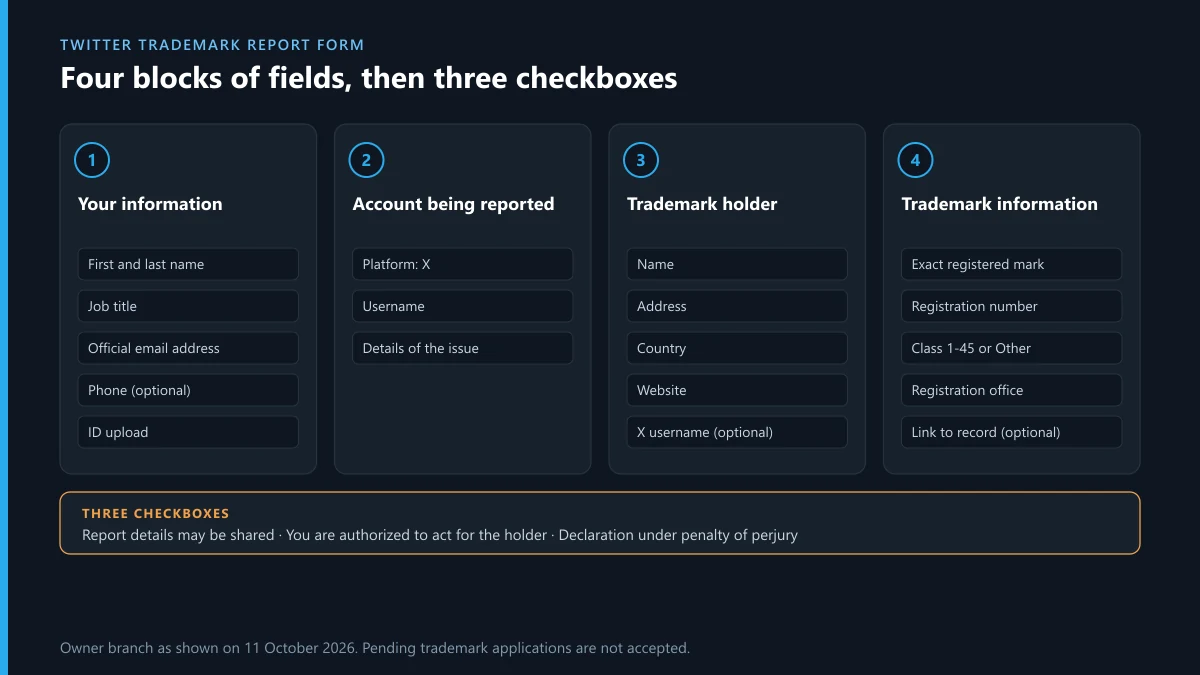
Four blocks of fields and three checkboxes. This is the owner branch of the Twitter trademark infringement form as it stood on 11 October 2026; the representative branch adds the items noted in the last column.
| Block | Fields | Notes |
|---|---|---|
| Your information | First and last name, job title, email, phone (optional), ID upload | Email "should be an official email address". Representatives also give company, company website and proof of authority |
| The account being reported | Platform (X is the only choice), username, details of the issue | The details box carries a warning about liability for knowing misrepresentation |
| Trademark holder | Name, address, country, website, X username (optional) | Country list has 249 entries |
| Trademark information | Exact registered mark, registration number, class, registration office, link to the record (optional) | Class menu runs 1 to 45 plus "Other" |
The class menu follows the 45 classes of the Nice Classification, and it matters more than it looks: the policy treats use in a different class as a non-violation, so a registration for clothing won't carry a complaint against a software account.
What do the three checkboxes commit you to?
The first says X may give "contracted agencies and/or the reported user" details of the report, and adds that your contact information will not be disclosed. The second says you're authorized to act for the holder. The third is a declaration "under penalty of perjury" that everything above is accurate. Read the first one next to the policy page, which warns that X may provide the account holder with your name. Taken together: expect the other side to learn who complained, though not your phone number or address.
What happens after you file an X trademark report?
X reviews it and answers by email. The policy gives three possible results for the reported account: a suspension, a chance to bring the account into line, or permanent suspension on first review. An incomplete report gets a follow-up question first, which the policy says "will result in a delay".
What the policy no longer offers is the handle. Nothing on the page says a suspended account's username passes to the trademark holder, and the form has no visible question about it. Its markup does still carry a hidden field named "Want_username", a leftover from the years when Twitter asked whether you wanted the name released. We wouldn't plan around it. If the account is suspended, the username stays locked with it.
Two more things to expect. X publishes no time frame, so a quiet fortnight isn't a refusal. And a successful Twitter trademark infringement report removes one account, not the person; a copy under a new handle needs a new filing. For the wider picture of how reports turn into penalties, see the steps between a report and a suspended X account.
How often does X act on intellectual property complaints?
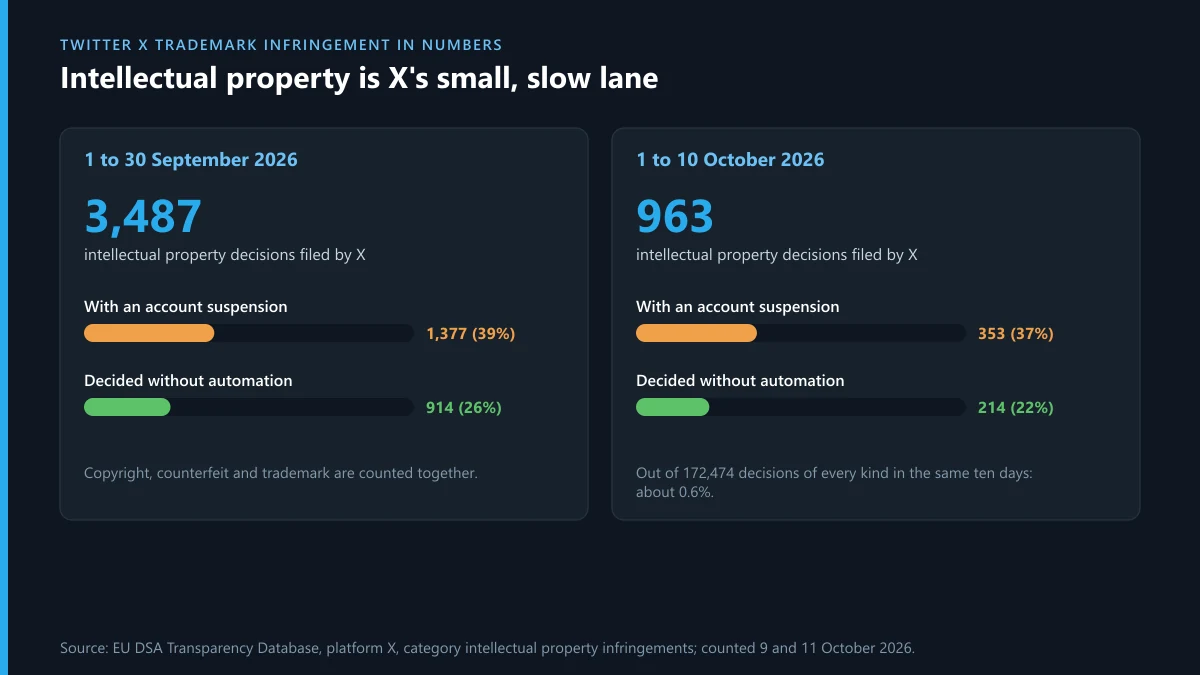
Rarely, compared with everything else it enforces. X has to file each moderation decision affecting EU users with the EU's DSA Transparency Database. We counted its entries on 11 October 2026. Between 1 and 10 October, X filed 172,474 decisions, and 963 of them sat in the intellectual property category. That is about 0.6%. Of those 963, 353 recorded an account suspension, and 214 were marked as decided without automation.
September looked much the same in proportion: 3,487 intellectual property decisions for the month, 1,377 with a suspension and 914 handled by a person. The category mixes copyright, counterfeit and trademark, and X leaves the sub-category field empty, so nobody outside the company can say how many were trademark alone. What the figures do show is scale. Twitter X trademark infringement cases are a small, slow lane next to the hundreds of thousands of automated scam suspensions, and roughly a quarter of the decisions in that lane involve a human reader. A complete, precise filing is what that reader needs.
Twitter trademark dispute: what if your account is the one reported?
You have two moves, and the order depends on whether the complaint is right. If X gave you the chance to comply, comply in full: change the handle, avatar or bio so nobody could take you for the brand, and add a plain line such as "not affiliated with" where the name must stay. If the account is already suspended and you think that's a mistake, the policy says you can submit an appeal.
A good appeal in a Twitter trademark dispute argues from the policy's own carve-outs. Show that your use sits in a different class or territory from the registration, or that you name the brand only to describe, review or criticize it. Attach your own registration if you hold one. Don't argue that the account was popular, or that the complainant is a bully. Because X may send you the complainant's name with the notice, you can also write to them directly, and a withdrawn complaint is the quickest way back. A wave of hostile filings is a different problem; how paid Twitter ban services work and where they stop describes that pattern.
When do the Twitter trademark guidelines not apply?
More often than brand owners expect. The Twitter trademark guidelines cover one harm, confusion about a registered mark, and several neighbouring problems have their own doors on X.
- No registration yet. Use the company branch of the impersonation form, which asks for a work email and what was copied, not a registration number.
- Fake goods. Choose the counterfeit option at the top of the same intellectual property form.
- Your photos, videos or text. That is copyright, with its own DMCA branch.
- A scam using your name. Report it in-app as well; the scam route is the fast, automated one.
Shortcuts sold for this don't exist. A seller offering to "mass report" a brand squatter can't pass the owner-or-representative gate, which is one reason Twitter mass report bots advertised on Telegram fail on trademark cases in particular. For accounts that break several rules at once, the lawful ways a Twitter account gets taken down sets the routes side by side.
Is the same brand being copied on Instagram or Telegram?
Usually, yes. An account that lifts a mark on X tends to keep a matching profile elsewhere, and each platform wants its own filing. Meta's version is covered in Instagram's trademark report form, read field by field; it also demands a registration, but lets you list up to 30 links in one go. Copied product photos call for a DMCA takedown on Instagram, and a court order or regulator letter goes through Instagram's legal request channel.
When the copy poses as a founder or employee instead of the company, start from what to do when someone impersonates you on Instagram, or a photo of you posted on Instagram without your permission if a staff member's face is being used. Fake shops that take customers' money fit reporting an Instagram scammer. Depending on what you're aiming at, see reporting a whole Instagram page, reporting one Instagram post or the general guide to reporting a person on Instagram.
Brand disputes can turn personal. Threats sent to your team belong in Instagram harassment reporting, and demands for money in exchange for silence in an Instagram blackmail report. Staff often ask whether the other side will see their name; whether Instagram tells someone who reported them answers that, and taking back an Instagram report filed by mistake covers the reverse case.
Set expectations with whoever signs off the budget. What gets an Instagram account taken down and why you can't delete another person's Instagram account yourself explain the limits. Paid offers such as Instagram ban services, removal services for Instagram accounts and spam report bots for Instagram can't do more than file reports.
Telegram has no trademark form of its own; brand copies there are reported from the channel's profile or by email. Squatters sometimes get in through a hijacked brand account instead of building a new one, so check yours first. Recovering a hacked Telegram account covers a takeover in progress, and getting back into a Telegram account you've lost access to covers a lost number. If an old company account sits on a SIM nobody uses any more, deleting that Telegram account is safer than leaving it for the next owner of the number.
FAQ
Do I need a registered trademark to report on X?
Yes. The form requires a registration number and states that pending trademark applications are not sufficient. Without a registration, a business copied on X can use the company branch of the impersonation form, which asks for a work email and what was copied instead.
Can I use the Twitter trademark infringement form without an account?
Yes. The trademark form opened in full for us while signed out on 11 October 2026. It asks for a work email address, not an X login. The copyright branch of the same form is different and does ask you to sign in.
Will X give me the username after the account is suspended?
Don't count on it. The current trademark policy lists suspension, a chance to comply, or permanent suspension as outcomes and says nothing about transferring a handle. The form has no visible question about wanting the username.
How long does a Twitter trademark report take?
X gives no time frame. The reply comes by email, and an incomplete report gets a follow-up request first, which the policy says delays processing. Filing the same complaint twice while the first is open tends to slow things down.
Will the account owner find out who reported them?
Probably. The policy says X may provide the account holder with your name and other information in the report. The form's own checkbox says details may go to the reported user but that your contact information will not be disclosed.
Do X trademark guidelines treat a parody or fan account as infringement?
Not by itself. X's policy treats nominative and fair use as non-violations, and parody accounts fall under its separate rules on misleading identities. A fan or parody account becomes a problem when a visitor could take it for the brand's own.
Can a lawyer or agency file the report for my company?
Yes. Choose the authorized representative option. It adds fields for the representative's company and website and requires an upload showing authority to act, such as an agent's agreement or a power of attorney.