8 October 2026 · Telegram Ban Service · 15 min read
Twitter ban service: what can someone legally file for you on X?
A Twitter ban service can't make X suspend anyone. X decides, after matching an account to one of its rules or to a law. The honest part of an X takedown that can be hired out is the filing: choosing the rule, assembling evidence and submitting X's forms as your authorised agent. Report floods and guaranteed-ban packages breach X's own Authenticity policy.
The phrase "Twitter ban service" covers two very different businesses that happen to share a search term. One sells a result it can't deliver: an account gone by a date, for a fee. The other sells paperwork, which is less exciting and is the only part X lets anyone do for you. On 8 October 2026 we ran X's September decisions through the EU's public database by source, half expecting a slice of them to be labelled as notices from users or trusted flaggers. Instead we saw all 690,425 filed under a single catch-all label, which says a lot about how little of the process is visible from outside, and even less about it is for sale. This page splits the real service from the sold one. It covers which X forms an authorised agent can file, the one legal priority lane and why money can't buy it, what the public numbers show, and how to check a takedown service before paying. We run a Telegram reporting desk, so the Telegram side gets its own section near the end.
What does a Twitter ban service actually sell?
Usually one of three things, and only the third holds up. The first is volume: a bot, a panel or a group of accounts that reports the target again and again. The second is access, a claim to know someone inside X who can switch an account off. The third is filing help, where someone builds the report around a specific X rule or law and submits it properly.
The first two are what most listings for an X ban service mean, and both run into X's own rules before they run into X's reviewers. Volume reporting is named as engagement spam in the Authenticity policy. Access is worse. On 19 September 2025 X's Global Government Affairs account said it had found middlemen offering its staff bribes to reinstate banned accounts for scammers, and that legal proceedings were under way, as The Block reported. A seller promising an inside contact is offering you a part in that, not a shortcut.
Filing help is different in kind. It doesn't promise an outcome, because nobody outside X can. It promises that the right report reaches the right queue with the evidence a reviewer needs, and that's worth paying for in a handful of situations.
Which parts of an X account takedown can someone file on your behalf?
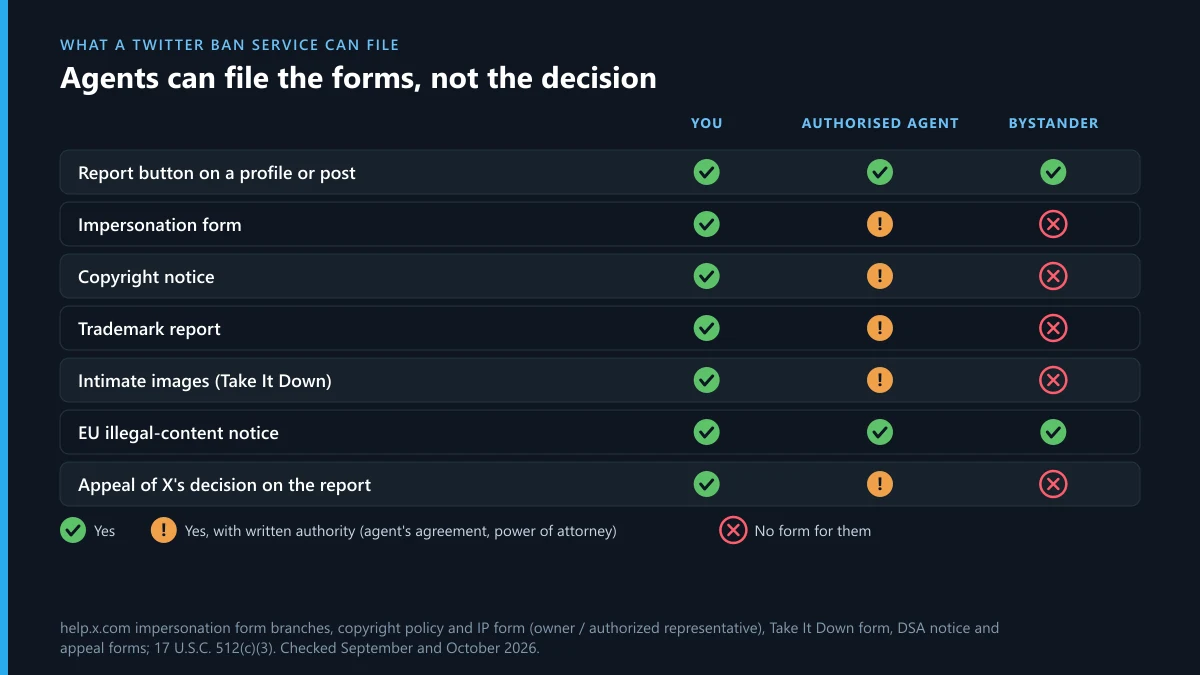
The dedicated forms, mostly, and only with your written authority. X built several of its forms with representatives in mind. Its impersonation form has a branch for "someone I represent" that requires proof of authority, such as an agent's agreement or a power of attorney, and a company branch whose relationship options include working at a law firm, marketing or PR company. The copyright form asks whether you're the owner or an authorised representative and stops if you're neither. The Report button is the odd one out: anyone can press it, so an agent adds nothing there except better evidence.
| Filing | You | An authorised agent | A stranger or bystander |
|---|---|---|---|
| Report button on a profile or post | Yes, and X may weigh the target's report more | Yes, as any user; no special weight | Yes |
| Impersonation form | Yes, after an ID and selfie check | Yes, with an agent's agreement or power of attorney, plus the agent's own ID check | No form; report from the profile instead |
| Copyright notice | Yes, as the rights holder, logged in | Yes, stating under penalty of perjury that they're authorised | No |
| Trademark report | Yes, with a registration number | Yes, as the holder's representative | No |
| Intimate images (Take It Down) | Yes | Yes, as an authorised representative | No |
| EU illegal-content notice | Yes | Yes, under the agent's own name and email | Yes |
| Appeal of X's decision on the report | Yes, as the person who filed | Only if the agent filed it | Only for their own report |
The copyright row carries legal weight. Under 17 U.S.C. § 512(c)(3) a takedown notice must state, under penalty of perjury, that the sender is authorised to act for the owner, and § 512(f) makes anyone who knowingly misrepresents infringement liable for damages. A service that files copyright claims for content you don't own is putting your name to that risk.
When is it worth hiring an X account takedown service at all?
When the filing itself is hard, exposes you, or spans several platforms. Privacy is the plainest case. X's copyright policy says it forwards the full notice to the person who posted the material, including the sender's name, address, phone number and email, and it suggests using an agent if that worries you. For a stalking victim whose photos are being reposted, an agent's name on the notice is a real protection.
Brands are the second case. A company reporting a fake account fills in a job title, a company email and a relationship to the brand, and a trademark report needs the exact registered mark and its registration number, with pending applications refused. Legal or PR staff do this routinely. The third case is volume of a different kind: a single impersonator running copies on X, Telegram and Instagram needs three separate filings under three sets of rules.
None of this makes X act faster or more often. It makes the first report complete, which matters because X's impersonation form starts every branch with an ID and selfie check through Persona and asks for the evidence up front. Something like a Twitter account takedown service earns its fee there, in preparation, not in pressure.
Is there a fast lane at X that money can buy?
There's one priority lane written into law, and it isn't for sale. Article 22 of the EU's Digital Services Act creates trusted flaggers, whose notices platforms must give priority and decide without undue delay. The status is awarded by the national Digital Services Coordinator where the applicant is based, only to entities with real expertise in spotting illegal content and independence from any platform. According to the Commission's trusted flagger page, last updated on 5 October 2026, only EU-based entities can apply.
Trusted flaggers must publish yearly reports on the notices they send, and a regulator can strip the status from one that files too many inaccurate or unsupported notices. That rules out the business model a ban seller needs. A flagger that took money to report legitimate accounts would be reporting itself out of the scheme.
Paying X directly doesn't open a lane either. X's Premium FAQ says the X Rules won't apply differently to subscribers and that enforcement cases stay with the existing teams under the current review process. Premium's dedicated support covers subscription issues only.
What does the public record show about how X accounts get banned?
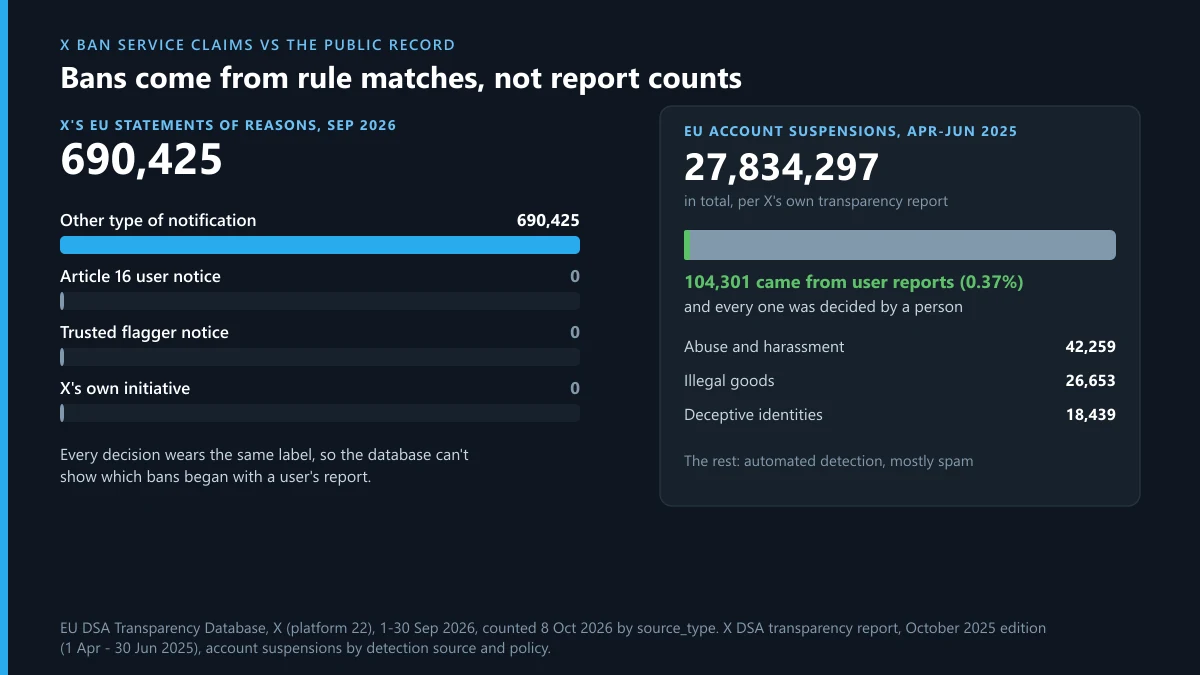
That most bans come from X's own systems, that user reports matter only when a person confirms them, and that the EU database can't tell the two apart. We counted X's statements of reasons for 1 to 30 September 2026 in the DSA Transparency Database on 8 October, split by the source field. X's own transparency report fills in what the database leaves blank.
| Measure | Figure | Where it comes from |
|---|---|---|
| All X statements of reasons, September 2026 | 690,425 | DSA Transparency Database |
| Filed as "other type of notification" | 690,425 (100%) | Same |
| Filed as an Article 16 user notice, a trusted flagger notice, or X's own initiative | 0 each | Same |
| Account suspensions in the month | 650,812, of which 12,977 decided without automation | Same, counted 7 October 2026 |
| EU account suspensions, April to June 2025 | 27,834,297 | X DSA transparency report, October 2025 |
| Of those, triggered by user reports | 104,301 (0.37%), every one decided by a person | Same |
| Suspension appeals in that quarter, and overturned | 58,314 and 7,414 | Same |
Two things stand out. In the database every X decision wears the same source label, so no outsider can see whether a ban began with a user's notice, a trusted flagger or a filter. Anyone who shows you a database entry as proof that "their" reports worked is reading something the record doesn't say. X's own report is more useful. In the April to June 2025 quarter, 104,301 suspensions came from user reports, and all of them were enforced by a person; by policy the largest groups were abuse and harassment at 42,259, illegal goods at 26,653 and deceptive identities at 18,439. Reports do end accounts, then, but through a reviewer who matched them to a rule. The other 99.6% came from automated detection, most of it spam and platform manipulation, where a report's main job is to point the system at an account it missed.
Why do report floods and guaranteed-ban packages fail on X?
Because X counts rule matches, not reports, and it treats the flood itself as a violation. The Authenticity policy lists duplicate or false reports in large numbers, repeatedly reporting the same posts or accounts, and coordinating others to do it as engagement spam, while saying good-faith reports are fine. X's decision factors, as its DSA report lists them, include whether the reporter is the target or a bystander, the account's history and the severity of the harm. A hundred bystander reports about posts that break no rule still add up to no rule broken.
The law points the same way. Article 23 of the Digital Services Act lets platforms suspend, after a warning, the processing of notices from people who keep sending manifestly unfounded ones. X's UK appeal form goes further and has the filer affirm that abusive reporting can lead to their reporting ability being disabled.
The mechanics don't help sellers either. X's API has no reporting call, so a bot has to drive logged-in accounts, which breaks X's automation rules; we followed that trail in how the Twitter mass report bots sold on Telegram are built. The same story repeats for Instagram report bots copied from GitHub into Telegram shops, for spam report bots tested against Instagram's filters and for report bots that take the money and do nothing. Telegram behaves the same: a Telegram mass report bot can't force a channel ban, and there's no report count that bans a Telegram channel. A guarantee on top of any of this is a sales line, nothing more.
How do you check an X account takedown service before paying?
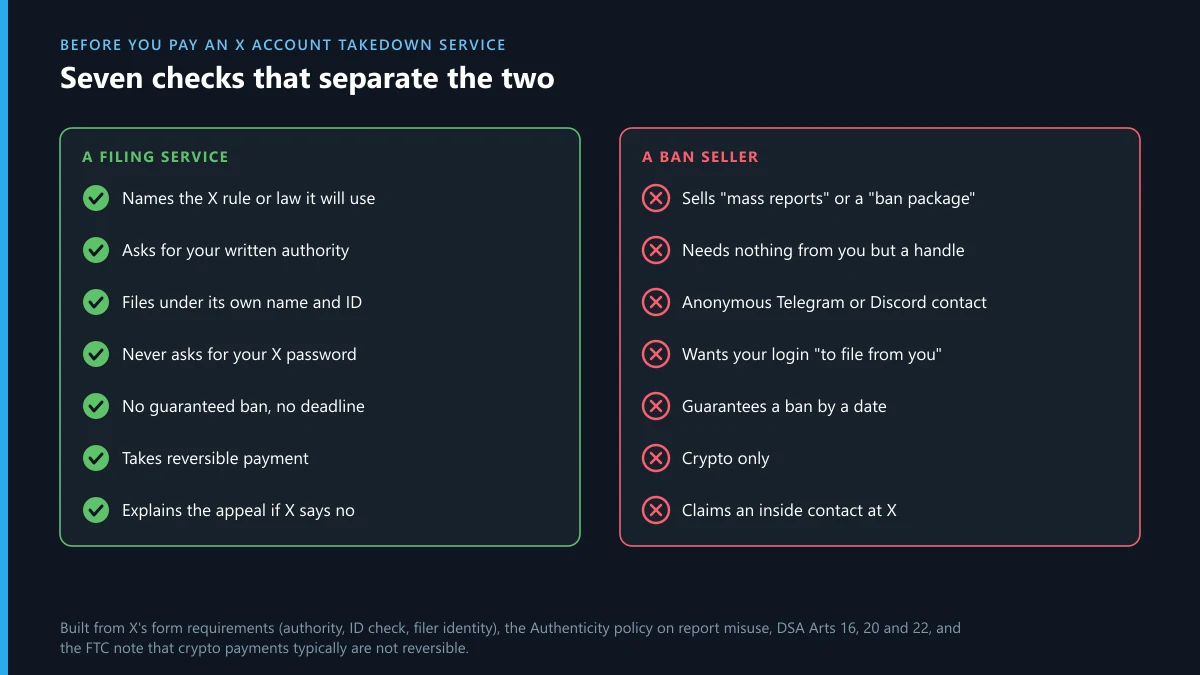
Ask what it will file, under whose name, and what happens if X says no. A legitimate service can answer all three in a sentence each. Run through these before any money moves:
- It names the rule or law. Impersonation, copyright, a threat, a scam, an illegal-content notice in a named EU country. "Mass report" or "ban package" isn't a rule.
- It asks for your authority in writing. X's representative branches want an agent's agreement or a power of attorney. A service that doesn't ask for one can't file those forms honestly.
- It files under its own identity. EU notices carry the sender's name and email, and the impersonation form runs the filer through an ID check. Anonymous sellers can't do either.
- It never asks for your X password. No X form needs the reporter's login handed to a third party.
- It won't guarantee a ban or a date. X decides. Anyone promising otherwise is selling what the previous sections ruled out.
- It doesn't insist on crypto. The FTC notes that cryptocurrency payments typically are not reversible, which is exactly why scam sellers prefer them.
- It explains the appeal. If X turns the report down, the filer can challenge the decision. The next section covers how.
Paid recovery offers deserve the same checklist, since many sellers advertise bans and unbans side by side; what a genuine account recovery specialist can and can't do applies the same tests on the Telegram side. Our own Telegram reporting service for rule-breaking channels and bots works to those terms: named rule, official routes, no guaranteed outcome.
What if X turns the report down?
The person who filed can ask X to look again, and in the EU that right is written into law. Article 20 of the Digital Services Act gives anyone who submitted a notice access to the platform's internal complaint system for at least six months after the decision. X's DSA appeal form reflects that: its drop-down covers a report made under EU law and a report made under X's terms. Only the original filer can use it, which is one more reason the filing should be in the name of you or an agent you've authorised, not a stranger's bot account.
Outside X, certified out-of-court dispute settlement bodies can review the decision. User Rights, a German body, lists X among the platforms it covers, free for individuals. Expect limits. X's DSA page says it isn't bound by any decision such a body makes, and its transparency reports have recorded zero disputes processed. For an account that keeps breaking a rule, a fresh report with new evidence often does more than an appeal against the old one.
Where does Telegram fit into an X account takedown?
Often right behind it. X scam accounts move victims into Telegram "support" chats, ban sellers take orders through Telegram bots, and harassment campaigns get planned in Telegram groups before they reach X. X can't act on any of that, and Telegram won't act on X posts, so each side needs its own report. These are the common cases and where to start:
- An X scammer moved you to a Telegram chat. Begin with where a Telegram scammer report goes when the menu has no scam option, then build a Telegram fraud report around the payment trail. Before trusting any handle, read why Telegram scammer lists can't clear anyone.
- A channel mirrors leaked or stolen material from X. Compare the routes for taking a Telegram channel down with deleting a channel versus reporting the person who owns it. For copied photos or video, send a copyright takedown to Telegram and check how far a copyright notice reaches on a Telegram channel.
- A group organises pile-ons against you. Use the in-app report for a Telegram group or channel, flag the specific messages that cross the line, and see each official route for reporting abuse on Telegram.
- Threats, payment demands or counterfeit goods. Go to reporting extortion and counterfeit sellers on Telegram; for material that's illegal outright, the right route for each kind of illegal content.
- A fake profile copies you on both platforms. Pair the X impersonation form with a report against the fake Telegram profile. If the fakes are generated images, report the deepfake bots producing them.
- A bot sells ban attacks or floods your contacts. See how to report a Telegram bot and why numbers get banned and reporting Telegram spam without blocking the wrong person.
- The whole operation, not one post. File a report against the entire channel or group, read how a Telegram account takedown actually works, and check which violations get someone banned on Telegram.
What if a ban service is pointed at your account?
Don't pay anyone to make it stop. A threat that "we've ordered a ban on you" is pressure, not a process, because the reports still have to match a rule a person can see in your posts. Keep screenshots of the threat, since coordinated false reporting is itself a breach of X's Authenticity policy and the threat is evidence of it. If X does suspend you, appeal from the suspended account; X overturned 7,414 suspensions after appeal in the April to June 2025 quarter alone.
Campaigns like this often hit Telegram accounts at the same time. If yours was banned, matching your Telegram ban to its recovery route comes first. A notice that your account is frozen is a different case, and recovering a frozen Telegram account starts with the notice date. If the attacker got in rather than reporting you, regaining access to a Telegram account you can't log into covers the login side.
Our recommendation is the same in both directions. Put your money into one well-built report, filed by you or by an agent you've authorised in writing, and spend nothing on volume, guarantees or anyone who claims a contact inside X.
FAQ
Is it legal to pay someone to get an X account banned?
Paying an agent to file truthful reports through X's forms is legal, and law firms and brand-protection companies do it routinely. Paying for false or mass reports is another matter: it breaks X's Authenticity policy, and a knowingly false copyright notice can make the sender liable for damages under US law.
Do I have to give a takedown service my X login?
No. None of X's report forms needs the reporter's password shared with anyone. An agent files under its own details and attaches your written authority. A service asking for your login is a security risk, whatever it claims to be selling.
Does paying for X Premium get reports handled faster?
No. X's Premium FAQ says the X Rules won't apply differently to subscribers and that enforcement cases stay with the existing teams. Premium's dedicated support handles subscription problems, not reports about other accounts.
What is a trusted flagger, and can I hire one?
A trusted flagger is an organisation that an EU Digital Services Coordinator has certified for its expertise in a type of illegal content, and platforms must handle its notices with priority. You can't buy that status or its priority. Some flaggers run public hotlines for their field and take tips for free.
Can a takedown service get the impersonator's username released to me?
Rarely. X's trademark policy offers no username release, and its impersonation help page says X generally doesn't accept individual requests for inactive or suspended usernames. A company filing the impersonation form can say it wants the handle; otherwise handle questions go through Premium Business support.
Someone says they paid to get my X account banned. What should I do?
Keep the message and don't pay to make it stop. Reports only lead to a ban if a reviewer finds a rule broken in your own posts, and coordinated false reporting breaks X's rules as well. Secure your login, check your posts against the X Rules, and appeal if a suspension comes.
Will X tell me whether the account I reported was banned?
Not reliably. X may notify you when it takes action, but its help page warns that an action notice may or may not relate to your report. In the EU, whoever filed a notice must be told the decision on it, along with the options for challenging it.
What should a legitimate X takedown filing cost?
X charges nothing for any of its report forms, notices or appeals, so a fee only ever pays for someone's time and expertise. Be wary of pricing per report or per thousand reports. That model only makes sense for a volume seller, and volume is the part X treats as spam.
Can an X account takedown service handle the Telegram side too?
Only by filing separately with Telegram, because neither platform acts on the other's content. Telegram takes reports through the in-app Report button, the @notoscam channel for scams and [email protected] for public content. Our desk handles that side for channels and bots that break Telegram's rules.