5 October 2026 · Telegram Ban Service · 14 min read
Someone posted a picture of me on Instagram without my permission: which form takes it down?
If someone posted a picture of you on Instagram without your permission, start with who pressed the shutter. A selfie or clip you made is your copyright, and Meta’s copyright form takes reports from any country. A photo someone else took goes through the in-app report or Instagram’s privacy form, which helps only where local law gives a removal right.
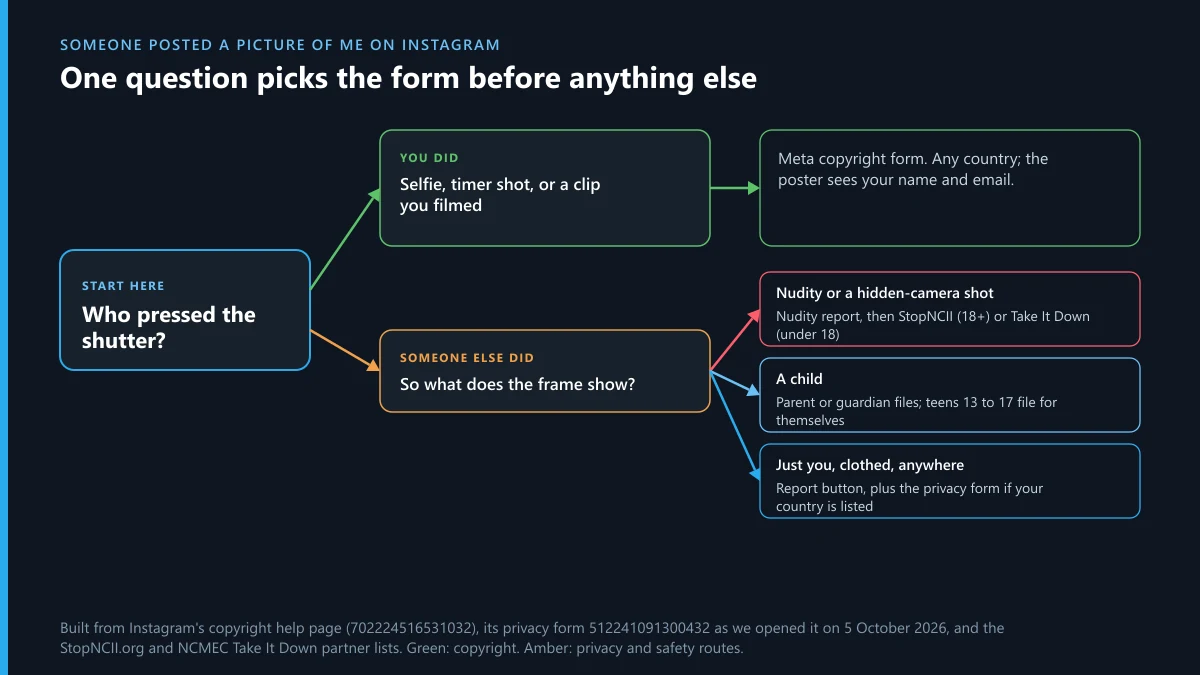
Someone posted a picture of me on Instagram without my permission. Who took it?
Whoever pressed the shutter, not whoever is in the frame, decides which form you use. Instagram's copyright help page says “if you take a photo, you are likely to own the copyright”, and it adds that appearing in a photo or video doesn't by itself make you the owner. So a selfie lifted from your own profile, a clip you filmed that someone re-uploaded, or a group shot you set up on a timer is your work, and Meta can take it down as infringement. A photo your friend, your ex or a stranger took on their own phone belongs to them, even when your face fills the whole frame.
The same split holds off Instagram. Someone posted a picture of me without my permission on Facebook, on X or in a Telegram channel: it's still the question you answer first. And when the search was “someone posted a picture without my permission” and the picture is one you shot of a sunset or a product, you are dealing with plain copyright, and your face doesn't come into it at all.
Most people skip this question and go straight to the Report button. That works when the post breaks a Community Guideline, such as nudity, bullying or an account pretending to be you. An ordinary photo of you at a party, posted by someone you know, usually breaks none of them, which is why so many reports come back saying the post doesn't go against the guidelines. The copyright route and the privacy route exist for exactly that gap.
Copyright form, privacy form or the Report button: what does each one cost you?
Each route trades something away. Instagram's page on whether reports are anonymous says they are, “except if you're reporting an intellectual property infringement”. The copyright form is the strongest tool for a photo you took, but it hands the poster your name and email.
| What you're weighing | Copyright form (you took it) | Privacy form (someone else took it) | Report button in the app |
|---|---|---|---|
| Who may file | The rights owner or someone they authorise | The person in it, a parent or guardian, or an adult's legal representative | Anyone who can see the post |
| Countries | Any; the form opens on “Where are you asserting rights?” | 157 on the list we saw on 5 October 2026, with no United States and no EU or EEA state | Any |
| What the poster learns | Your name, your email and what you reported | Not who you are | Not who you are |
| What you must supply | Contact details, the URLs, a signature and a good-faith statement | The link to each photo or video, one per line | Nothing beyond the reason you pick |
| What decides it | Whether the work is yours | Whether privacy law where you live gives a right to removal | Whether the post breaks a Community Guideline |
| If the poster pushes back | A US counter-notice can restore it in up to 14 business days unless you go to court | The form doesn't say | The poster can appeal the removal |
We opened Instagram's privacy report form on 5 October 2026 to see whether anything had moved since our last check on 28 September. Nothing had. It still says the channel is reserved for people reporting a privacy violation “concerning their image or video”, still asks “Who are you reporting for?” with three answers (Self, Child, Another adult), and still lists 157 countries. We searched the list for the United States, Germany, France, Ireland, Spain, Italy, the Netherlands, Poland, Norway and Iceland and found none of them. The United Kingdom, Switzerland, Canada and Australia are there.
That gap matches Meta's own rule: an adult's privacy report is honoured when it comes from outside the United States and local law gives a right to removal. Instagram's help page on unauthorised photos puts it as removing posts “if this is required by relevant privacy laws in your country”. Inside the EU, Meta routes people to a separate legal removal request form; from outside the EU its link sent us back to the Help Centre home, so we can't describe its fields. On the copyright side, Meta's transparency page says valid IP reports are acted on “typically within a day or less”. No such figure exists for privacy reports.
The volumes point the same way. In Meta's EU transparency report for January to June 2026, EU users sent Instagram 388,783 notices under Article 16 of the Digital Services Act. 94,759 of them were intellectual property notices, about 24%, against 22,509 on data protection and privacy. In the EU, the copyright door gets used about four times as often as the privacy one.
Someone posted a video of me on Instagram without my permission: is a video handled any differently?
The forms are the same; the clock isn't. The privacy form stops anyone who can't supply a link with “We are unable to further process your report without a relevant link (URL)”, and the format of the video decides how long that link lives.
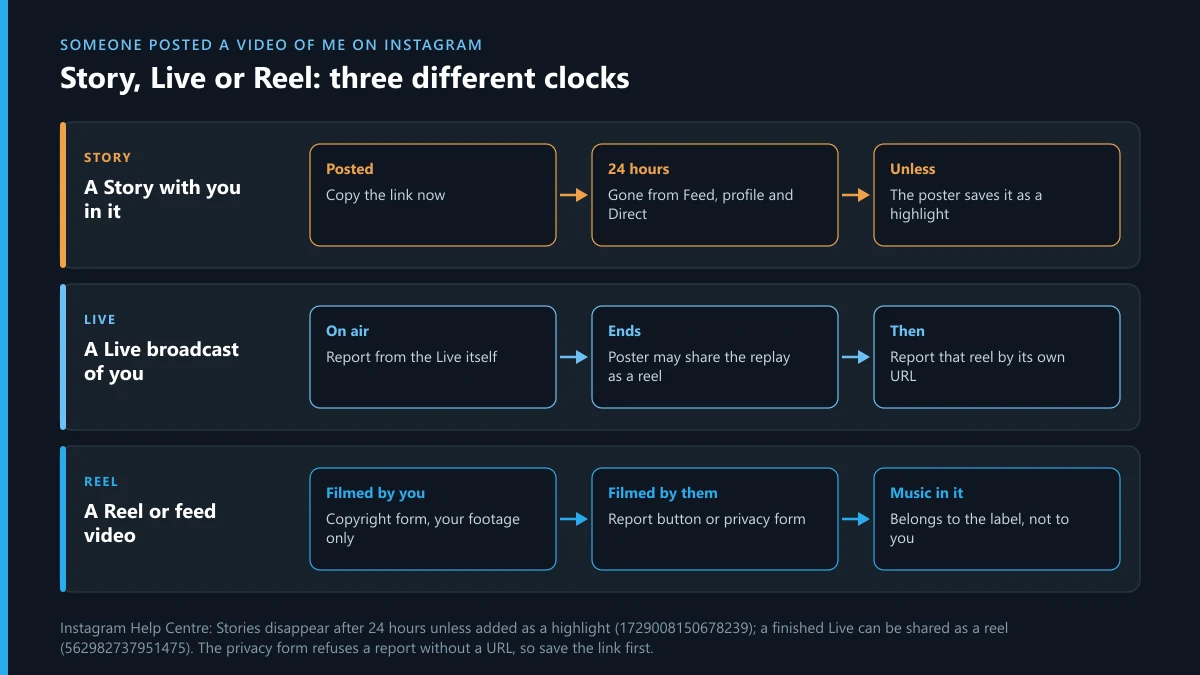
A Story is the tight one. Instagram's help page on Stories says they “disappear from Feed, your profile and Direct after 24 hours, unless you add it as a highlight”. Report the Story while it's up, copy its link, and screen-record it with the poster's username visible. A Live broadcast can be reported while it runs; once it ends, the poster may share the replay to their profile as a reel, which gives you a stable URL to file against.
A Reel or feed video sits still, but it carries more of you than a photo does: your voice, the street you walk down, sometimes the front of your building. Meta's privacy rules have a separate clause for images of the outside of a person's home, so mention it in the report if the clip shows where you live. If the video is your own Reel, downloaded and posted again, file it on the copyright form and claim only your footage. Any licensed song in it belongs to the label. Clips of strangers filmed in public by prank and street-interview accounts are the hardest case. US law generally allows filming in public places, and the privacy form isn't offered there, so the Report button only helps if the clip mocks, harasses or sexualises you.
Someone posted a picture of my child on Instagram without my permission: who is allowed to file?
The parent or legal guardian files for a child under 13, and a child aged 13 to 17 has to file personally. The privacy form spells it out. Choose Child and it first asks whether you're the legal guardian or legal representative; answer No and it stops with “The right to request removal of an image/video of a minor lies solely with the minor's legal guardian or parent.” It then asks whether the child is under 13. If not, and the teenager is able to report, it tells you Instagram requires “minors 13 years or older to submit the request through this form themselves”.
You don't need an Instagram account to do this. Instagram's help page on reporting images of your child says so directly, and it also reminds parents that people own the rights to the images they take. That cuts both ways: a team photo the club's coach took belongs to the coach, so the privacy route is the one that fits, not copyright.
In practice, someone posted a picture of my child without my permission usually turns out to be a school, a sports club or another parent rather than a stranger. A direct request to the club or school is often quicker than any form, because most of them have a consent policy for photos and will pull a post that breaks it. Keep the form for the cases where that ask fails. Images of a child with nudity are a different matter: Instagram's rules let it remove them whoever reports, and NCMEC's Take It Down service, which Instagram and Facebook joined as founding members, can stop copies of an under-18's intimate images from being posted again.
How to report someone on Instagram for using your photos
It depends on what they do with them. An account posing as you needs an impersonation report. An account reposting pictures you took needs a copyright report. Many fake profiles do both, and each gets its own report. Here is the order that keeps the evidence intact:
- Save the profile first. Screenshot the username, the bio and every post that uses your photos, and copy the profile URL as text. A removed account takes all of that with it.
- Report the account, not just one post. From the profile's three dots, tap Report, choose the option for an account pretending to be someone, and say it's you. Instagram's help page lists four answers there: you, someone you follow, a public figure, or a business.
- No account, or locked out? Use Instagram's impersonation report form, which handles the same report without logging in.
- File the photos you took on the copyright form. Put every URL in one report, so a single decision covers the batch.
- Check the other apps. Catfish profiles built from one person's photos rarely stay on one platform. If the same pictures front a Telegram account, flag it as a fake Telegram profile built from your pictures as well.
Someone posted a photo of me on Instagram and wrote the caption as if they were me: that is impersonation, even if the account uses a different name. Someone posted a picture of me without my permission on Instagram under their own name, with a cruel caption: that is bullying or harassment, and the Report button is the right tool.
What if the photo is intimate, or someone threatens to post it?
Then you skip the privacy form and use the faster routes built for that harm. Report the post for nudity or sexual content in the app. Meta's adult sexual exploitation policy names secretly taken images of sexualised body parts, the shots it calls “creepshots” and “upskirts”, as removable whoever took them. For adults, StopNCII.org creates a hash of the image on your own device and shares only that hash with partner platforms, Instagram, Facebook and Threads among them, so matching uploads get blocked.
The law has teeth here now. Under the US TAKE IT DOWN Act, covered platforms must remove reported non-consensual intimate images, and known identical copies, within 48 hours; the FTC began enforcing that duty on 19 May 2026, with civil penalties of up to $53,088 per violation. The privacy form itself sends anyone facing a threat to share private images to a separate help page, because a threat calls for a different response from a post.
The threat itself often comes over Telegram. If someone is demanding money or more pictures, document it and report the Telegram account running the extortion rather than paying. If a Telegram bot has turned an ordinary Instagram photo into a fake nude, report the deepfake bot and the channels that advertise it. Images that break the law outright belong in a report of illegal content on Telegram, and the police should hear about them too.
When the picture leaves Instagram for a Telegram channel
Instagram's report ends at Instagram's border. Screenshots of private profiles, “exposed” compilations and leaked Story clips get collected into Telegram channels, and those need Telegram's own routes. The Telegram FAQ says every app has Report buttons for flagging illegal content, gives [email protected] as its automated takedown address, and asks for links in the form t.me/… or @…. Telegram's API lists a report reason “for divulgation of personal details”; the in-app menu is now built by the server, so the wording on your screen may differ.
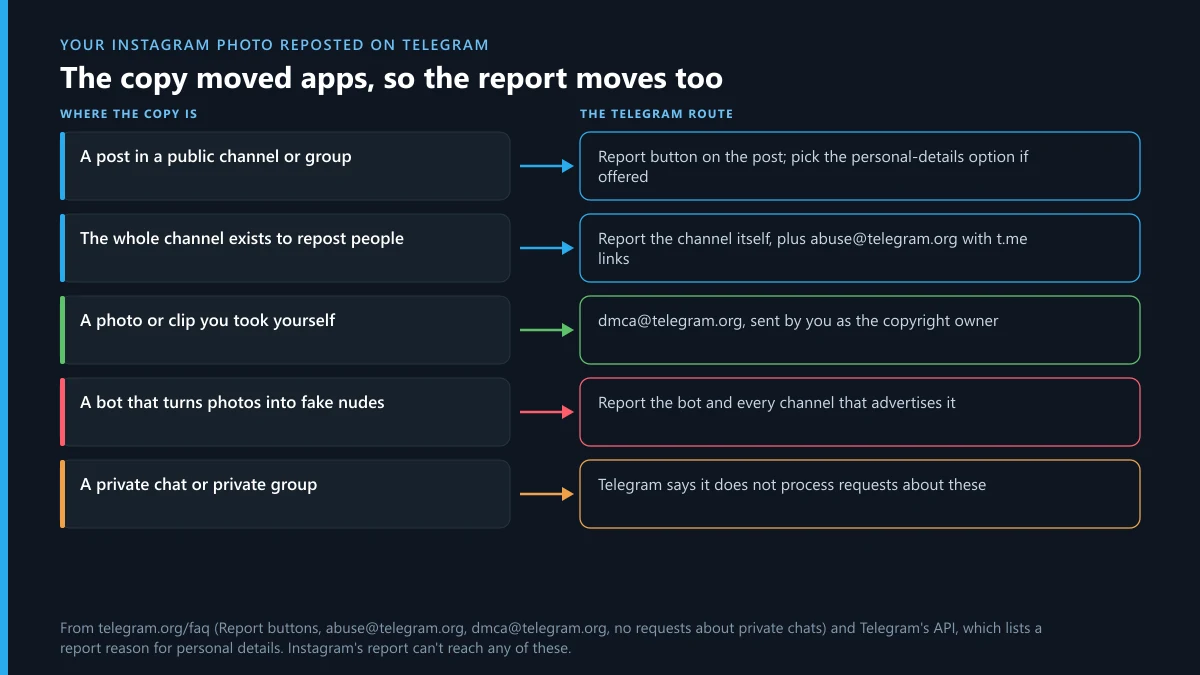
Report the single Telegram message that carries your photo when it's one post among many. When the channel exists to repost people, report the whole Telegram channel instead; our page on reporting a Telegram group or channel walks through the in-app flow, and where Telegram abuse reports go covers the email route. If the photo is one you took, the FAQ sends copyright complaints to [email protected], filed by the owner or an authorised agent; see how a Telegram DMCA takedown works and copyright claims against a Telegram channel.
Two limits are worth knowing before you start. Telegram says it doesn't process requests about private groups and chats, so a photo passed around a private group has no Telegram report route. And nobody outside a channel's admin team can delete it; Telegram's API answers anyone else's delete attempt with an admin-required error, which is why people who want to delete a Telegram channel they don't run end up reporting it instead. What Telegram can do is block it. Its safety page counted 27,126,529 groups and channels blocked in 2026 when we read it on 5 October, 436,508 of them for child abuse material. Our notes on what it takes to get a Telegram channel taken down and on taking down the Telegram account behind it cover the evidence that moves a review, and what actually gets a person banned on Telegram separates rule breaks from grudges.
Will more reports, or a paid “ban service”, get it down faster?
No. A privacy report turns on one fact, whether the law where you live gives a right to removal, and a hundred reports don't change that fact. Reviewers look at the post, not at the size of the pile. Our breakdown of how many reports it takes to ban a Telegram channel reaches the same answer for Telegram.
The sellers say otherwise. Telegram is full of offers to mass-report an Instagram account for a fee, and the tools behind them are the Instagram mass report scripts passed around on GitHub, Instagram spam report bots and their cousins aimed at X, the Twitter mass report bots sold on Telegram. A generic Telegram mass report bot is built the same way. Many are plain theft: the report-bot scams that take payment and deliver nothing show up in every Telegram scammer list worth reading. If one took your money, here is where to report a Telegram scammer, with a fraud report on Telegram for the payment trail and a spam report on Telegram for the bot that keeps messaging you.
Guard your own account while you chase the copies. Never send a login code to anyone promising a takedown; that is how Telegram accounts get stolen, and getting a stolen Telegram account back takes far longer than any report. If the people you message to complain report you as spam, Telegram can limit your own number; checking a limited number with Telegram's bot tells you where you stand. A frozen Telegram account or a banned Telegram account has an official appeal, and a so-called Telegram account recovery expert who asks for your code is the same scam again. For the Telegram copies themselves, our Telegram report service files documented reports through Telegram's own routes, for channels that genuinely break its rules.
FAQ
Will the person who posted it know I reported them?
Not from a privacy report or the Report button; Instagram keeps those anonymous. The copyright form is the exception. Meta's IP forms warn that the rights owner's name, your email address and the nature of the report go to the person who posted the content. Weigh that before you file a copyright report against someone you know.
Someone posted a video of me on insta as a Story. What do I do before it disappears?
Screen-record it with the poster's username on screen, note the time, and report it from the Story while it's still up. Stories vanish from Feed, the profile and Direct after 24 hours unless the poster keeps them as a highlight, and the privacy form won't take a report without a link. Once the Story is gone and you have no link, there is nothing left on Instagram to file against. Speed beats wording here.
Is it illegal to post a picture of someone without their permission?
It depends on the country. In the US, posting a photo taken in a public place is generally lawful unless it is intimate, defamatory or used to sell something. France protects a right to your own image under article 9 of its Civil Code, and Germany's KUG section 22 requires consent to publish a person's picture, with exceptions. Instagram's privacy decisions follow the same map, so the result changes with where you live.
Can I get a party photo a friend posted taken down?
Ask the friend first, since it is the quickest route and it keeps the friendship. If they refuse, the Report button only works when the photo breaks a guideline, and the privacy form only where your country's law gives a removal right. If you were tagged, you can remove yourself from the post, which takes your name off it even if the photo stays.
Can I stop people tagging me in photos on Instagram?
Partly. Instagram's tag settings let you allow tags from everyone, only from people you follow, or from nobody, and you can choose to approve tags by hand before they show on your profile. That controls the tag, not the picture. Someone can still post a photo of you without tagging you, and then the report routes on this page are what's left.
Can I report a picture of a child if I'm not the parent?
Not through the privacy form. It stops anyone who says they aren't the legal guardian or representative, with a line saying the right to request removal lies solely with the parent or guardian. You can still use the Report button if the image breaks a rule, such as nudity or bullying, and you can tell the parent so they can file.
The same photo is in a Telegram channel. Does Instagram's decision carry over?
No. Instagram and Telegram are separate companies, and a removal on one does nothing on the other. Report the Telegram post or channel in the Telegram app, email [email protected] with the t.me links, and if the photo is yours, send a copyright notice to [email protected]. Copies in private groups and chats fall outside Telegram's report process.
Can Telegram Ban Service remove a photo of me from Instagram?
No, and anyone who says they can is selling something they don't control. The Instagram report, the privacy form and the copyright form have to come from you, a parent or your legal representative. What we handle is the Telegram side: when your photo or video is being spread by a Telegram channel, bot or account that breaks Telegram's rules, we report it through Telegram's official routes.