4 November 2026 · Telegram Ban Service · 13 min read
Telegram fraud report: decide where to file first by what was lost
A Telegram fraud report can get an account removed or labelled, but it cannot return money, clear your name or unlock your login. So file by what you lost: money goes to your bank first, a stolen identity to the fraud authority and credit bureaus, intimate images to police and hash services, and account access to your own Devices screen.
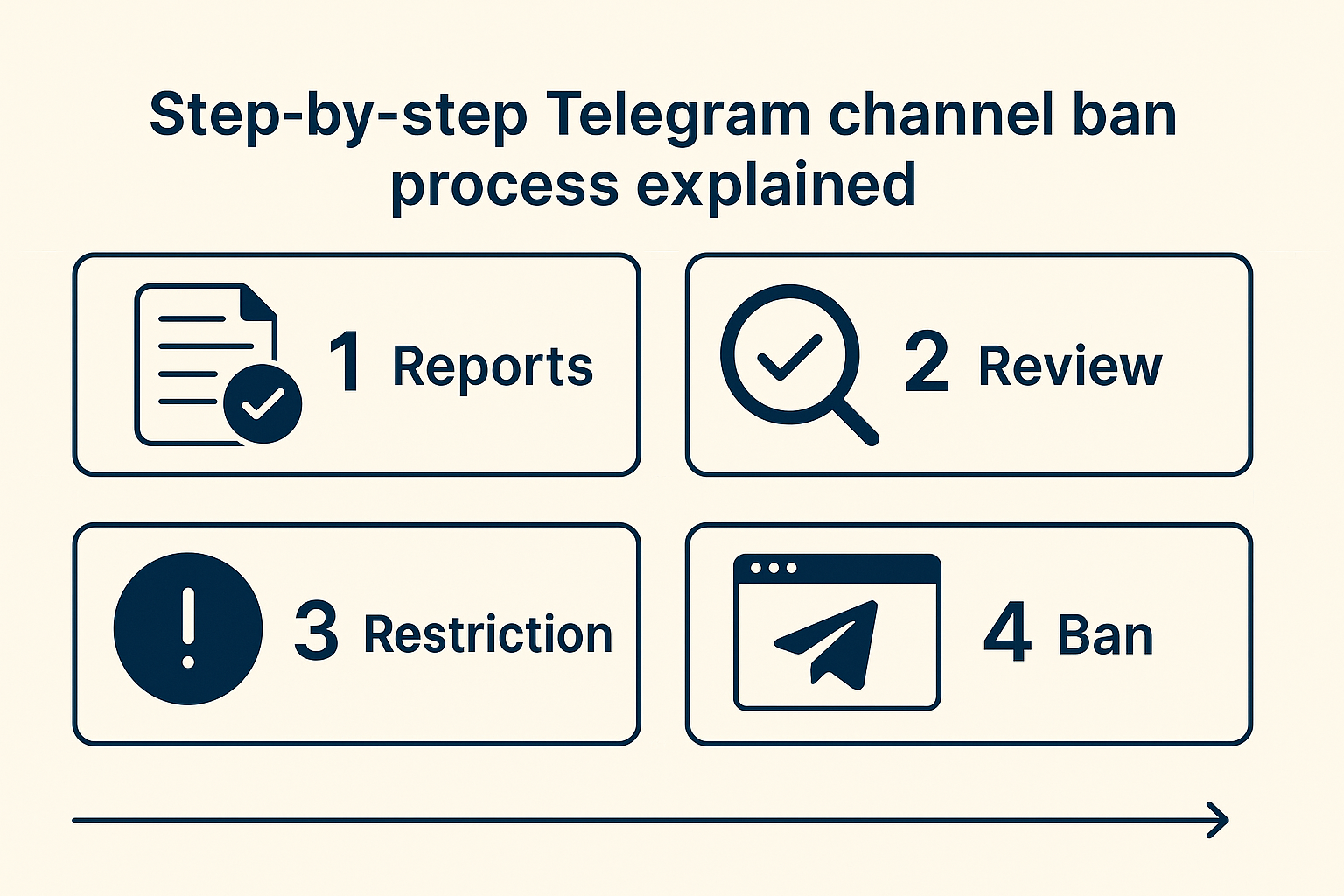
Which door comes first for each kind of loss?
The first door depends on what the scam took, because Telegram, your bank and the police each hold a different power. Telegram decides what stays on Telegram. A bank can act on money that may still be moving. Only a court can open the question of who runs an account: section 8.3 of Telegram's privacy policy, changed 21 August 2026, ties any disclosure of an IP address and phone number to a valid judicial order naming a suspect. Telegram Ban Service, the reporting desk that wrote this guide, works with the first of those powers alone, so this page sends you elsewhere before it sends you to us.
| What you lost | First door | Second door | What Telegram adds |
|---|---|---|---|
| Money | Bank, card issuer or crypto exchange | National fraud authority | Blocks the channel or bot, no refund |
| Identity | Fraud authority and credit bureaus | @NoToScam and in-app report | Removes or labels the copy |
| Intimate images, threats | Police, or NCMEC if a minor is involved | Hash service for other platforms | Blocks the post or channel |
| Account access | Devices screen on a signed-in phone or PC | Warn your contacts, set 2-Step Verification | Little, until you are back in |
A single scam can take two of these at once. A fake investment channel can walk off with a deposit and a passport scan, and a hijacked account can be used to ask your friends for cash. Start with whichever loss is still moving.
The FBI's 2025 IC3 report shows why a single route can't serve everyone. Extortion drew 89,129 complaints and $122,499,133 in reported losses that year, while investment fraud drew 72,984 complaints and $8,648,617,756. More people came forward over threats, far more money went on investments, and the two need different first calls. If you're still not sure a scam happened at all, our guide to how each Telegram scam gives itself away is the place to begin.
What does a Telegram fraud report change, and what can it not touch?
A report can get public content blocked or labelled, and that is close to the limit of it. The account owner's identity, your balance and your login all sit outside what a moderator can hand back to you.
Three outcomes are documented. Telegram's moderation page counted 29,364,020 groups and channels blocked in 2026 when read on 4 November 2026, a figure that covers every violation type and has no fraud line of its own. Its EU guidance adds a lighter result, since accounts, bots and communities involved in impersonation or fraud may carry a FAKE or SCAM label on their public profile. The third outcome is no action, and that same guidance warns a report can be dismissed when the information behind it is too thin.
Private chats need a separate word. Telegram's FAQ says it does not process takedown requests about private groups and chats. The Report button still functions there, though, and section 5.3 of the privacy policy says moderators may check messages reported to them by their recipients. So an email won't move a private scam message, while an in-app report on that exact message can reach a moderator.
Lost money: why does the bank go before Telegram?
A recent payment can sometimes still be recalled, and a Telegram fraud report does nothing for your balance. Telegram Ban Service has no say over that money either. The FBI's 2025 report calls time essential and tells victims to request a recall from their financial institution at once. Its Recovery Asset Team worked 3,900 incidents in 2025 covering $1,163,919,846 in attempted theft and froze $679,013,183, a 58% rate the report describes as success. Read that as money frozen in cases the team took up, never as a refund rate for victims.
The FTC's advice for people who paid a scammer changes with the payment method:
- Credit or debit card: call the number on the back of the card and ask for a refund.
- Bank transfer: ask your bank or credit union to reverse it.
- Wire: tell the transfer company a scammer tricked you.
- Gift card: call the issuer and keep the card and receipt.
- Crypto: contact the exchange or ATM operator, say the transaction was fraudulent, then report it at ReportFraud.ftc.gov.
UK readers have firmer ground on bank transfers. The Payment Systems Regulator protections cover UK Faster Payments and CHAPS transfers with a claim made within 13 months, an £85,000 cap, an optional excess of up to £100, and an expected five business days that can stretch to 35. Complicity in the fraud defeats a claim, and so can gross negligence unless you're a vulnerable consumer. Its dashboard reports 88% of lost money, £316 million, reimbursed in the 18 months to 31 March 2026. Crypto wallets aren't named in those protections.
Next comes the national authority: IC3 and ReportFraud.ftc.gov in the US, or Report Fraud, which replaced Action Fraud from 4 December 2025 for England, Wales and Northern Ireland, at reportfraud.police.uk or 0300 123 2040. Scottish residents call Police Scotland on 101. For a crypto payment, an FBI notice of May 2026 asks for the transaction ID, the receiving wallet address, any scammer details and a written account. Only after that do the public links go to Telegram.
The second scam aimed at the same victim
Fee-charging "recovery agents" target people who already lost money. The FTC's line on refund and recovery scams is blunt: "Never pay upfront for a refund or help with a refund."
Lost your identity: what stops misuse that Telegram can't see?
Credit bureaus and the fraud authority stop it, because a loan opened in your name never appears on Telegram. Moderators can only deal with the profile in front of them. If you sent a scammer an ID scan, a selfie or account details, treat the Telegram report as the smaller half of the job.
In the US, the FTC's identity theft guidance points to IdentityTheft.gov, which gives you a personal recovery plan and covers more than 30 kinds of identity theft. A fraud alert is free for one year and needs one call, because the bureau you contact must tell the other two. A credit freeze is also free, but Equifax, Experian and TransUnion each have to be contacted separately. Outside the US, start with your bank and national fraud authority. The IC3 report logged 31,675 identity theft complaints and $185,832,657 in losses for 2025.
Then deal with the copy. Telegram's FAQ names @NoToScam for a scammer pretending to be you, and the in-app Fake Account reason sits alongside it. The Telegram Ban Service walkthrough on reporting a fake Telegram profile covers each kind of copy. Stolen photos or brand content can also go to dmca@telegram.org, which Telegram limits to the copyright owner or an authorized agent, and the DMCA notice guide sets out that route.
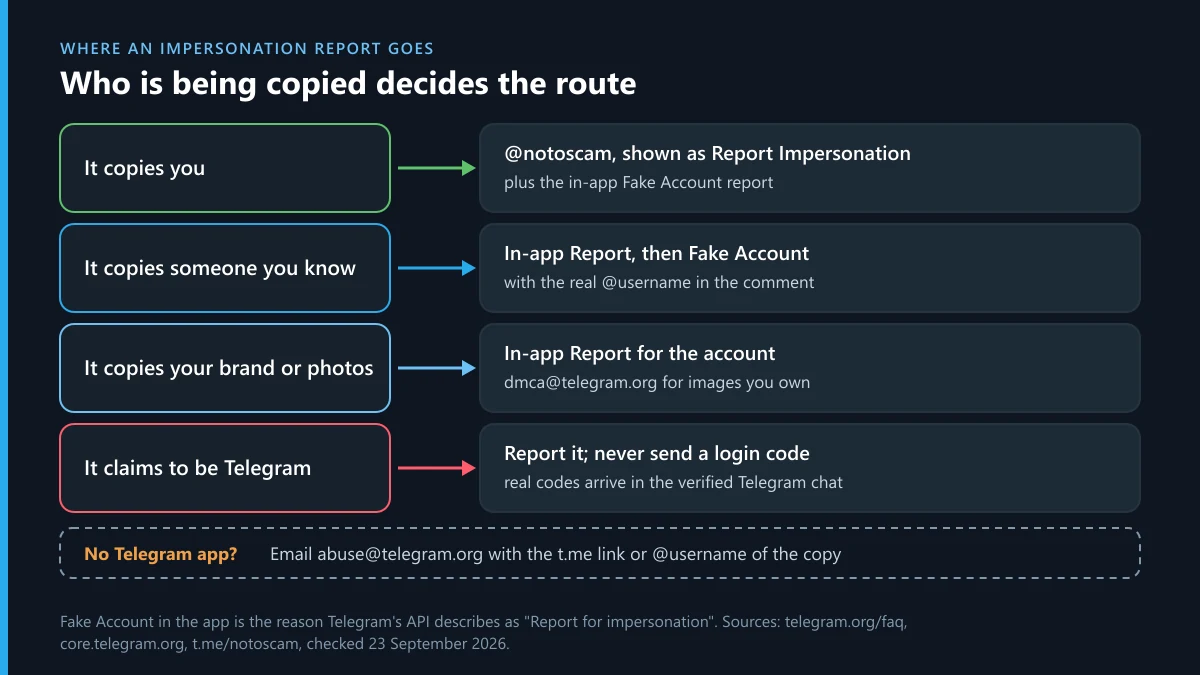
Intimate images or threats: who needs to hear first?
Police need to hear first, and paying should stay off the table, since no payment binds a blackmailer to anything. Save the chat, the @username and any links before you block. If anyone in the material is under 18, don't copy or forward the images at all; keep the usernames and links and go straight to the NCMEC CyberTipline.
Two services work by fingerprint, and your file stays on your device. Take It Down is for images taken when you were under 18, and StopNCII, where Take It Down points images from age 18 on, sends a hash to participating platforms. Here is the catch most guides skip: neither the Take It Down participant list nor the StopNCII partner list named Telegram when checked on 4 November 2026. A hash protects you on other apps. On Telegram itself you still report the post in the app and email abuse@telegram.org with the t.me link.
Be wary of firms selling a fix. An FBI notice from 2023 warns of for-profit sextortion companies charging heavy fees, and treats advice to avoid law enforcement as a warning sign. Police and non-profits help for free. More detail sits in the page on the Telegram nude blackmail scam.

Lost account access: what can only you do?
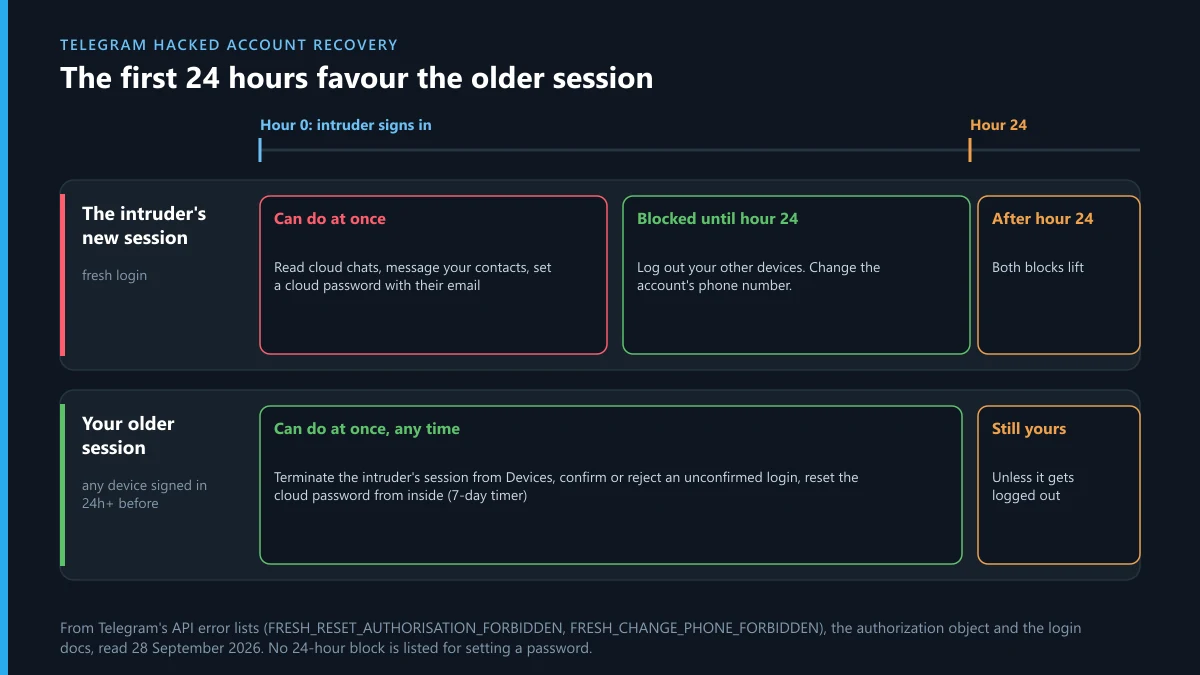
Only you can end the intruder's session, and it takes a device that was already signed in. No moderator, agent or reporting desk does this step for you. Telegram's FAQ puts it under Settings, then Devices, where you terminate the session you don't recognise.
Age favours you for a day. Telegram's API documentation for account.resetAuthorization returns an error when a session less than 24 hours old tries to log out other sessions, so an intruder's fresh login can't throw out your older phone straight away. After that, the protection lifts. Once you're in control, turn on 2-Step Verification with a recovery email, and tell contacts not to trust recent messages from you, because hijacked accounts are commonly used to ask friends for money.
Locked out entirely? Kaspersky's guide describes requesting an SMS code on your own number. It also warns that the "Reset account" option deletes the account, taking your chat history and channel admin rights with it, so treat that as the last resort. Don't forward a login code to anyone; Telegram's login documentation says its servers automatically invalidate codes sent to another Telegram chat. The Telegram Ban Service hacked account recovery guide has the full order.
What should your report to Telegram hold once the urgent door is closed?
A Telegram fraud report should hold a link, the rule broken and dated proof, filed through the route that fits the surface. Take these in order:
- Capture the @username, the t.me link and dated screenshots showing the account name, before any blocking.
- Open the profile, channel, group or bot and choose Report, then the closest reason. The guide to report routes for groups and channels covers each surface.
- For one message, tap it on Android, press and hold on iOS, or right-click on desktop and web, as Telegram's moderation page describes.
- For a public channel or bot, email abuse@telegram.org with the links, which the FAQ asks for so moderators can find the content.
- In the EU, use the reporting page linked from Telegram's guidance, which asks for your name, contact details and why the content is illegal.
- Block the account last.
A scam bot goes the same way, through Report on its profile plus an email. Skip @BotSupport: Telegram's bot FAQ offers that account for questions and suggestions and says nothing about abuse.
One good file outweighs a pile of copies. A moderator still has to confirm a breach, and Telegram's EU guidance says it may suspend processing for people who keep filing clearly unfounded, fraudulent or misleading reports. Volume doesn't decide outcomes and can backfire on the person sending it, which the piece on mass report bots versus real review explains, along with what actually gets someone banned. Add to a report only when new evidence turns up.
What does Telegram Ban Service take on, and what does it decline?
Telegram Ban Service takes the Telegram half of a genuine case, after you've been to the bank or the police. You send the @username or t.me link, the rule you believe it breaks and what you've saved. The desk reads that against Telegram's published rules, says no if there's no real breach, and otherwise prepares the evidence and files through the routes on this page. Telegram alone decides what happens next, so we can't promise a ban or a date.
Some requests get a flat refusal. We don't recover money or trace people. We don't file against rule-abiding accounts, critics or competitors, send false reports or run report bots, and we never ask for a password or a 2FA code. The account takedown explainer shows what removal does achieve, and if the channel is yours, the channel deletion guide covers it. For anything else on this list, the Telegram solutions hub or the contact page will get you to the right file.
Sources
- Telegram FAQ: Report buttons, abuse, @NoToScam, DMCA, private chats, Devices
- Telegram Moderation: 2026 counters, read 4 November 2026
- Telegram Privacy Policy, changed 21 August 2026: sections 5.3 and 8.3
- Telegram EU DSA guidance: FAKE and SCAM labels, dismissed reports
- Telegram API: account.resetAuthorization errors
- Telegram API: user authorization and login codes
- Telegram bot FAQ: @BotSupport
- FBI IC3 2025 annual report: complaints, losses, Recovery Asset Team
- FBI IC3 notice, 15 May 2026: what to file about a crypto payment
- FBI IC3 notice, 2023: fee-charging sextortion companies
- FTC: what to do if you were scammed
- FTC: identity theft, IdentityTheft.gov, fraud alerts and freezes
- FTC: refund and recovery scams
- UK Payment Systems Regulator: APP fraud reimbursement protections
- UK Payment Systems Regulator: reimbursement dashboard to 31 March 2026
- techUK: Report Fraud replaces Action Fraud
- Report Fraud: who should report there
- NCMEC Take It Down: participants
- StopNCII: partners
- Kaspersky: what to do if your Telegram account is hacked
FAQ
Should you report to Telegram or your bank first after a scam?
Your bank first, whenever money has left an account, and Telegram after that. The reason is what each one can reach: a bank may still be able to recall or dispute a recent payment, while Telegram can only act on the channel, bot or account. The FBI's 2025 IC3 report tells victims of a fraudulent transfer to request a recall from their financial institution immediately, then file at ic3.gov with full transaction details. The report logged $679,013,183 frozen across 3,900 Recovery Asset Team incidents in 2025, which reflects cases the team took up and is no promise of a refund. Waiting on a Telegram decision first costs time the payment may not have, and nothing about reporting to the bank stops you reporting to Telegram the same day. Keep the chat, the receipts and any wallet address, since you'll need them for both, and block the scammer only after they're saved.
Can a Telegram fraud report tell you who the scammer is?
No. A report goes to moderators and does not hand you the identity behind the account. Section 8.3 of its privacy policy, changed 21 August 2026, says an IP address and phone number may be disclosed after a valid order from judicial authorities confirming a suspect, and only following Telegram's own legal analysis. That route belongs to law enforcement, so a private person or firm can't use it. Your part is the trail that investigators will need: the @username, t.me links, dated screenshots and, for a crypto payment, the transaction ID and receiving wallet address. An FBI notice from May 2026 asks victims to supply those details along with any phone numbers, domains or aliases the scammer used. Any website offering to trace a Telegram user from a username deserves deep suspicion, particularly if it wants a fee first.
Is it safe to pay someone to recover money lost on Telegram?
Treat it as a likely second scam. The FTC says anyone asking for upfront fees or your personal or financial information in exchange for a refund is a scammer, and its advice is never to pay upfront. These offers target people who already lost money. Tracing promises don't survive a look at Telegram's privacy policy, which ties any disclosure of identifying data to a judicial order. The real routes are free: your bank, IC3 or ReportFraud.ftc.gov in the US, Report Fraud in England, Wales and Northern Ireland, and Police Scotland on 101. UK bank transfers may also fall under the Payment Systems Regulator's reimbursement protections, up to £85,000, claimed through your own bank within 13 months. Telegram Ban Service doesn't recover funds either; its work stops at reporting the Telegram content.
Does Telegram act on a scam in a private chat?
Sometimes, and only through the Report button. Telegram's FAQ says it doesn't process takedown requests about private groups and chats, which rules out abuse@telegram.org for this case. Yet its moderation page explains how to flag any message from an app, and section 5.3 of its privacy policy says moderators may check messages reported to them by their recipients. So report the specific message: tap it on Android, press and hold on iOS, or right-click on desktop or web, then pick a reason and add a comment. Take your dated screenshots before that step, showing the @username, and block only afterwards so nothing goes missing. If your loss was money, images or an account, the private chat is evidence for the bank or the police as well, and those are the bodies that can act on what happened outside the app.
Will more people reporting the same scammer get it banned?
Not by weight of numbers. A moderator still has to confirm a breach, and copies of the same evidence add little to that decision. Telegram's EU guidance goes further, saying it may dismiss a report that lacks information and may suspend processing for people who repeatedly send clearly unfounded, fraudulent or misleading notices, so piling on can rebound on the reporter. Panels and report bots sold as a shortcut can't create a violation that isn't there, and this desk won't use them. Numbers help elsewhere. If several people really lost money to one channel, each should file separately with their bank and with IC3 or their national fraud authority, because every complaint records its own loss and its own transaction details. On Telegram, one complete report beats twenty thin ones, and the moment to add to it is when something new appears, such as a further wallet, another channel or a fresh scam post.
What should you do first if a scam took money and your account?
Call the bank first if a transfer may still be stopped, then secure the account within the same hour. Deal with whatever is still moving. An intruder in your Telegram can message your contacts for money right now, so go to Settings, then Devices, on a phone or computer that was already signed in and terminate the unfamiliar session. Telegram's API blocks a session under 24 hours old from logging out others, which gives your older device the advantage for a limited time. Then set 2-Step Verification, warn your contacts on another channel, and phone your bank about the payment if you haven't. Identity comes next if you shared documents, starting with a fraud alert or your national authority. The Telegram fraud report comes last of all, because it stops the next victim instead of repairing your own loss, and you'll file it with better evidence by then.