8 October 2026 · Telegram Ban Service · 14 min read
What happens when you report someone on Twitter, and does anyone find out it was you?
When you report someone on Twitter, X logs the report, hides the post from your own timeline and reviews it against its rules, usually within a few days. The person isn't told who reported them; X says it doesn't disclose the complainant. The exception is a copyright notice, which X forwards with your name and contact details.
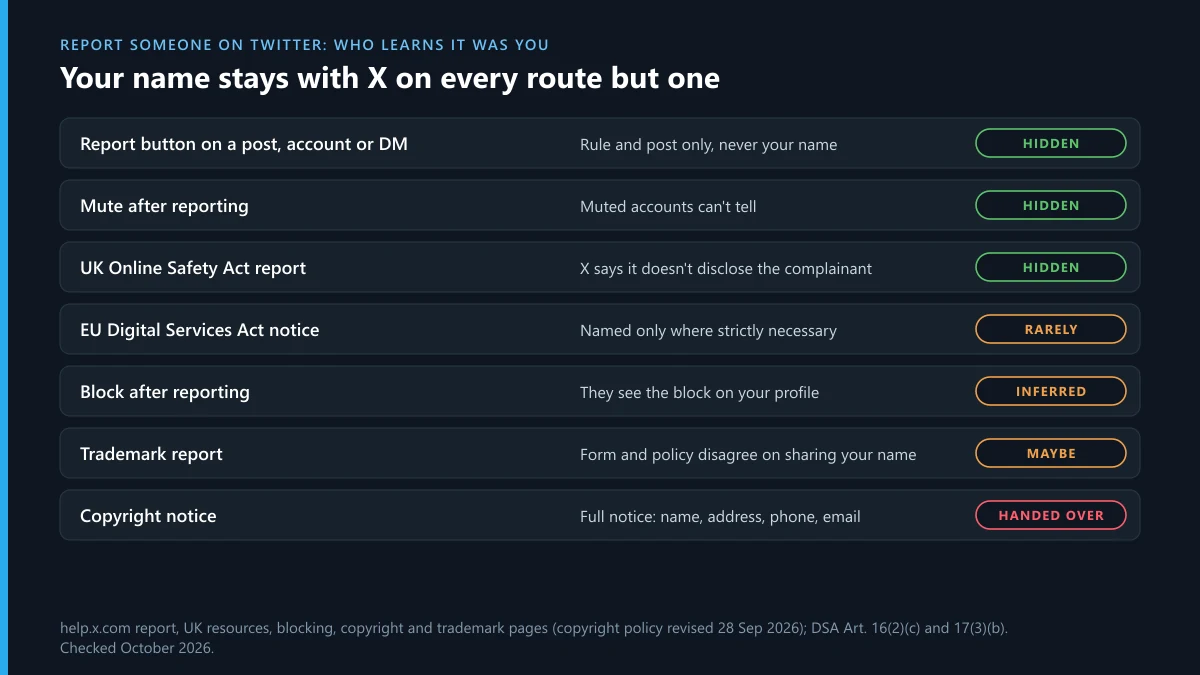
Two worries sit behind most searches about reporting someone on Twitter. Will anything happen? And will they find out it was me? For a lot of people the second one decides whether they report at all. X answers both, but in pieces: a reporting guide, a UK legal page, a copyright policy that was revised on 28 September 2026, and a blocking FAQ. We put those pieces side by side for this page. On 8 October 2026 we also counted what X filed with the EU for September in the DSA Transparency Database, to see what a reported post or account is actually likely to get. The report stays between you and X on almost every route. There's one exception that catches people out, and one habit that gives reporters away far more often than X ever does.
What happens in the first minutes after you report someone on Twitter?
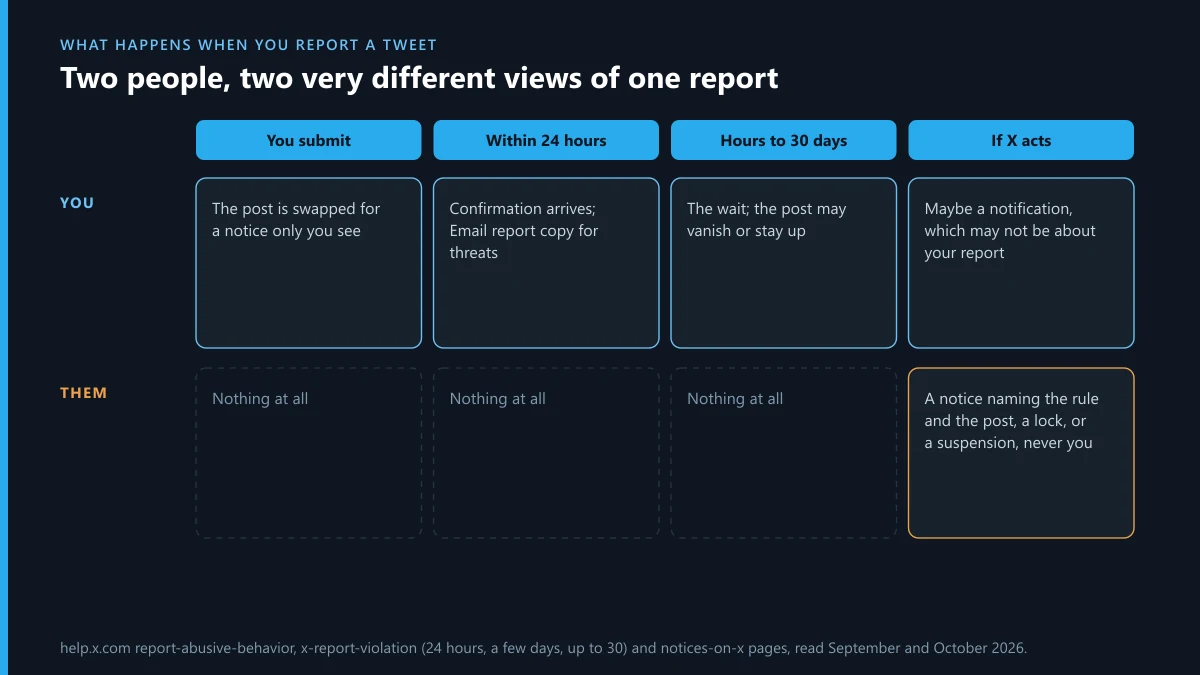
On your side, a few visible things. On theirs, nothing yet. Once you submit, X swaps the reported post in your timeline for a notice that only you see, saying you reported it. It then offers to mute or block the account, and those are separate choices that the report doesn't make for you. X's guide to reporting abusive behaviour says the confirmation of your report can take up to 24 hours to arrive. If the report is about a violent threat, the confirmation screen has an Email report option that sends you a copy you can hand to police.
The person you reported gets no alert at this stage. There's no "someone reported you" message in X. They hear something only if X decides a rule was broken, and even then the notice is about their post and the policy, not about you.
What happens when you report a Twitter account rather than one post follows the same path, with one extra step: X may ask you to pick posts from that account as examples. Account-level action has a higher bar. X's abuse and harassment policy says it usually limits a post's reach or makes the author delete it, and keeps suspension for accounts set up mainly to abuse people.
Does Twitter tell you who reported you?
No. When X acts on a report, the notice tells the account owner which rule they broke and which post did it. The reporter isn't named. X's UK resources page puts it plainly: X does not disclose information about the person who submitted the complaint. The same help pages say X releases account information only as required by valid legal process, such as a court order.
The answer doesn't change with the wording. Does Twitter tell you who reported your account? Does Twitter tell you who reported your tweet, or who reported your post? In each case the notice names the content and the rule, and leaves the reporter out. A locked account sees the post it has to delete. A suspended account sees the policy. Neither sees a username.
EU law adds a nuance. A notice filed under the Digital Services Act has to carry the reporter's name and email, except for child sexual abuse reports, so X knows exactly who sent it. The decision X then sends the affected user has to explain its reasons, and under Article 17(3)(b) of the DSA it may name the notifier only "where strictly necessary". That's a narrow exception, not the default.
Are Twitter reports anonymous?
To the person you report, yes. To X, no. Every in-app report is tied to the account that filed it, because the Report button only works when you're logged in. In the EU, a legal notice under the DSA goes further and needs your name and email.
That also settles how to report someone on Twitter anonymously: you already are, as far as the other person is concerned. A second account adds no cover, since the person never sees the reporter anyway, and reporting the same post from several accounts counts as misuse under X's Authenticity policy. X's impersonation report is the one route that works without an X account, and it asks for your details instead.
Which kinds of report can reveal your name?
Only a few, and copyright is the one most people don't expect. Here's what each route tells X about you and what the reported account can learn from it.
| What you do | What X knows about you | What the reported account can learn |
|---|---|---|
| Report a post, account or DM with the Report button | Your X account | The rule and the post, never your name |
| Mute them after reporting | Nothing new | Nothing: muted accounts can't tell |
| Block them after reporting | Nothing new | That you blocked them, if they open your profile |
| Copyright notice | Name, address, phone and email | The full notice, contact details included |
| Trademark report | Name, job title, official email | The form says contact details aren't disclosed; the policy says X may share your name |
| EU Digital Services Act notice | Name and email | Your identity only where strictly necessary |
| UK Online Safety Act report | Your contact details | Nothing; X says it doesn't disclose the complainant |
| A report bot or seller on Telegram | Nothing; X sees the bot's accounts | Whatever the seller decides to share, since the seller has your Telegram account and payment |
The copyright row is the trap. X's copyright policy says it sends the person who posted the material a full copy of the notice, including the filer's name, address, phone number and email, and it suggests using an agent if that worries you. It's the one route where the person you reported can end up holding your phone number. If the same stolen work is also sitting in a Telegram channel, a DMCA notice sent to Telegram covers that copy, and what counts as copyright infringement on a Telegram channel explains what that notice can reach.
The last row matters too. Paid report services don't make you more anonymous; they add a stranger who knows what you asked for. We looked at how the Twitter mass report bots sold on Telegram operate, and several Telegram report bots turn out to be scams that take the payment and do nothing.
Can someone see if you reported them on Twitter?
Not from anything X shows them. But people work it out from context, and that's where most reporters give themselves away. The common tells:
- You were the only other person there. If the removed post was a reply to you, or the reported messages were in a DM between the two of you, the notice points at you without naming you.
- The report had to come from you. X says it sometimes needs to hear from the person being targeted before it acts on harassment, and for misgendering or deadnaming it always does. If X acts on that kind of post, the target is the obvious reporter.
- You blocked them straight afterwards. X doesn't send a block notification, but its blocking page says a blocked account sees that it's blocked when it visits your profile. A block landing the same hour as a removal notice reads like a signature.
- You mentioned it. A post saying you've reported them is the most common way the secret gets out.
So how do you report someone on Twitter without them knowing? Report through the in-app button, mute instead of blocking if you just want the account out of your feed, and keep the report to yourself. Muting is invisible to the muted account. Block when you need them unable to reply or message you; your safety matters more than keeping the report hidden.
How do you report someone on Twitter, step by step?
From the post if one post is the problem, from the profile if the account is. Here's how to report someone on Twitter from the app or the website:
- Screenshot the post with the @handle and the date visible. Copy the post's link too, because a deleted post can't be reported afterwards.
- Tap the three-dot menu on the post, or on the profile for the account as a whole, and choose Report.
- Answer who the report is for. X asks whether it's about you, about someone else or a specific group, or about everyone on X. Answer truthfully, because it decides which rules X checks.
- Pick the reason that matches what happened. A spam report on a threat sends it to the wrong queue.
- If X asks for more posts from the account, choose the two or three that show the problem most clearly.
- For direct messages, open the conversation, tap the info icon and choose Report @username.
- Submit, then decide on mute or block separately.
What happens when you report a tweet as spam?
It goes to X's spam systems, which do nearly all of their work without anyone reporting anything. The post is hidden for you like any other report. Whether the account is limited or suspended depends on what the automated filters already see in its behaviour, so one spam report is one more data point rather than a case that a person picks up.
X's own EU figures show the scale. Between April and June 2025, X suspended 27,610,696 accounts for spam and platform manipulation on its own initiative. In the same three months, user reports led to 9,225 spam suspensions. Reporting a tweet as spam is still worth doing for an obvious bot, because it feeds the filters, but don't expect a reply. X's spam page also points you back to the app: its form says reports can't be created there. If the same spam reaches you on Telegram, reporting spam on Telegram works differently, and the limit that follows is something the sender does notice.
What happens when you report a tweet on Twitter and X agrees?
Usually something smaller than a ban. X's enforcement options, from lightest to heaviest:
- Limiting how far the post spreads, sometimes with a label.
- Requiring the author to delete the post. X's page on notices says the account stays locked until the post is removed, and the removal notice then stays visible for 14 days.
- Read-only mode, where the account can browse but not post.
- Suspension. A permanent suspension notice names the policy and the content behind it.
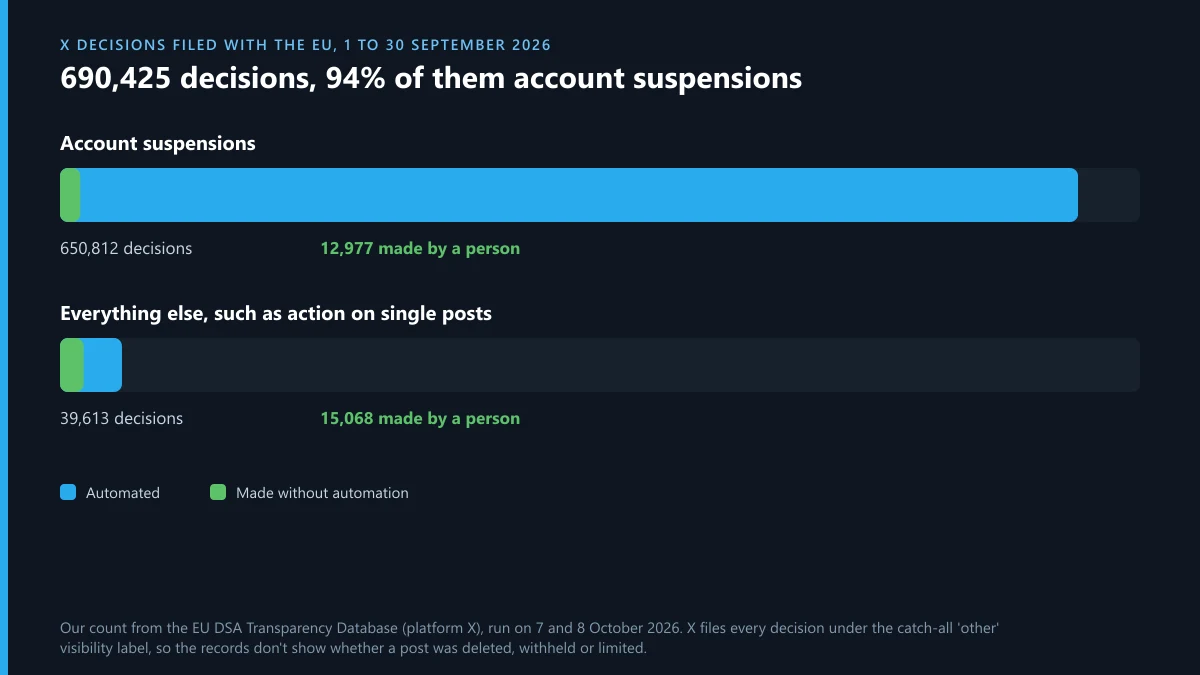
The EU data shows how lopsided the outcomes are. In September 2026, X filed 690,425 statements of reasons with the EU. 650,812 of them, about 94%, were account suspensions, mostly automated sweeps of scam and spam accounts. That leaves 39,613 decisions that didn't suspend anyone, which is where action on individual reported posts falls. A person made 15,068 of those, against 12,977 of the suspensions. One quirk limits what the database can tell you: X files every one of its decisions under the catch-all "other" visibility label, so the records don't say whether a given post was deleted, withheld in one country or just limited.
| X decisions filed with the EU, 1 to 30 September 2026 | All | Made without automation |
|---|---|---|
| Account suspensions | 650,812 | 12,977 |
| Everything else, such as action on single posts | 39,613 | 15,068 |
| Total | 690,425 | 28,045 |
We saw the same pattern in X's notice data from 2025. Of the illegal-content notices X closed between April and June 2025, 55% ended with no violation found, 34% with the content withheld in one country and 11% with deletion under the X Rules.
How long does Twitter take to review a report?
Anywhere from hours to a month. X says reports are acknowledged within 24 hours and usually resolved within a few days, though some take up to 30. Legal notices from the EU moved faster in X's April to June 2025 report, with median handling times of about 2 hours for harmful speech, minors and scams, 3 for defamation and violence, 4 for data protection and up to 7 for unsafe products.
Silence doesn't mean the report was rejected. X may tell you when it takes action, but its help page warns that an action notice may or may not relate to your own report, because several people can report the same post. The quickest check is the content itself: open the link you saved and see whether the post is gone, withheld or still up.
Searches like how long does twitter take to review a report reddit, are twitter reports anonymous reddit, does twitter tell you who reported your account reddit and what happens when you report someone on twitter reddit are looking for people who've been through it. First-hand stories are useful for what the wait feels like, but each describes one report in one category, which is why they disagree so much. The ranges above come from X's own filings.
Does reporting on Twitter do anything?
Yes, when the post breaks a named rule and the report shows it. The number of reports isn't what decides. A reviewer or a filter has to match the content to a policy, and the EU figures above show that most notices still end with no violation found. A clear report about a clear violation is what moves things.
Mass reporting doesn't add weight, and it can work against you. X's Authenticity policy treats duplicate or false reports in large numbers, coordinated report campaigns and paid third-party reporting services as engagement spam. Good-faith reports are explicitly fine: X's EU report for April to June 2025 recorded no actions at all against people for manifestly unfounded reports. Other platforms work the same way. The Instagram mass report bots passed around GitHub and Telegram sell the same idea, Instagram spam report bots promise more than a report can deliver, and on Telegram itself a mass report bot is no shortcut to a ban. How many reports it takes to ban a Telegram channel has the same answer as on X: no fixed number.
Is reporting someone on Telegram anonymous too?
For in-app reports, effectively yes. Telegram's FAQ says reports go to its moderators and has no line about telling the reported user who filed them. Telegram's EU form is different: it asks for your name and contact details, much like an X notice under the DSA. A reported account can still guess that something happened. Telegram's FAQ says accounts limited after spam reports can only message people who have their number saved as a contact, and the person notices that, though not who caused it.
When the account you reported on X moves the problem to Telegram, report each piece there. Telegram won't act on X posts, and X can't act on Telegram channels.
Retaliation sometimes follows a report, and it can land on your Telegram account rather than your X one. If yours was restricted after a wave of counter-reports, recovering a banned Telegram account starts with working out which kind of ban it is, and recovering a frozen Telegram account has its own appeal path. If someone used the confusion to take the account over, getting a Telegram account back comes first. Before paying anyone, read what a Telegram account recovery expert can and can't do. And if you'd rather hand the Telegram side to someone, our Telegram report service handles channels, bots and groups that break the rules.
FAQ
Will the person know I reported their tweet if X removes it?
They'll know the tweet broke a rule, because X tells them which post and which policy. They won't see your name. If the tweet was a reply to you or sat in a DM between the two of you, though, they may guess, so avoid blocking or posting about it at the same moment.
Does X tell you the result of your report?
Sometimes. X may send a notification when it takes action, but its help page warns that the notice may or may not relate to your report, since other people can report the same post. Checking the post or the profile yourself is the quickest way to see what happened.
Can I take back a report I made on Twitter?
We found no option in X's help pages for withdrawing an ordinary in-app report. Copyright notices are the exception: only the person who filed one can retract it, through X's retraction form or by emailing [email protected].
Does reporting someone on Twitter block them as well?
No. Reporting, muting and blocking are separate. After you report, X offers to mute or block the account. Muting is invisible to them, while a blocked account can see the block if it opens your profile.
Can reporting someone get my own Twitter account in trouble?
Not for a good-faith report, even if X decides nothing was broken. X's Authenticity policy targets false or duplicate reports in large numbers and coordinated report campaigns. X's EU report for April to June 2025 listed no actions against users for manifestly unfounded reports.
How do I check whether someone I reported was suspended?
Open their profile. A suspended account shows a suspension notice instead of its posts. A missing post with the account still active usually means X required a deletion, withheld the post in your country, or the author removed it.