9 October 2026 · Telegram Ban Service · 12 min read
How to delete someone else's Twitter account or tweet when X gives you no delete button
You can't delete someone else's Twitter account or tweet, and X has no form that does it for you. Only the owner deletes an account, by deactivating it and waiting 30 days. In practice, how to delete someone else's Twitter account means getting X to suspend it for a clear rule break, or using a family, trademark or legal route.
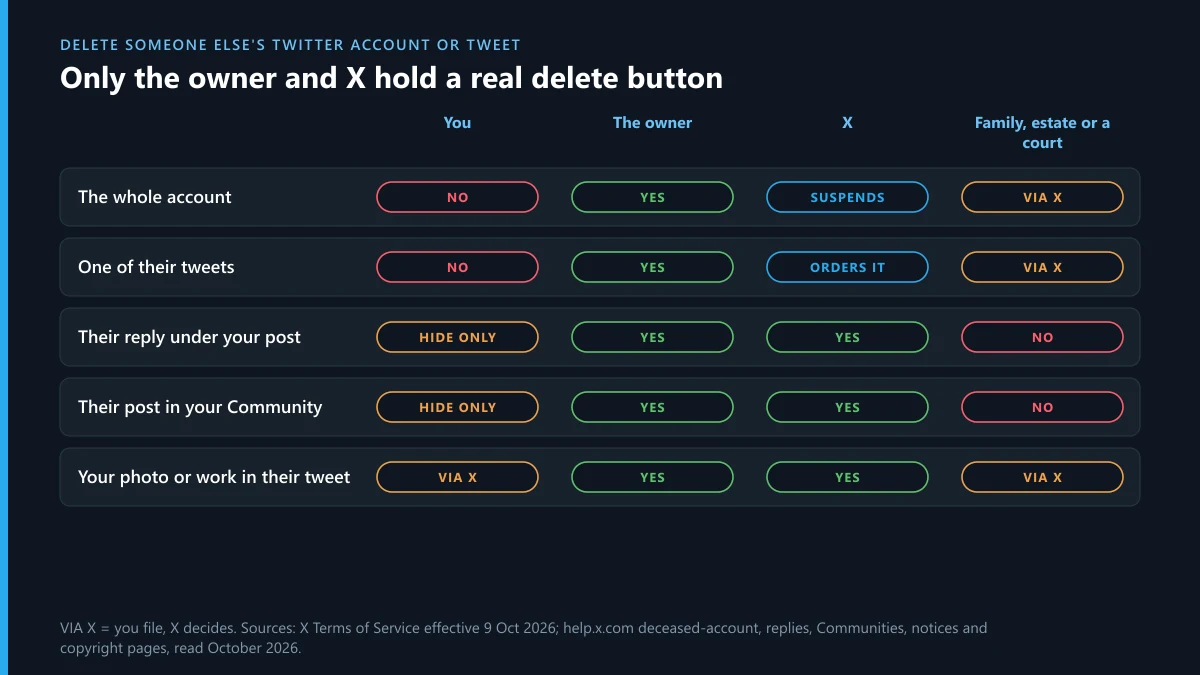
The search usually starts with a specific account. An ex who won't stop posting about you, a profile built from your photos, a stranger whose tweet is still the top result for your name. The word people type is "delete", and it's the wrong word for X, which is why so many of the answers out there feel like they skip the question. There is no form where you name an account and X wipes it. There are a handful of routes that end with the account suspended, the tweet gone, or both. Which one fits depends on who you are to that account and what the content does. X's updated Terms of Service took effect today, 9 October 2026, and they spell out when X itself ends an account. We read them alongside X's help pages and counted what X reported to the EU through 8 October, so the routes below are the ones that work this month.
What does "deleted" actually mean for a Twitter account?
Four different things, and only one of them is a true deletion. The owner can deactivate the account, and after 30 days X deletes it and frees the username. X can suspend it, which is what most people mean when they say an account "got deleted". X can terminate it under its Terms. And X can withhold an account or a post in a single country after a legal demand, while everyone else still sees it.
| Outcome | Who sets it off | What visitors see | Can it come back? |
|---|---|---|---|
| Deactivated, then deleted | The owner, or X on a family or estate request | The profile disappears; after 30 days the handle is free | Only within the 30 days, and only by the owner |
| Suspended | X, after a rule break or a report it upholds | An "account suspended" notice instead of posts | Yes, if the owner wins an appeal |
| Terminated | X, under its Terms | The account is gone; X may reclaim the username | Only through X's appeal form |
| Withheld in one country | A court order or a legal notice | A withheld notice, in that country only | It never left anywhere else |
| Removed for inactivity | X, when nobody logs in | The account is gone | X doesn't describe a way back |
The new X Terms of Service list five reasons X may suspend or terminate an account: breaking the Terms or Rules, creating legal risk for X, unlawful conduct, prolonged inactivity, and the service no longer being commercially viable for that user. They then add that, where the law allows, X can do it "for any other reason or no reason". Notice what's missing. Nothing in that list is "another user asked us to".
How often does X actually remove an account outright?
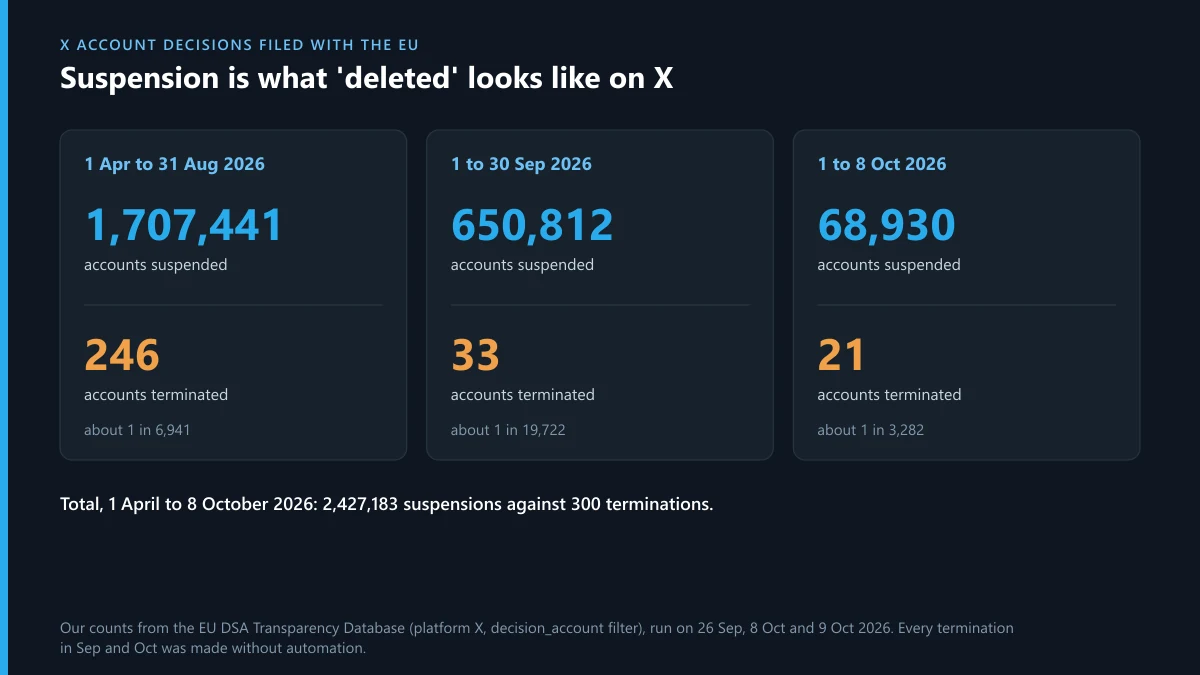
Almost never in so many words. X files its account decisions with the EU's DSA Transparency Database, and the database separates suspensions from terminations. We counted both for April through the first week of October 2026.
| X account decisions filed with the EU | Suspended | Terminated |
|---|---|---|
| 1 April to 31 August 2026 (counted 26 September) | 1,707,441 | 246 |
| 1 to 30 September 2026 (counted 8 October) | 650,812 | 33 |
| 1 to 8 October 2026 (counted 9 October) | 68,930 | 21 |
| Total | 2,427,183 | 300 |
That's roughly one termination for every 8,000 suspensions. Every one of the 54 terminations filed in September and October was made by a person rather than a system, while 2,302 of the 68,930 October suspensions were. For anyone trying to work out how to delete someone's Twitter account, the takeaway is plain: the realistic ceiling is a suspension, and a suspension already does what you want. The posts stop showing, the profile carries a notice, and the account can't post. The EU transparency database keeps about six months of records, so you can rerun the same filter yourself.
Who besides the owner can get a Twitter account deleted?
Four groups, each with its own door. None of them gets a delete button; each gets a way to ask X, with paperwork that proves the right to ask.
- Family or an estate, after a death. X's page on a deceased family member's account lets a verified immediate family member or someone acting for the estate request deactivation. X then emails for details, a copy of your ID and the death certificate. It won't hand over the login to anyone, whatever the relationship.
- A legal representative, if the owner is incapacitated. Same form family, but X asks for your ID, the account holder's ID and a power of attorney.
- A parent, if the owner is a child. X's minimum age is 13, and its safety forms include one for underage users. A parent can also get into the child's own device and deactivate it, which is faster when that's possible.
- A trademark holder. Only the holder or its representative may file, with a registration number; a pending application isn't enough. X's possible outcomes run from a chance to comply up to permanent suspension, and its trademark policy offers no username transfer.
Everyone else files as an ordinary user reporting a rule break. That's the route most people actually need, and it ends in suspension, not deletion. Sibling guides cover it from different ends: matching an account to the X rule it breaks, the enforcement steps X climbs before it suspends someone, and what the reported account learns about the person who reported it.
What if "someone else's account" is really yours?
This case is more common than it sounds. A hacker who changed the email and password, a former employee still holding the company handle, an old agency that set up the account in its own name. To X these are access problems, not removal requests, and the fix is to get the account back through X's account-access forms, then deactivate it yourself if you still want it gone. Reporting your own hijacked account as abusive can get it suspended with you still locked out, which makes recovery harder.
Telegram works the same way. The only account you can delete there is one you control, and deleting your own Telegram account works through Telegram's deactivation page or by letting the inactivity timer run out. If someone took yours over, recovering a hacked Telegram account comes before anything else, and Telegram account recovery in general covers lost numbers and logouts.
How to get someone's Twitter account deleted through a report
Plenty of people type it as how to get someones twitter account deleted and expect a request form at the end. The closest real thing is a report that shows X a rule break it can't miss, from the account as a whole rather than one bad moment. A report that ends in suspension usually has three things:
- Name the policy. Child safety, non-consensual intimate media, private information, impersonation and violent threats are the policies where one clear case can be enough for X to act on the account. A rude or unfair account with no rule behind the complaint won't be removed, however many people report it.
- Show a pattern across several posts. When X asks for examples from the account, pick the clearest two or three and screenshot each with the handle and date showing before you file.
- File as the right reporter. For harassment and private media, X often needs the person targeted. For impersonation, the person being copied or their representative. A friend's report on your behalf carries less weight.
If you've seen Telegram bots promising to finish the job for a fee, read how the Twitter mass report bots sold on Telegram really work first. X's Authenticity policy treats large numbers of false or duplicate reports, coordinated reporting and paid third-party report services as engagement spam, so the accounts doing the reporting are the ones at risk. What a Twitter ban service can and can't do explains where the honest version of that work stops. Faking a death certificate or a power of attorney to use the family route is fraud, and guessing someone's password to delete the account yourself is unauthorized access, a crime in the US, the UK and the EU.
Can you delete someone else's tweet yourself?
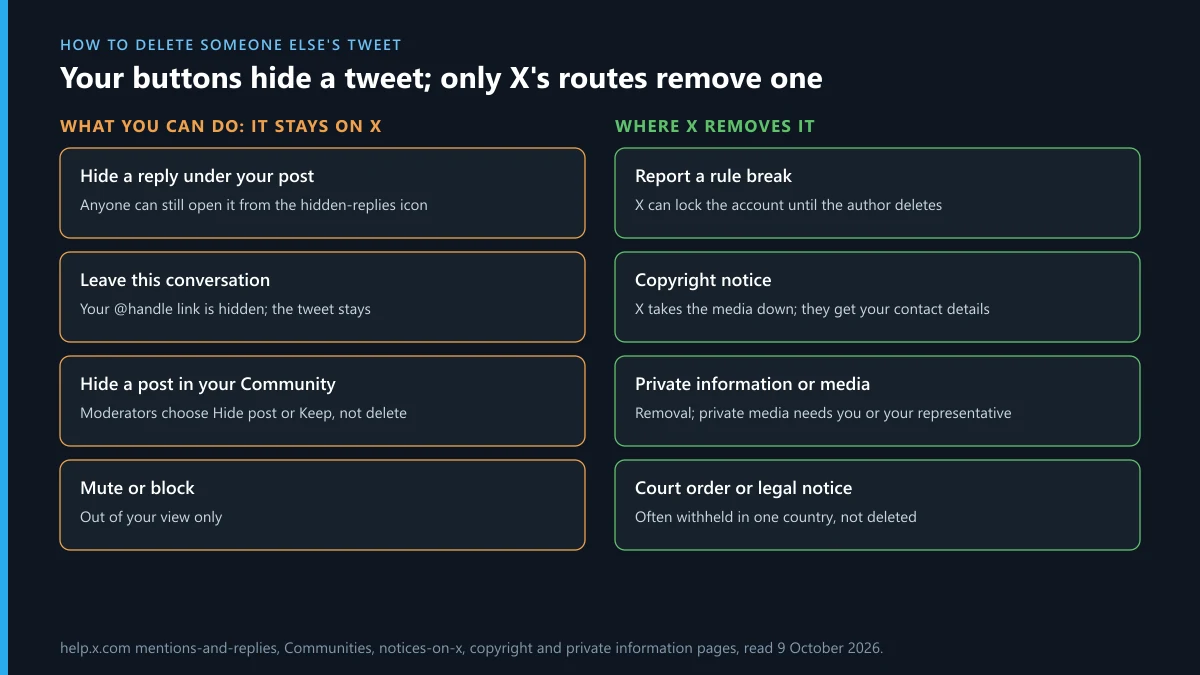
No. Every tool X gives you over other people's posts hides them instead of deleting them. When we checked each of those tools on 9 October 2026, we saw that the closest thing to a delete button belonged to Community moderators, and even that one is labelled "Hide post".
| Your tool | What it does | What stays |
|---|---|---|
| Hide a reply under your post | Moves it behind a hidden-replies icon; the replier isn't told | Anyone can still open it from that icon |
| Leave this conversation | Hides your @handle link in a post that mentions you | The post and its text |
| Hide a post in a Community you moderate | Takes it out of the Community, with a reason sent to the member | The rest of X; moderators report X Rule breaks separately |
| Remove a member from your Community | Stops them posting there | Everything they posted elsewhere |
| Mute or block | Takes the account out of your own view | Everything, for everyone else |
X's page on replies and mentions spells out the limit: a hidden reply is still reachable, and the author of the original post can unhide it at any time. In X Communities, moderators review reported posts and pick Hide post or Keep, then report anything that breaks the X Rules to X itself.
How to delete someone else's tweet: which routes actually remove it?
The ones that end with X acting on the post. Which one applies depends on what the tweet contains, so start there, not with the report menu.
- It breaks an X rule. Report the post. If X agrees, it usually orders the author to delete it and locks the account until they do. The removal notice then stays visible for 14 days. That's how to get someone's tweet deleted without a lawyer, and it's the most common way it happens.
- It uses your photo, video or writing. A copyright notice gets the material taken down by X itself. The poster receives a full copy of your notice, including your name, address, phone number and email, so many people file through an agent. Deleting the rest of the post doesn't settle a copyright complaint, and reposting the removed material can mean permanent suspension.
- It exposes your private information or private images. X removes it. For private photos and videos, X generally needs the report to come from you or your authorised representative. Intimate images posted without consent can also go through X's Take It Down form, which accepts only you or your representative.
- It's illegal where you live. A court order or a legal notice to X often ends with the post withheld in that country rather than deleted, which helps locally and does nothing abroad.
So how to delete someone's tweet comes down to two questions: whose rights does it touch, and can you prove it? A tweet that's merely embarrassing, unkind or unfair, and touches no rule and no right, stays up.
Is a deleted tweet really gone everywhere?
From X, yes. From search engines and archives, not straight away. Google may keep showing the old snippet for days or weeks after the tweet is removed. Once the tweet returns an error, Google's Refresh Outdated Content tool asks it to recrawl and drop the stale result, and anyone can use it, not just the site owner. Screenshots and reposts are separate pieces of content; each one needs its own report on the platform where it sits.
Is it any different on Instagram?
Not in principle. Instagram also leaves deletion to the owner, apart from family requests after a death, and hands everyone else a set of report routes, though the forms and outcomes differ. If the same person is doing this on Instagram, getting someone else's Instagram account deleted explains the same owner-or-Meta split, and how an Instagram account gets taken down covers the outcome itself. The right Instagram route follows the problem:
| What they did on Instagram | Where to start |
|---|---|
| One post is the problem | Reporting a single Instagram post |
| The whole page or profile is the problem | Reporting an Instagram page as a whole or reporting a person on Instagram |
| Repeated abuse aimed at you | Reporting harassment on Instagram |
| Threats to share images unless you pay | Reporting blackmail on Instagram |
| A photo of you posted without asking | Getting a picture of you removed from Instagram |
| Your own photos or videos reposted | Sending Instagram a DMCA takedown |
| Your brand name or logo misused | Filing an Instagram trademark report |
| A profile pretending to be you | What to do when someone is impersonating you on Instagram |
| Fake sales or money requests | Reporting a scammer on Instagram |
| A court order or legal demand | Instagram's legal request routes |
Two worries come up on both platforms. Instagram doesn't name the reporter either; whether the person finds out you reported them on Instagram walks through the exceptions. And if you reported the wrong post, taking back an Instagram report shows the little that can be withdrawn. Paid shortcuts look the same there too: Instagram ban services and Instagram account removal services can file reports, but Meta makes the call, exactly as X does.
FAQ
Can I delete my ex's Twitter account if I still know the password?
Don't. Logging in with a password you weren't given permission to use, even one you once shared, counts as unauthorized access in the US, the UK and the EU, and X shows the account owner where recent sessions logged in from. If the account is posting your private images or details, report it through X's private information routes instead.
Does a suspended Twitter account get deleted eventually?
X's help pages give no point at which a suspension turns into deletion. The account stays suspended unless the owner wins an appeal, and X's Terms let it terminate the account instead, which it rarely records doing: 300 terminations against 2,427,183 suspensions in its EU filings from April to 8 October 2026.
Can I get a tweet about me deleted if what it says is true?
Truth isn't the test X applies. A true tweet comes down only if it breaks a policy, such as posting your home address, your private photos or your ID, or if a court finds it unlawful where you live. Accurate criticism that touches no rule stays up.
Can I remove my name from someone else's tweet?
Partly. Leave this conversation hides your @handle link in a post that mentions you, but the post and its text stay up. If the tweet names you alongside private information, report it under X's private information policy.
Can a parent delete their teenager's Twitter account?
Not directly. If the child is under 13, X's underage-user form is the route. For an older teen, we found no parent request option in X's help pages, so the practical way is deactivating it together on the teen's own device.
Is there a service that can delete a Twitter account for me?
No honest one. A service can help you file reports, and X still decides. X's Authenticity policy counts paid third-party reporting and coordinated reports as engagement spam, so anyone promising a guaranteed deletion is promising something X doesn't sell.
Can I ask X to delete an account that hasn't posted in years?
Not as a request. X asks owners to log in at least every 30 days and says long-inactive accounts may be permanently removed, but that happens on X's own schedule, and inactive usernames are not handed to people who ask for them.
What happens to the username once an account is gone?
After an owner deactivates, the handle is freed when the 30 days run out. Usernames on inactive accounts are not released, and X's Terms let it reclaim usernames, so a handle tied to a suspended or terminated account may never become available.