15 November 2026 · Telegram Ban Service · 12 min read
WhatsApp ban service: what you can hire, and what nobody can sell
A legitimate WhatsApp ban service cannot ban a number or file reports for you, because WhatsApp accepts user reports only through its in-app process and says outside contact changes nothing. Honest help is narrower: preparing evidence, walking you through your own in-app report, drafting copyright or trademark claims under WhatsApp's IP Policy, and building a police file.
Can anyone sell you a WhatsApp ban service that works?
No outside party can ban a WhatsApp number. Only WhatsApp can, and its Help Center says so in plain words. The account bans article states that "third party services can't ban your WhatsApp account or remove your account ban," and the reporting and blocking article adds that the in-app process is the only way to report someone. Contacting WhatsApp outside that process, it says, "won't expedite the review process or impact the decision."
Telegram Ban Service is a reporting desk built for Telegram channels, groups and bots that break Telegram's rules, so on WhatsApp it can only act as an adviser to the person who was harmed, never as the one who files. That limit shapes everything below. When an advert promises a WhatsApp ban service with a price per number, it is offering one of two things: help with a real case that the victim still reports personally, or a product WhatsApp itself says cannot exist.
The second kind is the common one.
What does a WhatsApp number takedown actually involve?
A WhatsApp number takedown means WhatsApp bans the account registered to a phone number after deciding it broke the Terms of Service. The decision rests on evidence WhatsApp can see, and that evidence is narrow. Per the Help Center's block and report guide, a report sends "up to five of the last messages they've sent to you," basic details of the last five calls, the reported user ID, message timing and type, and sometimes how first contact began. The reported person is not notified.
Read that list again from a stranger's side. Someone who never chatted with the target forwards nothing, which is why a paid crowd of reporters adds no proof. WhatsApp also bans a large share of accounts on its own signals: in its India monthly report dated 1 October 2026, covering August 2026, it counted 6,202,400 banned Indian accounts, of which 1,690,800 (about 27%) were banned before any user report arrived.

The figure comes from WhatsApp's own India monthly reports; The percentage is simple division of those two published figures.
Five jobs a WhatsApp ban service can honestly take on
Honest help sits around the report, not inside it. You file, and the helper makes your filing count. That sounds like a small offer, yet most failed WhatsApp cases fail on the evidence side: the victim blocks first and deletes the chat, reports from a second phone that never received the messages, or sends a long email to an address WhatsApp does not use for reports. Telegram Ban Service spends most of a WhatsApp case on those preventable mistakes. A rights holder with a stolen logo needs a different document altogether, and a person who lost money needs the bank before anyone else. The table splits each job by who acts and what an adviser adds, using the routes WhatsApp publishes as of November 2026. Where a row names you, nobody can stand in for you, however much they charge.
| Job | Who acts | What a helper adds |
|---|---|---|
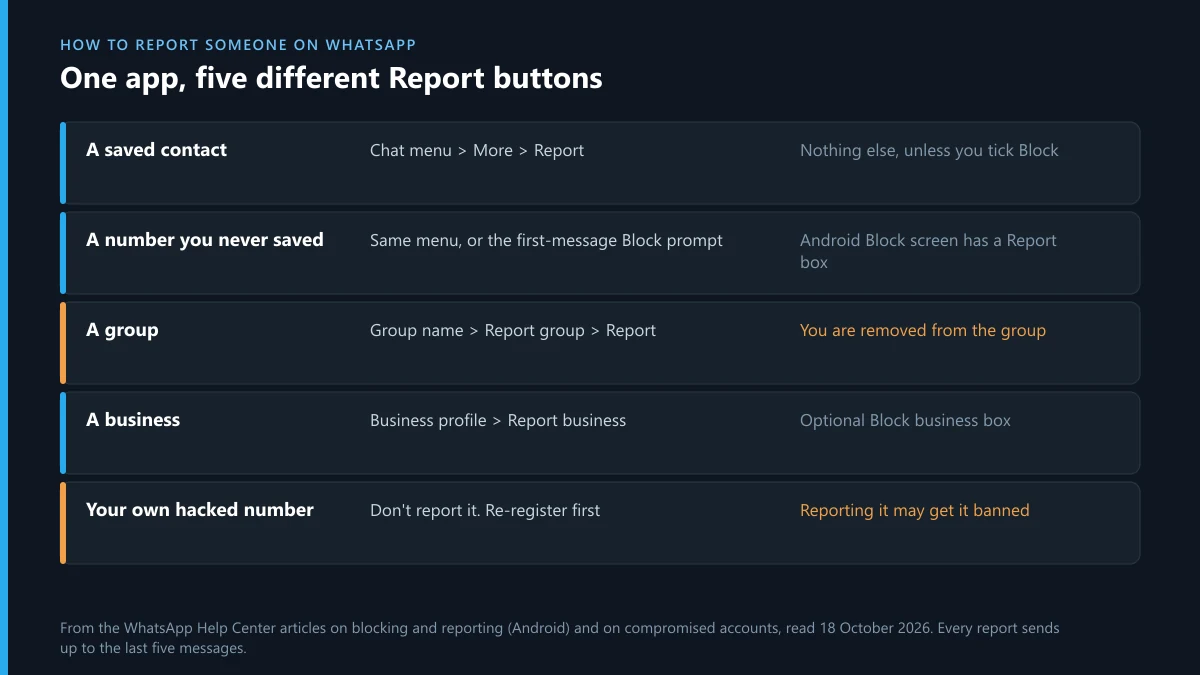
| In-app report of a contact, unknown number, group or business | The person who received the messages | Which Report button fits, and a reminder to screenshot before blocking or leaving a group |
| Evidence file | You, with the helper | Dated screenshots, the number in full international form, payment receipts, a one-page timeline |
| Copyright or trademark claim | The rights holder or an authorised agent | A draft for WhatsApp's IP contact form that names the profile photo, name or Channel content |
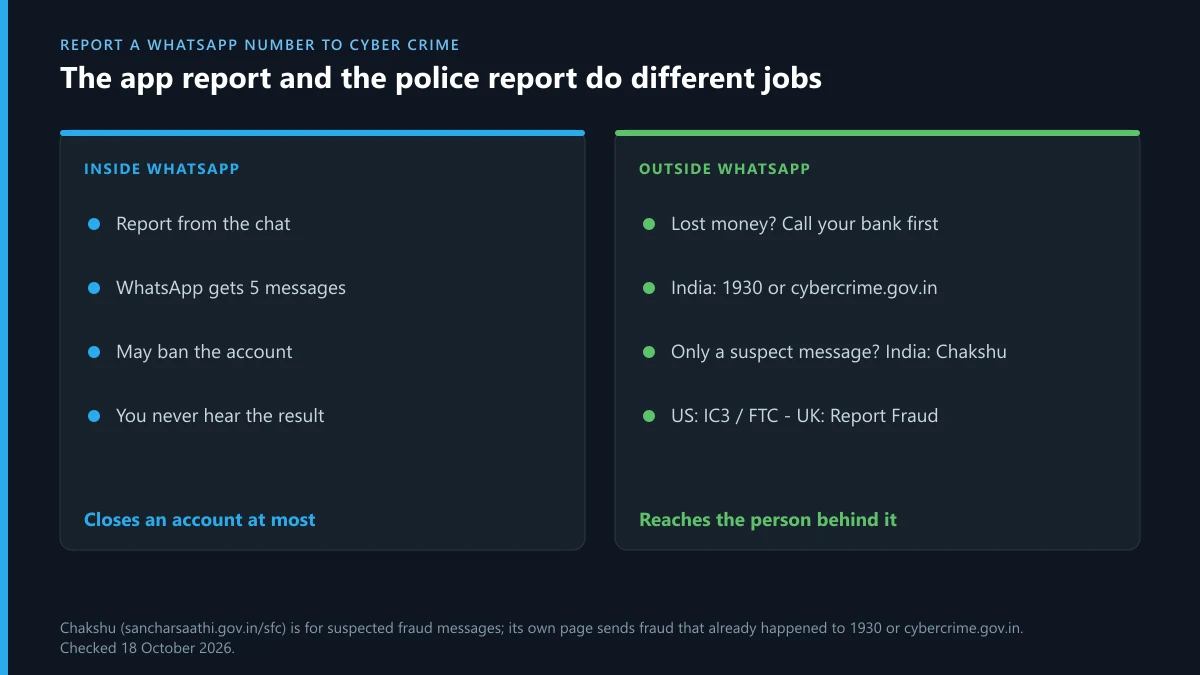
| Police or fraud report | The victim | A timeline officers can act on, and the note that WhatsApp answers law-enforcement requests |
| Telegram channel selling "WhatsApp bans" | Telegram Ban Service | One report through Telegram's official route, with your proof of the sale |
Only the last row is a filing the desk makes itself, because it concerns Telegram, not WhatsApp. For the first four rows, the platform or the police decides; the adviser never claims a faster lane.
How a WhatsApp account takedown case is handled, from first message to outcome
A WhatsApp account takedown request moves through six steps, and the victim keeps control of the two that reach WhatsApp. This is the process passage the desk follows for every WhatsApp case it accepts.
- You send the number, screenshots and a short account of what happened. Nobody asks for your WhatsApp code, password or backup.
- The conduct is checked against WhatsApp's Terms and the law where you live. Spam, scams, threats, impersonation of a brand and infringing profile photos pass; an argument with an ex or a bad review does not.
- The route is chosen: the in-app report, the IP form, a police or fraud report, or a mix.
- You report from the chat on your own phone, while the messages are still there.
- WhatsApp acknowledges the report and, by its own wording, will not contact you again, so you never learn the result directly.
- If money left your account, the bank and the police come first; an in-app report closes an account at most.
One timing fact matters for step 6. WhatsApp's law-enforcement guidance says it does not store messages once delivered, deletes undelivered ones after 30 days, and preserves account records for 90 days when officers ask. Your phone holds the only copy of the chat, so export it before anything else.
Where do copyright and trademark claims fit on WhatsApp?
A copyright or trademark claim is the one WhatsApp route that a rights holder, rather than a chat participant, can start. WhatsApp's Intellectual Property Policy explains why: the company does not retain users' messages in the ordinary course, but it does host each account's profile picture, profile name and about text, plus content posted on Channels. Those hosted parts can infringe.
So a shop whose logo appears as the profile photo of a fake "support" number has a path that no stranger has. The policy offers a contact form for each claim type, and copyright claims can also go to WhatsApp's designated Copyright Agent. Under its repeat infringer rule, an account "may be banned," and the same rule covers Channel suspension. Telegram Ban Service drafts these claims for rights holders; the rights holder signs and sends them, and WhatsApp decides. If you have filed on other networks, the logic matches the copyright form Instagram uses for DMCA notices and X's DMCA notice and email rules.
What we decline, and why whatsapp number ban service ads don't add up
A whatsapp number ban service that promises a set price per number is selling volume, and WhatsApp's review does not run on volume. Telegram Ban Service turns these requests down every time:
- Takedowns of rule-abiding people: former partners, critics, rival sellers, reviewers.
- Mass reports, report bots, or "report squads" from many numbers.
- Fake lost-phone or deactivation requests sent to WhatsApp in someone else's name.
- Any request for a password, a six-digit code or a backup key.
- Guaranteed bans, and any deadline WhatsApp itself has not published.
Most of those ads live on Telegram, often in channels that rotate handles bought on the Telegram username auction market. A quick check of whether a seller's handle is free, sold or held shows when a "veteran" account was registered last week. If the channel you paid suddenly shows the notice that a channel cannot be displayed, Telegram may already have restricted it. Handed a login code to one of these sellers? Start with recovering a hijacked Telegram account, then report the seller.
How do the same limits look on X, Instagram and Telegram?
The same rule holds across networks: the platform decides, and a helper can only file where the platform accepts outside filings. X and Instagram run web forms for impersonation, privacy and IP that an authorised agent may use, which WhatsApp mostly does not. That gap is why the Twitter ban service guide to what can legally be filed and the look at what happens after you pay an Instagram ban service describe more agent work than this page can.
For removal rather than a ban, compare the account removal options X offers, the Instagram removal limits, form by form, and the step that comes first on X: matching the account to a specific X rule. On Telegram, impersonators often buy lookalike handles, so it helps to know how people buy Telegram usernames on Fragment and what owners keep when they sell a Telegram username.
FAQ
Is a WhatsApp ban service legit?
Some are legitimate advisers, and none can ban a number. WhatsApp's Help Center says third party services can't ban an account or lift a ban; only WhatsApp can. It also says the in-app process is the only way to report someone, and that contacting WhatsApp outside that process won't speed a review or change the result. A legitimate WhatsApp ban service therefore sells advice: which Report button to use, how to keep evidence, whether a copyright or trademark claim applies, and how to write up a police report. It does not sell a ban, and it never asks for your password, your six-digit code or a backup key. Test any offer against that line. If the seller names a fixed price per number, promises a deadline, or talks about report counts, it is describing something WhatsApp says does not work, and the money is the only thing that changes hands.
Can a whatsapp number ban service ban someone with mass reports?
No. A whatsapp number ban service built on mass reports misunderstands what a report carries. Each in-app report sends WhatsApp up to five of the last messages the reported person sent to the reporter, basic details of the last five calls, and timing data. A number that never chatted with the target has nothing to forward. WhatsApp also says a report of a Terms violation won't necessarily lead to a ban, and it catches many accounts itself: in August 2026, 27% of the Indian accounts it banned were removed before any user report, according to its own monthly report. Volume can also backfire, because organised false reporting is itself abuse of the service. If the person really is scamming or threatening people, one report from someone who received those messages is worth more than any number of strangers' clicks.
How long does a WhatsApp number takedown take?
WhatsApp publishes no timeline for acting on a report, so any seller who quotes one is guessing. What the Help Center does say is that after a report you don't need to share more details, and that WhatsApp will acknowledge receipt but won't contact you again. You may never be told whether a WhatsApp number takedown happened; the clearest sign is that the number stops appearing as an active account, which can also mean the owner left. The one published window people confuse with this belongs to the other side: a banned user who taps Request review sees that most reviews are completed within 24 hours. That clock covers appeals, not reports. Plan on silence, keep your own copies of the chat, and if money or safety is involved, run the bank and police steps in parallel instead of waiting on WhatsApp.
Will the person know I reported their WhatsApp account?
No, not from WhatsApp. The Help Center states that the user or group won't be notified when you report them. They may notice other things: if you also block them, your profile photo, last seen and status updates stop showing to them, and if you report a group, you are removed from that group, which other members can see as you leaving. On Android, the Block screen has a Report to WhatsApp box already ticked, so blocking can send a report unless you untick it. If you fear retaliation, think about what the person can infer from those side effects, not from the report itself. Where there are threats, contact local emergency services first, as WhatsApp's own guide advises, and keep the chat on your phone rather than deleting it, because it is your evidence.
What does a whatsapp account takedown cost?
Reporting costs nothing. The in-app report is free, WhatsApp's copyright and trademark contact forms are free, and so is a police report. What you might pay for is time from an adviser who organises evidence or drafts an IP claim, and that fee should be for the work, never for an outcome. Any price list for a whatsapp account takedown per number signals a seller who cannot deliver it, because WhatsApp states that third parties cannot ban accounts. Watch for payment requests in crypto or gift cards, deposits paid before anyone has seen your evidence, and refund promises tied to a ban. If you have a genuine IP case, a trademark lawyer may be worth the cost where large sums are involved. For a scam number that took money from you, the bank and the police are the routes that can get anything back.
Can a business get a fake WhatsApp number using its logo removed?
Often, yes, through the intellectual property route. WhatsApp's IP Policy says it hosts each account's profile picture, profile name and about text, and content on Channels, even though it does not keep messages. A fake support number that uses your registered logo or your copyrighted artwork in those fields can be reported through the trademark or copyright contact form linked from that policy. The rights holder, or someone authorised to act for them, files the claim. Repeat infringers' accounts may be banned and Channels may be suspended, per the same policy. Ask your customers to report the number from their chats as well, since their messages carry the scam evidence that an IP form cannot. Keep screenshots of the profile with the date visible, because the scammer can change the photo within minutes once a claim lands.
I already paid a WhatsApp ban seller on Telegram. What now?
Treat it as a scam report, not a lost order. First, if you gave the seller any login code, secure that account right away: on Telegram, end other sessions and set a cloud password; on WhatsApp, re-register the number and turn on two-step verification. Then contact your bank or card issuer about the payment and ask what dispute options exist. Keep the receipts, the seller's @username and the channel link. The channel itself can be reported to Telegram for fraud, and that report is the one filing a Telegram reporting desk can make on its own. File a fraud report with your national police or consumer authority too. Do not pay a second person who promises to recover the money, since recovery offers are a common follow-up scam aimed at people who were already cheated once.