24 October 2026 · Telegram Ban Service · 11 min read
How to report harassment on Facebook, and why some reports only count from the target
Open the post, comment, profile, Page or chat, tap the three dots, choose Report, then Bullying or harassment. That's the whole route. The catch is who presses it: for many attacks on private adults, Meta's policy removes the content only when the target or someone acting for them reports it.
Most guides on how to report harassment on Facebook stop at the menu. The menu is the easy part. The part that decides whether anything happens is buried in Meta's Bullying and Harassment policy, last changed on 23 September 2026. It sorts people into four tiers, and for a long list of attacks it says the target has to report. A friend reporting on your behalf can hit a wall that you wouldn't. We read the policy line by line on 24 October 2026 and checked Facebook's own help pages for each place harassment turns up. This page follows that order: where to press, then who should press it.
How to report someone for harassment on Facebook, step by step
The steps are nearly the same for a post, a comment and a profile. To report someone on Facebook for harassment:
- Go to the thing itself: the post, the comment, or the person's profile. For a profile, open it and tap the three dots under the cover photo.
- Tap the three dots and choose Report (on a profile it's Report profile).
- Pick Bullying or harassment. If the post threatens violence, pick that instead; threats go to a different team.
- Say who is targeted: Me, A friend, or someone else. This answer matters more than it looks, for the reason in the next section.
- Submit, then block. Blocking stops them seeing what you share and messaging you.
If you want to report someone on Facebook for harassment and bullying across many posts, report the profile, then report the two or three worst posts separately. A profile report alone asks Meta to judge the whole account; post reports give it something specific to remove. Before you block, screenshot each post with the date and the profile link showing, because blocking hides their content from you.
Who has to file it? Meta's four protection tiers
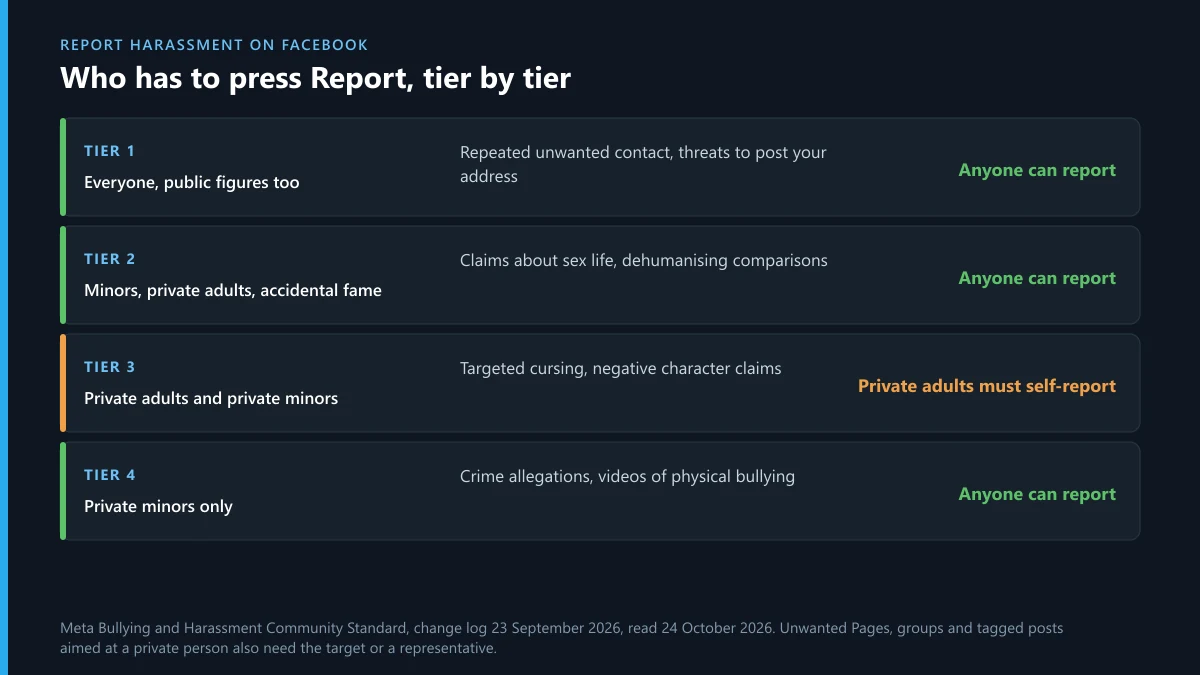
Meta's policy says that "in certain instances, we require self-reporting because it helps us understand that the person targeted feels bullied or harassed." The Bullying and Harassment Community Standard sets out which instances. The short version:
| Tier | Who it protects | Examples it covers | Who must report |
|---|---|---|---|
| 1 | Everyone, public figures included | Repeated unwanted contact, calls for self-harm, threats to post your address or phone number, attacks over sexual assault | Anyone |
| 2 | Minors, private adults, people famous by accident or for activism | Claims about sex life, dehumanising comparisons, ranking people by looks, harassing pranks | Anyone |
| 3 | Private adults and private minors | Targeted cursing, claims about sexuality, "everyone should block her", negative character claims | Private adults must self-report; some items need a self-report for everyone |
| 4 | Private minors only | Allegations of crimes, videos of physical bullying, gendered slurs | Anyone |
There's a second self-report rule on top of the tiers. Unwanted Pages, groups and events aimed at a private person, posts that tag the target, sexualised content about a public figure and sexually harassing messages come down "when it is reported by the target or an authorized representative." A parent counts as a representative for a child. A colleague who is angry for you doesn't.
So when you're the target, report it yourself and pick Me. When you're helping someone, show them the steps rather than filing in their place. That one change, more than any wording in the report, is what flips a "doesn't go against our Community Standards" reply.
How to report a Facebook account for harassment, not just one post
A report on a single post removes that post. To get the account itself restricted, Facebook needs a pattern. Use Report profile, choose Bullying or harassment, and then report the worst individual posts so the reviewer sees the pattern. Meta's policy also lets it disable accounts that are part of "directed mass harassment" by organised networks, and it removes mass-harassing content sent to your inbox or profile. If one person runs several throwaway accounts, report each, and say so in any free-text box you get.
Two account types go to other routes. An account that poses as you is impersonation, not harassment; Facebook has a separate impostor form, and the same logic runs through the four ways to report an impersonator on X. An account that posts your address or phone number falls under privacy; X's private-information report shows how that route differs from a harassment report. When reports keep failing against an account that plainly breaks the rules, a managed case like our Instagram account removal service is the comparable route on Meta's sister app.
How to report harassment on Facebook Messenger
Messages are reported as a whole conversation, not one message at a time. Facebook's Report a conversation page gives these steps on a computer:
- Open the conversation.
- Click the person's or chat's name at the top.
- Scroll down and click Report.
- Pick a category, such as Bullying or harassment, then Done.
The page is plain about two things: "We won't let the person know who's reported them," and a report "won't be created" for technical problems or false information. In the Messenger app the path is the same idea: tap the name, then Report. Facebook defines harassment in messages as "repeatedly contacting a person despite that person's clear desire and action to prevent contact", so tell them once to stop, in writing, before you report. That message becomes proof that the contact was unwanted, which the Tier 1 rule turns on. Then block. If messages start arriving from new accounts after you block, report each one; repeated contact across accounts is exactly the pattern the policy names.
Harassment from a Page, a group, or on your business page
A Page or group set up to mock a private person is covered by the self-report rule above: it comes down when the target or their representative reports it. Open the Page, tap the three dots, choose Report Page, and say it targets you. That is how to report bullying on a Facebook page when the whole Page is the attack. For one bad post on an otherwise normal Page, report the post instead. The same split, whole account against one post, is laid out for Instagram in reporting a whole Instagram page.
If you're asking how to report harassment on a Facebook business page you run, you have tools a normal user doesn't. As an admin you can hide or delete comments, ban a person from the Page, and turn on profanity filtering, then report the person as well. Hidden comments stay visible to the poster and their friends, which often stops the escalation. When the harasser runs a copycat Page using your business name, a trademark report is usually faster than a harassment one; Meta's trademark report for Instagram and X's trademark route both show what the form asks for.
Can you file a page harassment report on Facebook anonymously? As far as the other side goes, yes. Facebook's help pages say the reported person or Page isn't told who filed. The one exception is a report sent to a group's admins rather than to Facebook, because admins see who sent it.
Is there a Facebook harassment report form outside the app?
Not a general one. People search for a facebook harassment report form or a facebook harassment reporting form expecting a web page like a police form. For harassment, the Report menu in the app is the form, and each facebook harassment report is filed from the content itself. Meta keeps separate web forms only for narrower cases: an impostor account, a private image or a photo of you posted without consent, defamation, and copyright. If you don't have a Facebook account, or you've been blocked, Facebook's advice is to ask a friend to report it, with the caveat about self-reporting above. Meta's full set of legal forms sits in one directory; Meta's legal request forms lists which form takes which complaint. When the harassment reuses your photos or writing, a copyright notice can work where a harassment report doesn't, as in filing a DMCA notice on X.
How to report cyberbullying on Facebook when the target is a child
Children get the most protection in the policy. Tier 4 covers private minors only, and it removes things that would stay up about an adult: claims that a child committed a crime, videos of a child being physically bullied "shared in any context", and gendered slurs. Meta also says its policies "provide heightened protection for anyone under the age 18". To report cyberbullying on Facebook as a parent, use the same Report steps and choose Someone else, then say the person is a minor. As the child's parent you count as an authorised representative for the self-report items.
Save the posts first, then report, then block. Talk to the school if classmates are involved; most cyber bullying on Facebook between pupils is also a school discipline matter, and schools can act faster than any report queue. Meta's Bullying Prevention Hub has guides for parents and teachers on starting those conversations.
How often Facebook acts on harassment, by its own EU record
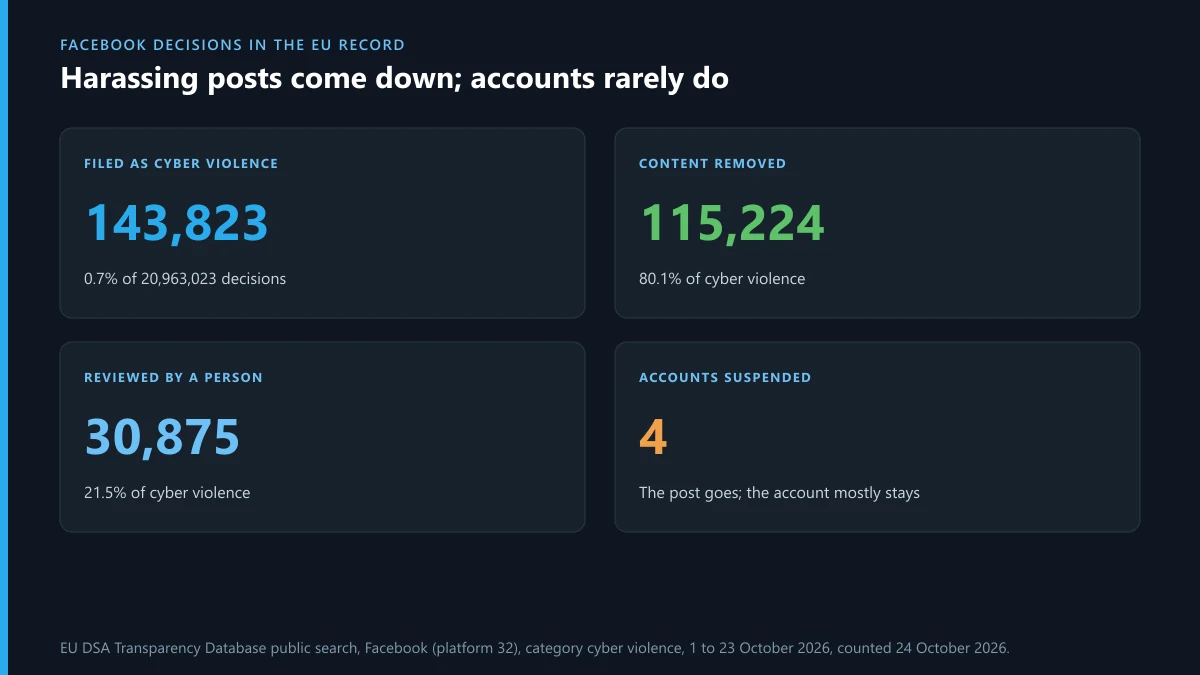
Meta files every moderation decision on Facebook for EU users in the DSA Transparency Database. The category there is "cyber violence", which covers harassment, bullying and stalking. We counted 1 to 23 October 2026 on 24 October:
- All Facebook decisions: 20,963,023.
- Filed as cyber violence: 143,823, about 0.7%.
- Content removed: 115,224 of those.
- Reviewed by a person rather than automatically: 30,875, about 21%.
- Started by a formal legal notice under Article 16: 1,608.
- Accounts suspended for it: 4.
The last line is the useful one. Facebook removes harassing posts by the hundred thousand and almost never suspends the account behind them for it. A report usually takes the post away, not the person. That's why the account section above tells you to report the pattern, and why a police report sometimes matters more.
When a Facebook harassment police report should come first
Go to the police before or alongside Facebook when there's a threat to hurt you, someone turns up where you live or work, the person threatens to share intimate images, or a child is being sexually approached. Those are crimes in most countries, separate from Facebook's rules. In England and Wales the Protection from Harassment Act 1997 covers a course of conduct, and the Online Safety Act 2023 added a threatening communications offence. In the US, federal law makes cyberstalking a crime under 18 U.S.C. § 2261A, and every state has its own harassment law.
For a facebook harassment police report, bring screenshots that show the date, the profile URL and the content, plus any message where you asked them to stop. Don't delete the conversation; police can ask Meta for account records through its law enforcement portal, but only for what still exists. If they ask you for the profile link, copy it from the browser, not the app, so the numeric ID is included. And if you're in immediate danger, Facebook's own help page says the same thing we do: call the local police first.
How to report harassment on Facebook and other social media platforms
Harassment rarely stays on one app. On Instagram, the rules are Meta's same policy with a different menu, set out in reporting harassment on Instagram, from comments to DMs. If the same person also runs a fake shop or money scheme there, Instagram's scam report route is the better door. On X, the impersonation and private-information routes linked above cover most cases.
When it moves to Telegram, harassers often grab a username that copies yours. checking whether a Telegram username is free tells you if a copycat handle exists, and if you'd rather not keep a handle someone is chasing, selling a Telegram username on Fragment explains the fees. A login screen suddenly flooded with codes you didn't request is often someone trying your account; the Telegram "Limit exceeded" error explains what it means and how long it lasts.
FAQ
Will the person know I reported them for harassment on Facebook?
No. Facebook says it won't tell the person who reported them, for posts, profiles and conversations. The exception is reporting a post to a group's admins instead of to Facebook, because admins see who sent it.
Why did Facebook say the harassment doesn't break its rules?
Often because the wrong person reported it. For many attacks on private adults, such as targeted cursing or claims about sexuality, Meta's policy acts only when the target reports. Report it yourself and choose Me as the person targeted.
Can I report harassment on Facebook for a friend?
Yes, but it may not count for every type. Tier 1 and Tier 2 attacks can be reported by anyone. Many Tier 3 attacks on private adults need the target or an authorised representative, such as a parent or lawyer, to report.
Can I report harassment on Facebook without an account?
Not through a general form. Facebook asks people without an account, or who have been blocked, to have a friend report it. Separate web forms exist only for impostor accounts, private images, defamation and copyright.
Does reporting a harassing account get it banned?
Rarely on the first report. Facebook usually removes the posts and keeps the account. In the EU, from 1 to 23 October 2026, it filed over 140,000 harassment and bullying decisions and suspended only a handful of accounts for them.
Should I delete harassing messages after I report them?
No. Keep them, and screenshot them with the date and profile link. Police can ask Meta for records, but only for what still exists, and your own copy is the fastest proof.
How do I report a Facebook group made to bully someone?
Open the group, tap the three dots, choose Report group, and say it targets a specific person. A group aimed at a private person is removed when the target or their representative reports it.