10 October 2026 · Telegram Ban Service · 13 min read
How to report impersonation on Twitter, from the first screenshot to X's decision
To report impersonation on Twitter, screenshot the fake profile first, then file X's impersonation form if the copy is of you or someone you represent, or use Report on the profile if you're a bystander. The form starts with an ID and selfie check. X then suspends the copy or makes it change.
The typical case looks like this: an account with your name, your headshot and one swapped letter in the handle, replying to your followers with a "refund" link. Most people press Report on the profile, pick whatever reason looks closest, and wait. Reports like that often go nowhere, and not because X ignores impersonation. They go through the wrong door, without the evidence that door asks for, from someone X doesn't treat as the injured party. When we reread X's impersonation help page on 10 October 2026, it described copies of you as something that "may result in permanent account suspension". Getting there depends on three choices you make before you file: who you are to the person being copied, what proof you keep, and which form you open. Searches for how to report Twitter impersonation rarely mention the first one, so this page takes the choices in the order you'll face them.
What does the Twitter impersonation policy count as impersonation on Twitter?
An account crosses the line when it poses as a real person, group or organization in a way that could fool people. X's help article calls it posing "in a confusing or deceptive manner", and the April 2025 X Authenticity policy now holds the rule. Sharing a name isn't enough, and neither is a funny take on someone. What X looks at is whether an ordinary visitor would believe the account is the real one. Most impersonation Twitter users run into falls into three groups: copies of private people aimed at their friends, fake celebrities pushing giveaways, and fake company support desks.
Why do the best Twitter impersonations and memes stay up?
That's why the twitter impersonation policy and the meme culture around it can coexist. The best Twitter impersonations people share, the parody presidents, the fake brand accounts with absurd tweets, survive because they tell you they're fake. X's rules for parody, commentary and fan accounts ask for four things together: the PCF label switched on in account settings, a profile photo that isn't identical to the real one, a word like "parody" or "fan" at the start of the display name, and the same word in the bio.
| What the account does | How X tends to treat it |
|---|---|
| Same name, photo and bio as you, replying to your followers | Impersonation; report it |
| Your photos under a different name, posing as a new person | A fake persona under the same policy |
| "Parody" in name and bio, PCF label on, different avatar | Allowed, even if it's harsh |
| Parody wording in the bio only, copied avatar | At risk; one missing element can be enough |
| Twitter impersonation memes reposting a screenshot of a famous fake | Usually just commentary; nobody is being posed as |
| "Support" account using a company's logo to collect logins | Impersonation and a scam; report both |
How to report impersonation on Twitter in four moves
Save the evidence, choose the door, pass the identity check, then wait for the reply email. In that order, because the copy can change its name or delete posts the moment it notices you. Whether you want to report a Twitter account for impersonation of yourself or of someone you work for, the moves are the same.
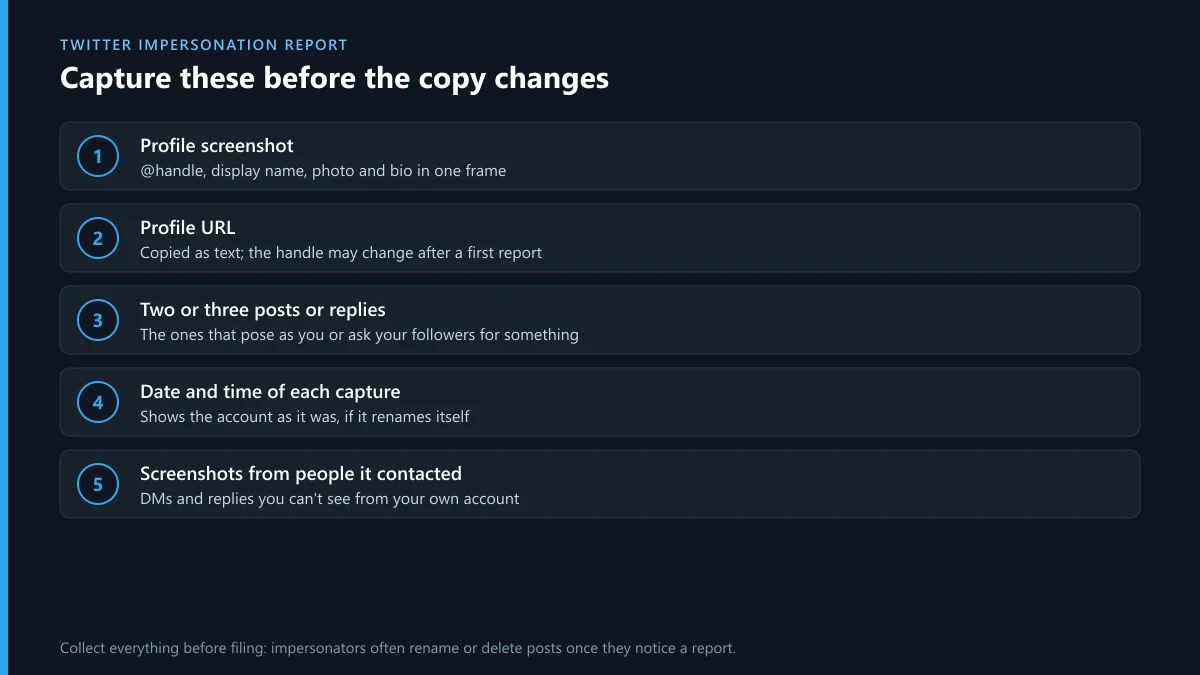
- Capture the account before it changes. Screenshot the profile with the @handle, display name, photo and bio visible, then two or three posts or replies that show it pretending to be you. Copy the profile URL. Impersonators often rename themselves after the first report, so write down the date and time of each capture.
- Pick the door that fits who you are. If the copy is of you, or of a person or brand you're authorized to act for, use X's impersonation report form. If you're a bystander who spotted a fake of someone else, X has no form for you; report from the account's profile menu instead.
- Get through the identity check. Each branch of the form starts with a government ID and a selfie checked by Persona, a verification company. X says it usually takes about five minutes, and Persona may keep the data for up to 30 days. If your own X account is the one being copied, the form asks you to sign in to it first.
- Watch your email, not your notifications. The answer to a form report arrives by email. X investigates and either suspends the copy or makes its owner change it so it no longer poses as you.
A twitter impersonation report filed by the person being copied carries more weight than ten reports from friends. The help page says it plainly: "you or your authorized representative can file a report". If you're curious what the other side is told, what the reported account learns after a report on X covers the notices, and X's form tells the company branch that the reported user may be given details.
Someone is impersonating me on Twitter: what should I do first?
Secure your own account, warn your followers from it, then file. People skip the first two and lose more than the report gains. A copy usually exists to borrow your trust, so the damage happens in DMs and replies before X looks at anything.
Turn on two-factor authentication and check the sessions list in your X security settings, because some copies start as a phishing attempt on the real account. Post once from your real profile: name the fake handle, say you'll never ask anyone for money or codes in DMs, and pin it. Ask two or three people who were contacted to send you screenshots; they make better evidence than your own captures. Then file through the form. If the impersonator moved to other apps, deal with each one separately. A copy of you on Instagram has its own route, described in dealing with someone impersonating you on Instagram, and a fake that has taken over your real Telegram account needs getting a hijacked Telegram account back before any report makes sense.
One note on what not to do: don't message the impersonator, and don't ask friends to mass-report it. That second one can backfire, as the next section explains.
Which route fits which kind of impersonator?
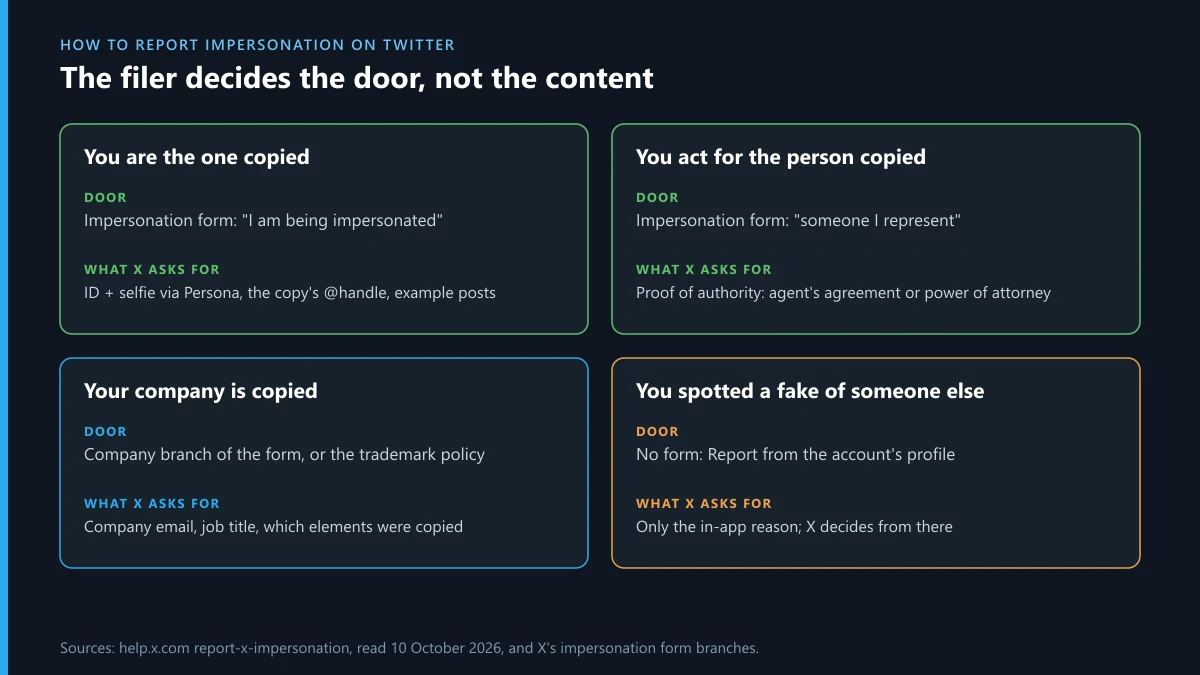
It depends on who is being copied and what the copy is for. When you report impersonation on Twitter, the filer decides the door more than the content does.
| Who is being copied | Who should file | Where | What X asks for |
|---|---|---|---|
| You | You | Impersonation form, "I am being impersonated" | ID and selfie, the copy's @handle, example posts |
| A client, relative or public figure you act for | Their representative | Impersonation form, "someone I represent" | Proof of authority, such as an agent's agreement or power of attorney |
| Your company or brand | An employee or the company's agency | Company branch of the form, or the trademark policy | Company email, job title, which elements were copied |
| Someone you don't know | Anyone, as a bystander | Report button on the profile | Nothing beyond the in-app reason |
| Nobody real; it's a stolen-photo persona | The person whose photos were used | Impersonation form, or a copyright notice for the photos | The original images |
One trap: if you use the profile menu to report Twitter account for impersonation of yourself, you've walked through the bystander door, and X gets less to go on than the form would give it. Reports don't add up the way people hope either. X counts coordinated or paid reporting as engagement spam under the Authenticity policy, which is the risk behind the Telegram bots that sell Twitter mass reports. A single report from the right filer, with screenshots, does more. If the copy also harasses or threatens people, it may break other rules, and matching a hostile X account to the rule it breaks helps you add those grounds. The steps X takes before suspending an account explain why a first violation sometimes ends in a forced profile change rather than a ban.
Why do impersonation reports barely show up in X's own numbers?
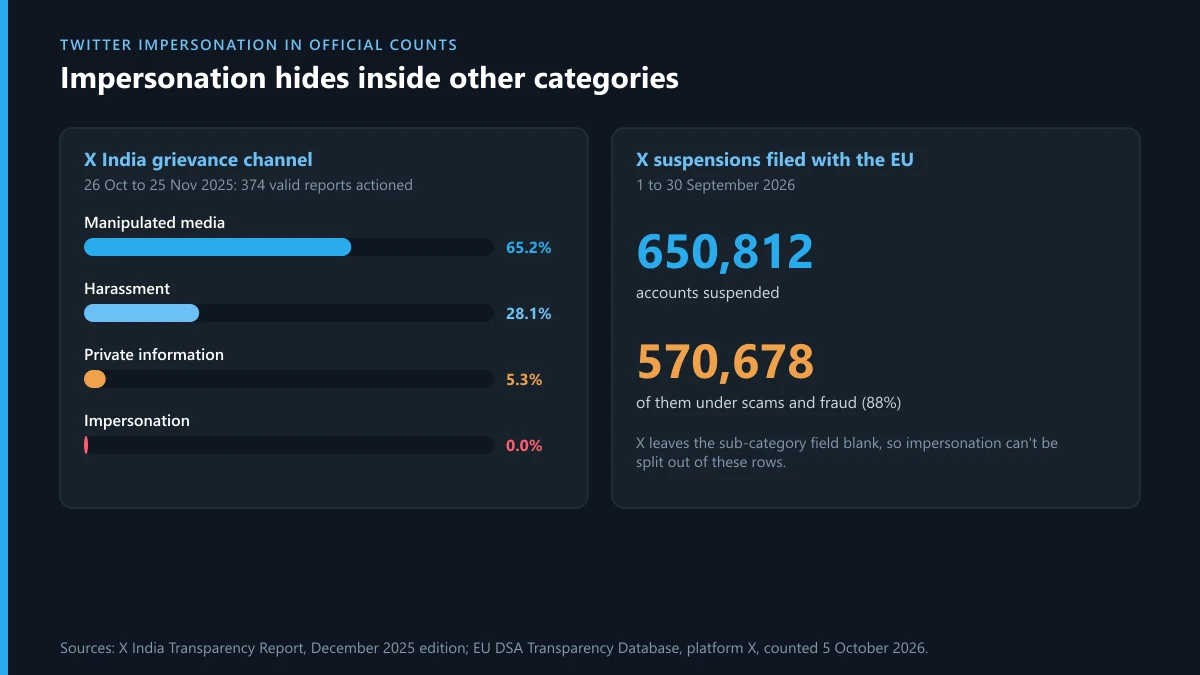
Because they're filed and recorded through other channels. X's India transparency report for December 2025 covers 26 October to 25 November 2025. Its grievance channel received 1,323 reports, and "alleged impersonation" was 0.0% of them. Impersonation was also 0.0% of the 374 valid reports X actioned, while harassment was 28.1% and manipulated media 65.2%.
That doesn't mean nobody in India was impersonated that month. X's report explains that it leaves out account-related requests, and that content actioned under a different policy from the one reported is recorded under that other policy. Impersonation reports go to the dedicated form, not the grievance address, so they never reach this table. The EU picture looks similar. X files its account suspensions with the EU's DSA Transparency Database, and in September 2026, 570,678 of its 650,812 suspensions sat under scams and fraud, the category many fake support and celebrity accounts fall into. The practical lesson: an impersonation complaint sent to a generic inbox or a legal address tends to vanish. Send it to the form built for it.
Does Twitter Blue make impersonation easier to get away with?
It did once, and the checkmark still isn't proof of identity. In November 2022, when Twitter Blue first sold blue checks for $8 a month, verified fakes of brands and public figures spread within days, and Twitter paused sign-ups before relaunching in December. Twitter blue impersonation became a news genre of its own, and plenty of the best Twitter impersonations people still trade as memes date from that week.
The rules now work a little differently. A blue check comes with X Premium, and X's page on verified accounts says those accounts "will not undergo review" for being notable or authentic. What X added is friction: changing your display name, profile photo or @handle costs a temporarily lost checkmark until X validates the account again. So a copy that renames itself to look like you loses its check for a while. In December 2025 the European Commission fined X €120 million under the Digital Services Act, partly over the blue check misleading users, and X is appealing. In a report, treat a checkmark on the copy as one more sign it was built to deceive.
How do you report Twitter brand impersonation?
Two documents point different ways, so pick on purpose. People typing twitter report impersonation for a company usually find only one of them. X's impersonation help page tells companies to file under the X trademark policy. The impersonation form, meanwhile, has its own company branch, which asks for a company email, a job title and which elements were copied: name, logo, contact details or content passed off as the copy's own. It doesn't ask for a trademark registration number.
Use the trademark route when you hold a registered mark and the account uses it in a confusing way, such as a fake shop under your logo. A pending application isn't enough there. Use the company branch of the impersonation form when the copy poses as your organization, such as an "@YourBrandHelp" account answering customer complaints with a phishing link. When we reread both pages on 10 October 2026, we found the help article still sending companies to the trademark policy while the form kept its own brand branch, so neither page alone gives the full picture. For twitter brand impersonation that's both, file both and cross-reference them. Marketing agencies and law firms can file for a client, and the form asks whether you're one.
Twitter account suspended for impersonation: how do you get it back?
Fix the profile, then appeal. Most accounts suspended for impersonation are fan, parody or tribute accounts missing one of the four labels, or new accounts that copied a famous name too closely. X's Authenticity policy usually starts with a required profile change and moves to suspension on repeat breaks; severe cases can be suspended permanently the first time.
If X locked you out with a request to edit the profile, do it in full: switch on the PCF label, change the avatar, put "parody" or "fan" at the start of the display name and in the bio. If the account is fully suspended, file an appeal through X's account access appeal form and say exactly what you've changed or will change. An appeal that argues the account was obviously a joke rarely works; one that shows the labels now in place does better. If the suspension came from a wave of hostile reports, how Twitter ban services operate and where they stop is worth reading to recognize the pattern.
Does reporting impersonation work the same on Instagram and Telegram?
The logic carries over from X; the forms don't. Instagram's impersonation route also wants the person being copied or their representative, plus an ID. If a copy turned up there too, a report on the Instagram person behind the account or a report against the whole Instagram profile is where to start. When the fake asks your followers for money, Instagram's scammer reporting fits better, and if it threatens to leak images, use the Instagram blackmail report route. Repeated abuse aimed at you belongs in Instagram harassment reports.
If the copy reposts your own photos, two rights-based routes exist: an Instagram DMCA notice for your own media, or a privacy request when a picture of you went up without consent. A brand copied on Instagram has Instagram's trademark complaint form, and court orders go through Meta's legal request channel. For single posts rather than whole accounts, see reporting one Instagram post. Reporters stay anonymous there with few exceptions, as whether an Instagram user finds out who reported them explains, and a mistaken report can be partly withdrawn through un-reporting an Instagram post.
The outcome is still Meta's decision. Paid offers look the same as on X: Instagram spam report bots, Instagram ban sellers and account removal services for Instagram can file reports, nothing more. What it takes for an Instagram account to be taken down and why nobody but the owner or Meta can delete an Instagram account set honest expectations.
On Telegram, impersonators often build a channel with your name and photo and then message your contacts. Report the channel from its profile, and check your own account: recovering a Telegram account you've lost covers logouts and number changes. And if an old Telegram account of yours sits on a phone number you've given up, deleting your own Telegram account stops anyone from picking it up and posing as you with your real history.
FAQ
Will the impersonator know I reported them?
X doesn't show the reported account who filed an in-app report. The impersonation form is different for companies: its company branch warns that X may share details of the report with the reported user, though it says your contact information won't be disclosed. If anonymity matters, have an authorized representative file.
How long does X take to act on an impersonation report?
X publishes no time frame. The reply to a form report comes by email, and X may ask for more details first. If nothing arrives after a week or two, file again with fresh screenshots rather than sending duplicates every day.
Can I report impersonation without an X account?
Yes. X's help page says you don't need an account to report impersonation, and the form works signed out. The one exception is when your own X account is the one being copied: the form then asks you to sign in to it.
Can I get the impersonator's username after it's suspended?
Usually not. X's help page says it generally doesn't accept individual requests for inactive or suspended usernames. Handle requests go through Premium Business support, and trademark holders can ask under the trademark policy.
Someone made an account with my email address. Is that impersonation?
Not on its own. X treats an email or phone number already in use as an account-access issue and has a separate help article for it. If the account also poses as you, report it through the impersonation form as well.
Can I report a fake account pretending to be a celebrity?
Yes, as a bystander from the account's profile menu. Only the celebrity or their representative can use the form, which is why fakes of famous people often last longer than copies of private users.
What if the fake account is using AI-generated photos of me?
X's Authenticity policy covers it. Its fake personas clause names stock, stolen and AI-generated profile photos and copied bios, so an account built from synthetic images of your face can be reported through the same impersonation form, with your real photos as comparison.
Is a parody account of me allowed?
It is if it follows X's parody rules: the parody label switched on, a profile photo that isn't yours, and a word like parody or fan at the start of the display name and in the bio. Missing any of those turns it into a reportable copy.