23 October 2026 · Telegram Ban Service · 10 min read
Libel on Facebook: can you sue the poster, and what does reporting it actually do?
Yes. Libel on Facebook is defamation in writing, and you can sue the person who posted it. You usually can't sue Meta, which US law shields under Section 230. Reporting is a separate track: Meta's defamation form only takes claims from the person named, and in many countries it won't act without a court order.
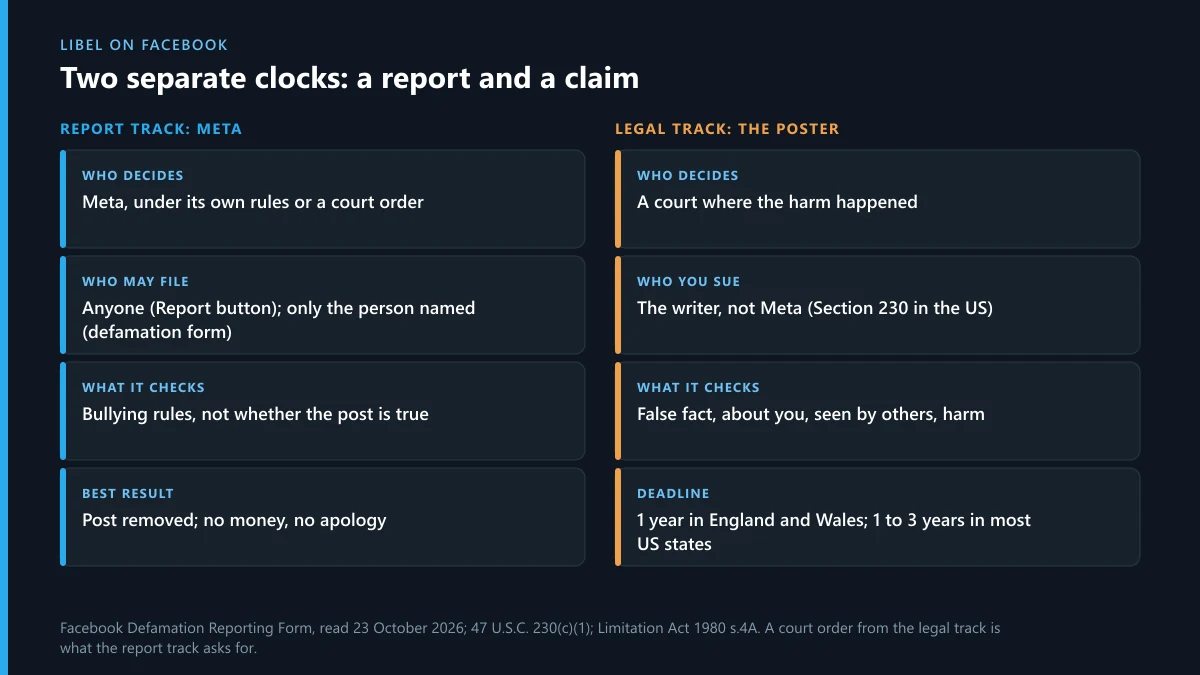
A false post about you sets two clocks running. One is Meta's: a report that may or may not take the post down. The other is the law's: a claim against the person who wrote it, with a deadline that can be as short as a year. People mix the two up, file a report, wait, and find the legal clock has nearly run out. On 23 October 2026 we went through Meta's defamation form field by field and counted what Facebook files as illegal speech in the EU. This page keeps the two tracks apart.
Is libel on Facebook the same thing as Facebook slander?
Not quite, though people use the words loosely. Libel is defamation in a lasting form, such as writing or a picture. Slander is spoken and passing. Almost everything on Facebook is written down, so a false post, comment, caption or review is libel. What people search for as Facebook slander is nearly always libel in legal terms. A live video is the grey case. In England and Wales, section 166 of the Broadcasting Act 1990 treats words in a broadcast as published in permanent form, and many US states treat broadcast defamation as libel too.
The name matters less than what you have to prove. The outline is similar in most common-law countries:
| What you must show | What it means on Facebook | Where it usually fails |
|---|---|---|
| A false statement of fact | "She stole from the till" is a fact claim; "she's a terrible manager" is opinion | Insults, jokes and opinions |
| It is about you | Named, tagged, or clear enough that people who know you recognise you | Vague posts with no way to tell who is meant |
| Someone else saw it | A post, comment or group message read by at least one other person | A private message sent only to you |
| Fault | In the US, carelessness for private people; "actual malice" for public figures under New York Times v. Sullivan (1964) | Public figures who can't show the poster knew it was false |
| Harm | In England and Wales, "serious harm" under section 1 of the Defamation Act 2013; businesses must show serious financial loss | A post seen by a handful of people and quickly deleted |
Is it illegal to slander someone on Facebook?
Usually it is a civil wrong, not a crime. So is it illegal to slander someone on Facebook? In the US and UK the person named sues for damages; the police don't prosecute it. A handful of US states still have criminal defamation laws, rarely used, and many countries outside the US and UK keep defamation in their criminal codes. The post can also cross into crime for other reasons. Threats, stalking, posting someone's address to get them harassed, or sharing intimate images all have their own criminal routes. If the false claims come with a threat, report to the police first and treat the defamation as a second issue.
Can you sue someone for slander on Facebook?
Yes. If the post meets the tests in the table, you can sue someone for slander on Facebook, or more precisely for libel, in the courts where the harm happened. The defendant is the person who wrote the words. So can you sue for slander on Facebook, and can you sue for libel on Facebook, in the same claim? You plead whichever the law calls it, and lawyers sort the label. Can you sue for defamation on Facebook against Meta itself? In the US, almost never. Section 230(c)(1) of the Communications Decency Act says a platform isn't treated as the publisher of what its users post. In Klayman v. Zuckerberg (2014), a US federal appeals court threw out a claim against Facebook on exactly that ground.
Outside the US the platform has less cover. In England and Wales, section 10 of the Defamation Act 2013 stops a court hearing a claim against anyone other than the author, editor or publisher unless suing the author isn't reasonably practicable. Two practical points apply everywhere:
- The clock. England and Wales give you one year from publication (Limitation Act 1980, section 4A). US states mostly allow one to three years; California allows one.
- An anonymous poster. You first need a court order making Meta hand over account details. That is a US subpoena or, in England and Wales, a Norwich Pharmacal order. Meta won't name a user because you ask.
Can you be sued for slander on Facebook as the one posting, commenting or sharing?
Yes. The same rules run the other way, so you can be sued for slander on Facebook for a post, a comment under someone else's post, or a review of a business. Can you be sued for libel on Facebook for sharing someone else's post? In England, Wales and Australia, repeating a defamatory claim counts as publishing it again. In 2021 Australia's High Court went further in Fairfax Media Publications v Voller. It held that media companies running public Facebook Pages were publishers of the comments readers left under their posts.
The usual defences are truth, honest opinion, and privilege for things like reports of court cases. In England and Wales these are sections 2 and 3 of the 2013 Act. "I was only asking a question" and "I deleted it after an hour" aren't defences, though a fast deletion and apology can cut the damages.
How to report slander on Facebook: two doors, two different tests
Meta has two ways in, and they ask different questions. How to report slander on Facebook depends on whether the post also breaks a Facebook rule.
| Door | Who can use it | What Meta checks | Typical result |
|---|---|---|---|
| Report button, reason "Bullying or harassment" | Anyone with an account | Facebook's Community Standards, not truth | Removed if it breaks a rule; you're not named to the poster |
| Defamation Reporting Form | The person named, their organisation, or their lawyer | Local law, by the country you pick | Often a reply that Meta can't decide truth and wants a court order |
| Court order sent to Meta | You or your lawyer, after a judgment | That the order is valid | Content restricted where the order applies |
The Facebook defamation report form is the one most people mean by a facebook defamation report. We went through it on 23 October 2026. It says a defamation report "must come from the injured person or their authorized representative". It takes up to 10 URLs, and for each one you explain the exact statements and why they are false. For a comment it asks for the post's link, the commenter's name and the date. It also asks which country you're claiming rights in. Depending on that answer, the form shows one of three warnings. Meta is "not in a position to adjudicate the truth or falsity" of posts. For the US it cites Section 230. In other countries it says it can't act without a court order.
So a facebook report slander attempt usually works best through the first door when the post is also bullying. If the post uses your business name, the trademark route can be faster; filing a trademark report with Meta walks through it on Instagram, which shares the same legal team. When the defamation comes with your photo, the privacy steps for a photo posted without your consent often succeed where the defamation form stalls. To see every legal channel Meta lists in one place, start from Meta's legal request forms for Instagram content.
How often does Facebook act on illegal speech in the EU?
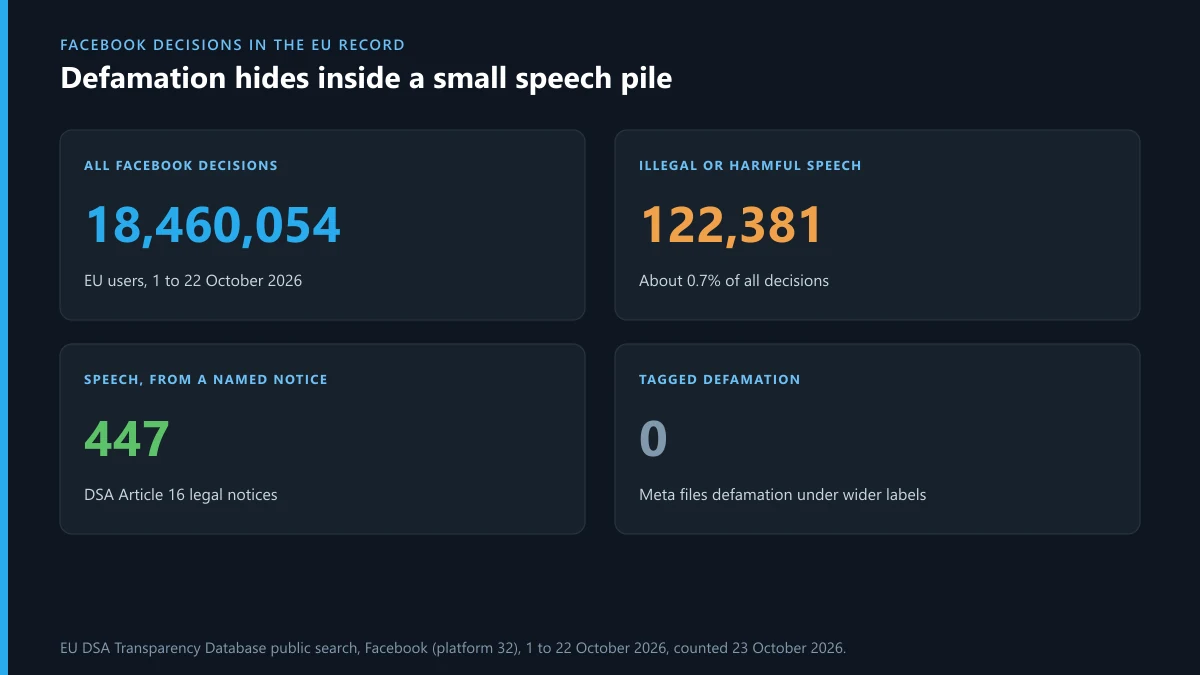
Rarely, by its own records. Meta files every Facebook moderation decision for EU users in the DSA Transparency Database. We counted 1 to 22 October 2026 on 23 October:
- All Facebook decisions: 18,460,054.
- Filed as illegal or harmful speech: 122,381, about 0.7%.
- Of those, started by a named legal notice under Article 16: 447.
- Tagged with the database's defamation keyword: 0.
The last line doesn't mean Meta removed nothing for defamation. It means Meta doesn't use that label. Defamation claims are filed under the wider speech heading, or handled as bullying under Facebook's own rules. That pattern fits the form: Meta prefers to act on a rule it wrote, or on a court's ruling, not on its own reading of who is telling the truth.
Facebook slander cases and Facebook libel cases that went to court
A few facebook defamation cases set the pattern courts still follow:
- Applause Store Productions v Raphael (England, 2008). A former friend set up a fake Facebook profile and group about Mathew Firsht and his company. The High Court awarded £22,000: £15,000 libel and £2,000 privacy to Firsht, and £5,000 to the company. It was reported as the first UK libel case over a social network.
- Mickle v Farley (New South Wales, 2013). A former student posted false claims about a music teacher on Facebook and Twitter. The court awarded $105,000, of which $20,000 was aggravated damages. That part was for ignoring the first lawyer's letter.
- Fairfax Media Publications v Voller (Australia, 2021). Page owners can be publishers of the comments under their posts.
- Klayman v. Zuckerberg (US, 2014). Facebook itself was immune under Section 230; the claim had to be against the users.
Read together, the facebook slander cases and facebook libel cases say the same thing. The writer pays, a deleted post still counts, and ignoring a lawyer's letter makes it worse. A quick takedown by Facebook never cancels the claim.
When does a Facebook defamation lawyer make sense?
When the post costs you something real: a job, clients, a custody dispute, or a business review that is plainly false. A facebook defamation lawyer usually does four things. They send a letter of claim or cease-and-desist, which in Mickle was the step the poster ignored. They preserve the evidence with dated captures. They get the court order that unmasks an anonymous account. And they win the judgment Meta's form asks for. Many offer a fixed-fee first letter, which often ends it.
Before you call one, save everything. Screenshot the post with the date, the profile URL and the comments, and copy the link. A post deleted after the poster gets your letter is still evidence if you captured it. Don't reply in the comments or post your side; that can turn one claim into two.
The same problem on X, Instagram and Telegram
False claims rarely stay on one network. On X, reporting a whole X account covers a profile built to smear someone. A fake one using your name goes through X's impersonation report, and posts that add your address go through the X private-information form. what the other side is told after an X report explains the notices. When the smear reuses your own photos or writing, a copyright notice can be quicker than a defamation claim. See sending a DMCA notice on X and a DMCA takedown on Instagram. On Instagram, what it takes to get someone else's Instagram account removed sets out which reports can end an account.
Harassers who move to Telegram often grab names that copy yours. checking whether a Telegram username is taken shows if a copycat handle is held or for sale, and if you hold the handle they want, how selling a Telegram username works lists the fees. If your Telegram login suddenly fills with codes you didn't ask for, read what the Telegram "Limit exceeded" message means.
FAQ
Can I sue Facebook for libel posted by someone else?
In the US, almost never, because Section 230 shields platforms from being treated as the publisher of users' posts. Elsewhere it's possible but harder than suing the author. In England and Wales, a court won't hear it against a platform if suing the author is reasonably practicable.
How long do I have to sue for libel on Facebook?
In England and Wales, one year from when the post went up. US states mostly allow one to three years, and California allows one. The clock usually runs from publication, not from when you found the post.
Will Facebook remove a post just because it's false?
Usually not on its own judgment. Meta's defamation form says it isn't in a position to decide whether posts are true. It acts when a post breaks a Community Standard such as bullying, or when you send a court order.
Can I find out who runs an anonymous account that defamed me?
Only with a court order. Meta won't name a user because you ask. A lawyer can seek a subpoena in the US, or a Norwich Pharmacal order in England and Wales, that makes Meta hand over account details.
Is a Facebook review of my business defamation?
Only if it states false facts that harm the business. A bad opinion, however unfair, is usually protected. In England and Wales a company must also show serious financial loss.
Does a deleted post still count as libel?
Yes. Publication happened when people saw it, so deleting it later doesn't undo the claim, though it can lower the damages. That's why screenshots with dates matter.
Can someone else report defamation about me on Facebook?
Not through the defamation form. It only accepts reports from the person named, their organisation or an authorised representative such as a lawyer. Friends can still use the Report button if the post is also bullying.
What does a Facebook defamation lawsuit cost?
It varies widely. Many lawyers do a fixed-fee first letter, and that often settles it. A full claim through trial can run into tens of thousands, so most cases end with a deletion and an apology.