8 November 2026 · Telegram Ban Service · 11 min read
TikTok Account Ban Service: What a Legitimate One Can Do
A TikTok account ban service can only prepare and file the reports TikTok already offers; TikTok alone decides a ban. Reviewers weigh the rule broken, not the report count, and strikes expire after 90 days unless a severe violation triggers a permanent ban on the first strike, according to TikTok's help center.
Buying a TikTok account ban service: what is on sale?
Mostly labour, not power. Anything sold as a TikTok account ban service is paperwork that leads into TikTok's own review queue, and nothing more.
Every honest version does the same few jobs. It reads the account, names the specific Community Guidelines rule or law the account breaks, gathers screenshots and links, and tells the client which TikTok route fits: the in-app report, the impersonation webform, or the intellectual property forms for rights holders. Some prepare the paperwork and let the client file, because several routes ask for the harmed person's own identification. Telegram Ban Service, a reporting desk that files only through Telegram's official channels, sees the other side of this market every week: Telegram channels advertising TikTok "bans" for a flat fee per username. Those listings rarely say which rule the target broke. That missing line is the whole test. A seller who cannot name the violation is selling volume, and TikTok's reporting guide describes reviewers checking whether the content breaks its policies, which is a question about the account, not about the customer's budget.
Which TikTok routes can lead to an account takedown?
Four official doors exist, and each has its own filer. A TikTok account takedown that skips all four isn't a takedown; it is someone getting into the account.
| Route | Who should file | What it needs | Typical outcome |
|---|---|---|---|
| In-app report, Report account | Anyone who saw the violation | The right reason, such as scam or hate | Review against the Community Guidelines |
| Impersonation (in app or webform) | The impersonated person or brand | Real account, ID on the US form | Ban if the copy is confirmed |
| Copyright or trademark form | The rights holder or an agent | Proof of ownership, exact URLs | Item removal; repeat infringers can be banned |
| Under-13 report | Anyone; parents have a direct request | Username and the age signal | Removal if the age is confirmed |
Where a third party fits in a TikTok account takedown
The table shows why sellers rarely say how they work. The strongest routes belong to the harmed person. TikTok's impersonation article gives the copied person a "Me" option in the app and a US webform that asks for valid identification and an electronic signature, which a stranger cannot honestly supply. TikTok's copyright policy lets an authorised agent file for the owner, but it warns that misleading or fraudulent reports will be denied and that the uploader may learn the owner's name. So the realistic role for outside help is narrow. It can sort evidence, pick the correct reason and keep the client from filing the wrong form. It cannot add weight to a report, and it cannot open a fifth door that TikTok never built.
How does TikTok decide that an account gets banned?
By strikes and severity. TikTok's content violations and bans page says strikes expire after 90 days and stop counting toward a permanent ban.
The same page keeps a harder track for the worst behaviour. Severe violations, such as threatening violence or child sexual abuse material, can end an account on the first strike, and accounts that pile up strikes across several policies can also be banned for good. Deleting a video does not remove its strike. A successful appeal does. TikTok's enforcement page adds that content first passes an automated review, which may remove a likely violation or pass it to a human moderator. Nothing in either text rewards the number of people who complain. That is the plain reason any TikTok ban service quoting "100 reports for a guaranteed ban" is describing a system that does not exist. A rule-abiding account collects no strikes, however many reports land on it, and an account that does break a severe rule needs one accurate report, not a crowd.
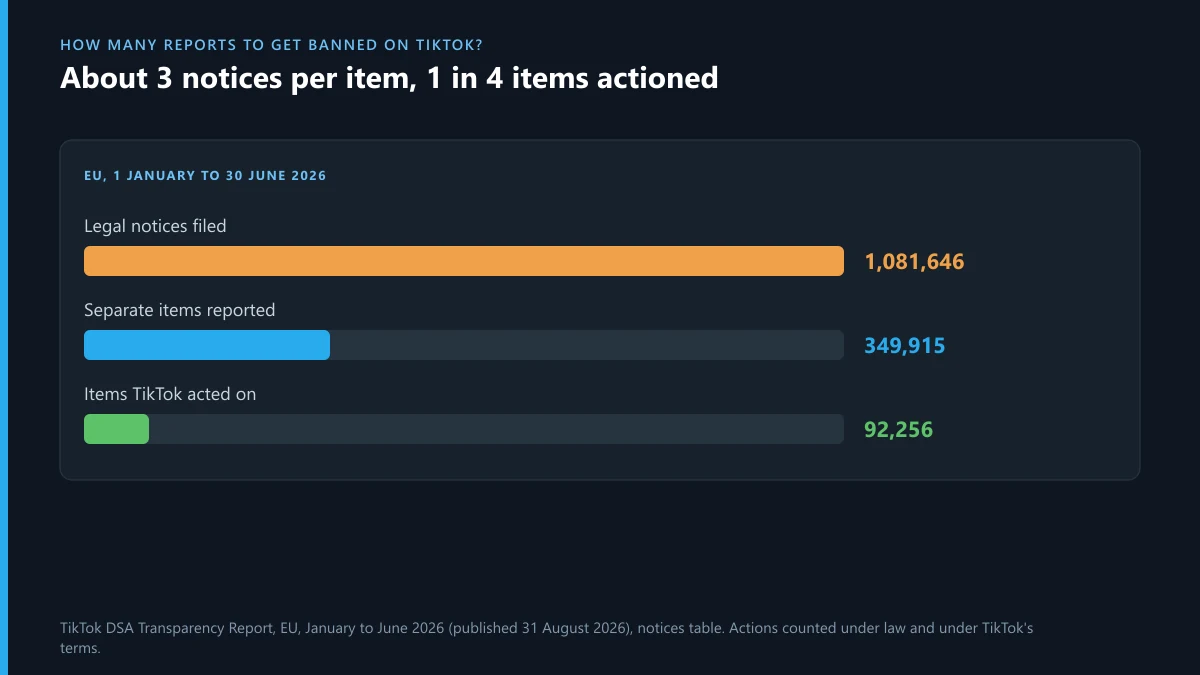
The EU record points the same way. TikTok's DSA transparency report for January to June 2026 lists 1,081,646 legal notices covering 349,915 separate items, and TikTok acted on 92,256 of those items. Repetition moved little.
What should a ban TikTok account service refuse?
Most of what it is asked for. A ban TikTok account service worth hiring turns away more jobs than it accepts, and it says so before taking money.
Telegram Ban Service applies the same refusals on its own Telegram work, and they translate directly. Decline any account whose owner follows the rules, however rude, competitive or annoying they are. Decline critics, ex-partners and rival sellers dressed up as "scammers" without evidence. Decline bulk reporting from bot farms or bought accounts, because TikTok's US Terms of Service, updated 15 July 2026, list unfounded reports, notices and complaints among prohibited conduct, so the client's own account carries the risk. Decline any request for a password, login code or session file, from either side. And decline to promise a result or a date, since TikTok publishes neither a report threshold nor a review deadline. One more refusal matters for child safety: sexual images of a minor go to the NCMEC CyberTipline and the police, never into a paid queue.
How do you vet a TikTok ban service before paying?
Ask five questions, in this order, and stop at the first bad answer.
- Which TikTok rule or law does the target break? A seller who replies "any account" fails here.
- Which route will be used, and who files it? Impersonation and copyright claims should come from you or your authorised agent.
- Will they ask for any login? Yours or the target's, the answer must be no.
- What is promised? "TikTok reviews it and decides" is honest; "banned in 24 hours" is not.
- How is payment taken? Crypto up front, per username, with no written scope, is the usual pattern behind lost money.
Many of these sellers live on Telegram. Before paying a handle printed in an ad, run a quick Telegram username check to see whether it resolves at all, and if the link opens on a notice such as "this channel cannot be displayed", Telegram may already have restricted it.
Where Telegram Ban Service fits in a TikTok case
Only on the Telegram side. The desk reports no TikTok accounts; it handles the Telegram channel, bot or account tied to a TikTok scam, impostor or fake ban seller.
A case runs like this. You send the TikTok profile link, the t.me link and screenshots or receipts. The desk checks whether the Telegram material breaks Telegram's Terms of Service or the law, and says so plainly when it doesn't. If it does, it picks Telegram's route, which Telegram's FAQ on illegal content lists as the in-app Report button, abuse@telegram.org with the links included, and @NoToScam for scammers impersonating someone. The evidence is ordered so a moderator can follow it in one reading, and you are told what was filed. Telegram Ban Service files; Telegram decides, and no action is a possible answer. A common pairing is a fake TikTok giveaway pushing viewers to a channel that sells "rare" handles. Compare that pitch with how people sell a Telegram username on the official marketplace, where you can buy Telegram usernames through Fragment instead of a stranger, and how prices on the Telegram handle market are set. If your own Telegram was taken over in the process, start with Telegram account recovery steps.
The same buyer's test on X and Instagram
The vetting questions above are not TikTok-specific. Sellers who promise TikTok bans usually list X and Instagram on the same menu, with the same per-username price. Telegram Ban Service hears that bundled menu often, and the answer is the same on every app.
The guide to an honest Twitter ban service and its limits runs the same rule-first check against X's policies, and the note on what a Twitter account removal service can actually file covers the forms involved. For Meta's app, read how an Instagram ban service should work, what an Instagram account removal service can and can't request, and why deleting someone else's Instagram account has no outside button either. Copyright is the one area where the rights holder has a direct, documented lever; see the walkthroughs for an Instagram DMCA takedown notice and a DMCA takedown on Twitter. Each platform keeps its own record, so a ban on one never transfers to the next.
Sources
- TikTok Help Center: Content violations and bans, read 8 November 2026
- TikTok Community Guidelines: Enforcement, read 8 November 2026
- TikTok Help Center: Report an impersonation account, read 7 November 2026
- TikTok Intellectual Property Policy: copyright, read 7 November 2026
- TikTok Terms of Service (US), updated 15 July 2026
- TikTok DSA Transparency Report, EU, January to June 2026
- Telegram FAQ: illegal content and takedown requests, read 7 November 2026
FAQ
Is a TikTok account ban service legal?
Hiring help to prepare an accurate report is legal in most places, because the report itself is a tool TikTok offers every user. What changes the answer is method. A TikTok account ban service that files true reports about a real violation is doing paperwork. One that floods TikTok with unfounded complaints breaks Section 3.4 of the US Terms of Service, updated 15 July 2026, and the risk lands on whoever owns the reporting accounts, often the client. One that gets into the target's account by guessing or buying a password is committing unauthorized access in many countries. So the legal question is really three questions: is the target breaking a rule, is the report honest, and is anyone touching a login? If all three answers are safe, a service is merely saving you time. If any answer is wrong, walk away. Telegram Ban Service only takes Telegram-side work that passes the same test.
How much does a TikTok ban service cost, and is it worth it?
Prices in Telegram ads usually come per username, paid up front in crypto, and that pricing model is itself the warning. A per-target fee assumes every account can be banned, which TikTok's own rules contradict: an account that follows the Community Guidelines collects no strikes no matter who pays. For a real violation, the in-app report and TikTok's webforms are free, and the strongest ones, impersonation and copyright, ask for the harmed person's own identification or proof of ownership. Paying a third party can make sense only for organising evidence on a messy case, such as a brand facing many copycat profiles, and only with a written scope that names the rule broken and the route used. No reputable helper charges a success fee tied to a ban, because the outcome belongs to TikTok. If a seller refuses to name the rule, you are paying for volume, and volume is what TikTok's terms forbid.
Can a ban TikTok account service guarantee results?
No. Nobody outside TikTok controls its decisions, so a guarantee is either a misunderstanding or a sales trick. TikTok's help center describes strikes that expire after 90 days, permanent bans on the first strike only for severe violations such as threats of violence, and bans for accounts that build up many strikes across policies. All of that is applied by TikTok's automated systems and moderators. A ban TikTok account service can influence one thing: whether the report is accurate, uses the right reason and carries clear evidence. That improves the odds that a reviewer sees a real violation; it does nothing for an account that breaks no rule. Watch for wording like "guaranteed in 24 hours" or "refund if not banned", which usually means the seller plans to keep the payment and blame TikTok. An honest helper says TikTok reviews and decides, and tells you when there is nothing worth reporting.
What is the difference between a TikTok account takedown and a ban?
In everyday searches the two words mean the same goal, an account that no longer appears, but they come from different routes. A TikTok account takedown is the general idea of getting a profile removed, and it can happen several ways: TikTok bans it for breaking the Community Guidelines, removes it after a confirmed impersonation claim, deletes it after an underage report, or disables it after repeated copyright or trademark infringement. A ban is the enforcement outcome TikTok applies after review. The owner can also delete the account voluntarily, which no outsider can do for them. Single videos are different again: a copyright report may remove only the infringing item while the account stays up. If you search for a takedown, first decide which of those situations you are in, because each has its own form and its own filer, and the wrong form simply wastes a review.
Will the account owner know who reported them?
TikTok says it does not share the reporter's identity with the person whose account or content was reported. The owner may still receive a notice that a video broke a rule or that the account was restricted, and in a small circle they can sometimes guess who complained. Copyright is the exception: TikTok's intellectual property policy says the uploader may receive information about the report, including the copyright owner's name. That matters when a TikTok ban service offers to file "copyright claims" on content you don't own. Your name, or a fake one, would sit on a legal notice, and TikTok says misleading or fraudulent reports will be denied. If you fear retaliation from someone you know, save evidence first, block the account after reporting, and tell someone you trust. Threats of violence belong with the police as well as with TikTok, whatever any seller promises about discretion.
I paid a TikTok ban seller on Telegram and got nothing. What now?
Stop paying, and keep everything: the ad, the chat, the username, wallet addresses and any receipts. Do not send more money for an "unlock fee" or "priority upgrade", which is the usual second step. Then report the seller where it lives. Telegram's FAQ points users to the in-app Report button on the channel, bot or account, to abuse@telegram.org with the t.me links included, and to @NoToScam when the scammer is impersonating someone. If the payment went through a card or a regulated exchange, ask that provider about a dispute quickly, since windows are short. Telegram Ban Service can take this part of the case: it orders your screenshots and files a documented report through Telegram's official routes, so a moderator can see the pattern in one reading. It does not recover funds, it cannot promise Telegram will act, and it never asks for your password or login code.
Can a service ban a TikTok account that is impersonating my business?
A service can prepare the case, but the strongest filing comes from you. TikTok's impersonation article lets the copied person or brand report in the app under Pretending to Be Someone, and its US webform asks the filer to state who is being impersonated, upload valid identification and sign electronically; outside the US, the form sits under Report a potential violation, then Account violation, then Impersonation. If the copy also uses your logo or videos, the trademark and copyright forms add a second, documented route for the rights holder or an authorised agent. Gather the fake's exact username, screenshots of your material in use, and your official account link before you start. A helper may sort that evidence, but anyone who asks for your TikTok login to do it has failed the first test. When the impostor sends customers to a Telegram channel, Telegram Ban Service can report that side.