5 November 2026 · Telegram Ban Service · 13 min read
How to Delete Someone Facebook Account: Who Can Press Delete
How to delete someone Facebook account has a short honest answer: you can't. Only the owner can delete a profile, and Meta can disable one for rule breaks. Outsiders get four narrow requests: a deceased relative, an incapacitated person, an under-13 user, or an impostor posing as you, each with its own Meta form.
Who holds the delete button in each relationship?
The relationship decides everything. A Facebook account is a contract between one person and Meta, so the delete button belongs to the account holder, and every other route is a request that Meta can refuse. Telegram Ban Service is a reporting desk built around Telegram abuse; it reads Facebook cases through the same question, because searchers who land here usually fit one of the six rows below, and the last row has no door to knock on.
| You are | Who acts | The route | What it leaves behind |
|---|---|---|---|
| The owner | You | Deactivation or deletion in account settings | Messages you sent stay in friends' inboxes |
| Family of someone who died | Meta, or the legacy contact | Memorialisation or removal request | Memorialised: posts stay. Removed: nothing to visit |
| Guardian of an incapacitated adult | Meta | Removal form with legal and medical papers | A deactivated shell if recovery is possible |
| Someone who spots an under-13 user | Meta | Minimum-age report form | No confirmation either way |
| The person impersonated | Meta | In-app report or impostor form | On the form, your ID may be kept for up to a year |
| Anyone else with a grudge | Nobody | None exists | Possible exposure for you |
How to delete someone Facebook account permanently: what does "permanently" mean?
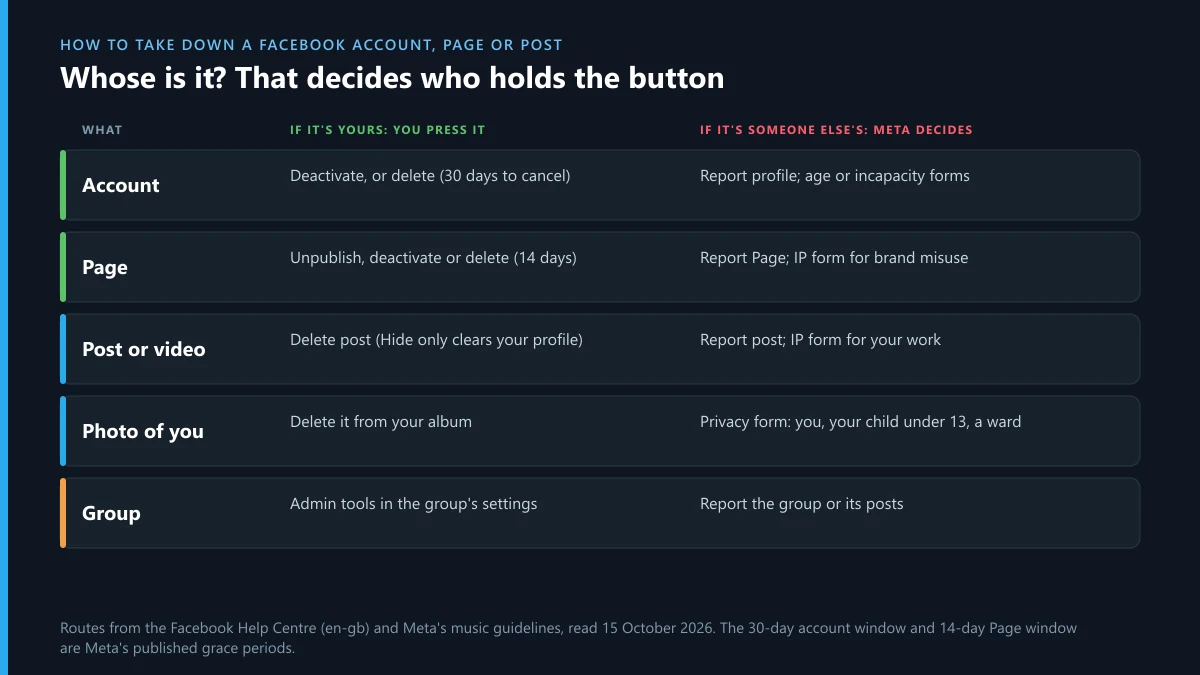
Permanent deletion is an owner's action, and Meta describes it as final once the waiting period ends. Anyone asking how to delete someone Facebook account permanently should know that the word has a specific meaning in Meta's help pages. Under its permanent deletion article, the owner can't reactivate, loses Messenger and Facebook Login, and any Page only they controlled goes too. Copies of messages they sent stay with the recipients.
Timing is the part people misread. Meta lets the owner cancel for 30 days after starting, though it notes that the number varies by region, and says clearing everything posted can take up to 90 days from the start of the process. Its deactivation comparison shows the softer switch: the profile is hidden, nothing is deleted, Messenger keeps working, and the owner can return whenever they like.
So a profile that vanishes tells an outsider very little, and Telegram Ban Service can't press that button for anyone.
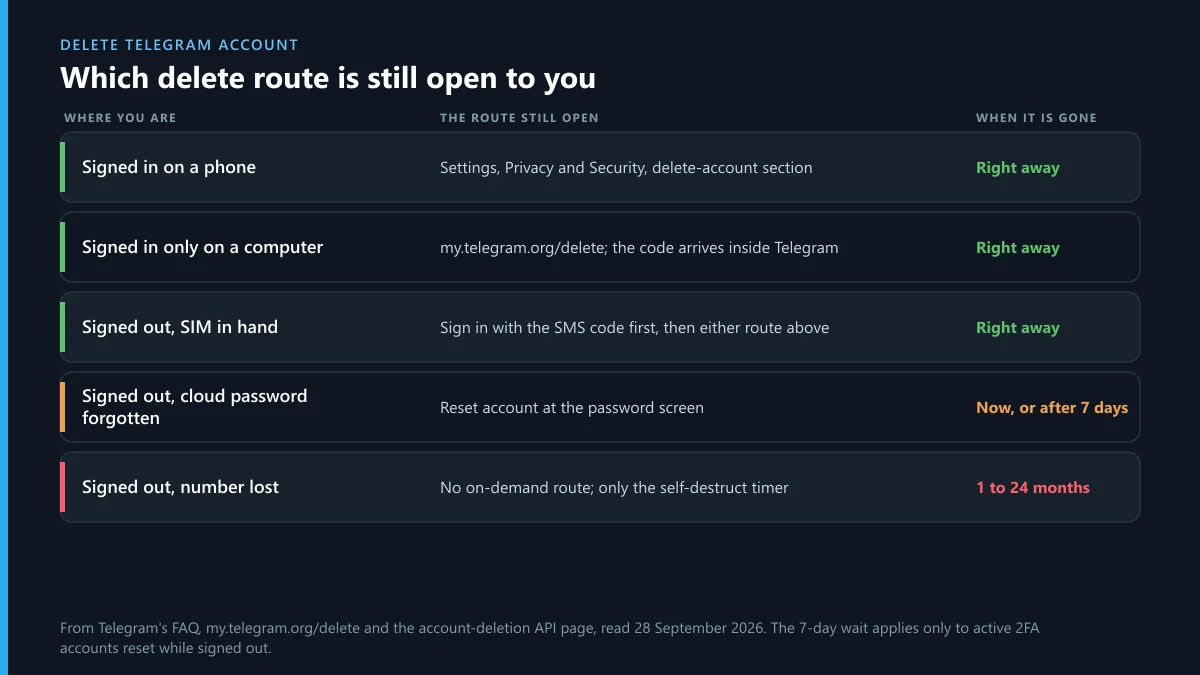
Telegram works differently, which is worth knowing if you run both. Its owner-only delete routes for a Telegram account mostly take effect right away, with no 30-day grace period to save you.
If Meta disables an account, is that the same as deleted?
No. Disabling is Meta's enforcement action, and the owner can usually contest it, while deletion is the owner's own choice. Meta's page on disabling accounts describes two paths as of November 2026: continued posting after warnings and restrictions, or one violation severe enough on its own, with child sexual exploitation as its example. Severe material of that kind belongs with police and child-safety hotlines first, not with a stranger's reporting service.
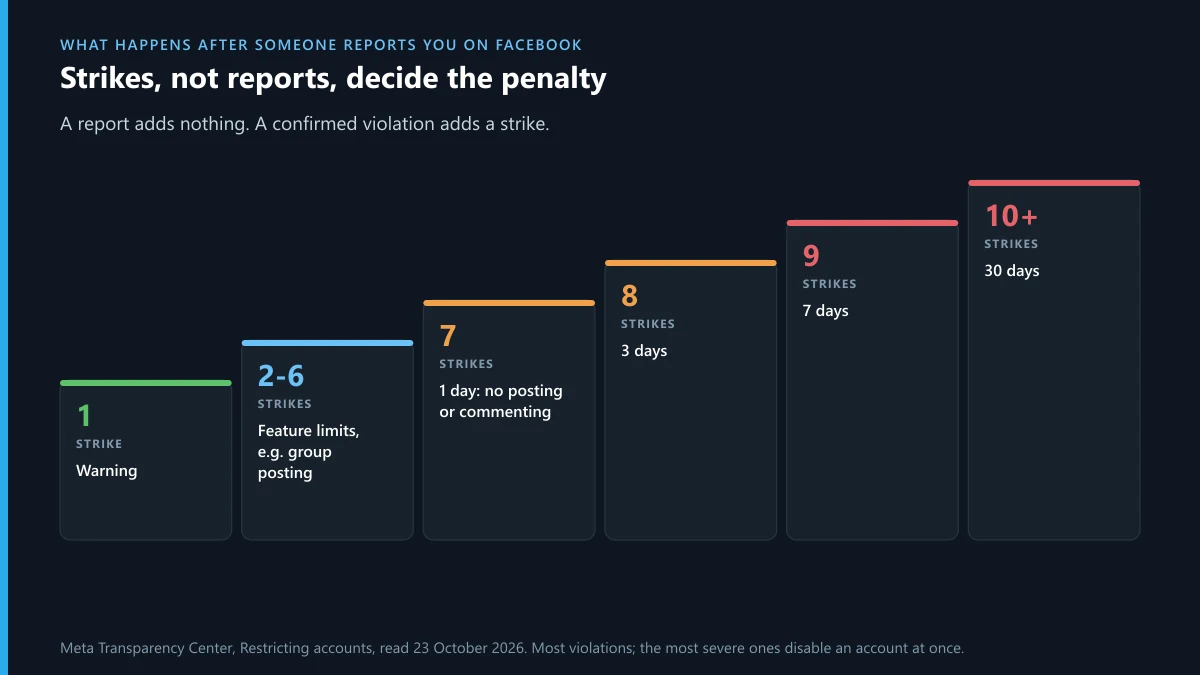
Most accounts never get near that point. Meta's restrictions ladder starts at a warning for one strike and reaches a 30-day block on creating content at ten or more, and strikes come from confirmed violations, not from how many people clicked Report. Telegram Ban Service can't add a strike to anyone.
A missing profile doesn't prove a ban either. Facebook's "content isn't available" screen also appears for a Page URL that never existed, as a test on 23 September 2026 showed, in the same way a "this channel cannot be displayed" notice on Telegram can reflect a filter or a country block instead of a removal. Audience settings or a block can hide an account from you personally, so check while signed out before you conclude anything.
Can a family member remove the account of someone who died?
Yes, with proof, and the family then chooses between two different outcomes. Immediate family or an executor can use Meta's special request form for a deceased or incapacitated person, which offers four options: memorialise, remove because the owner died, remove because the owner is medically incapacitated, or a special request. Meta's removal article for a deceased relative asks for a death certificate. The same form states that nobody gets login details.
Memorialise or remove?
The two leave very different things behind. On a memorialised profile, "Remembering" appears beside the name, past posts stay visible to their original audience, and nobody can sign in. A Page with that person as sole admin gets removed; a Group in the same position gets paused.
A legacy contact chosen in advance can change the profile picture and answer friend requests, and can delete the account at any time, yet can't read messages or edit old posts. Without a legacy contact, the memorialised profile can't be changed at all, so settle the choice among relatives before the request goes in. Telegram Ban Service has no part in this route: Meta's forms are yours to use directly.
An incapacitated relative or an under-13 child: which form applies?
Each has its own short form, and neither is a general complaint box. Both need facts you can actually document, and each one tells you what Meta will do afterwards.
Medically incapacitated adults
Meta's account removal request for an incapacitated person demands two documents: proof of guardianship such as a power of attorney or court order, and a note from a doctor or medical facility describing the condition. Once verified, Meta removes the account, or deactivates it where the condition is reversible so the person can log back in after recovery. The form opens with a warning that hacked accounts don't belong there. Hacked is a recovery problem, as our guides to taking back a hijacked Telegram session and Telegram account recovery when the usual route fails explain for that platform, and Telegram Ban Service never takes a login to help with either.
Users under the minimum age
Anyone can file Meta's under-age report, using only a profile or Page link. Facebook's minimum is 13, higher in some jurisdictions. Meta deletes a profile made with a false birth date when the age can be reasonably verified, and it won't confirm the outcome, so you find out only if the profile disappears for you. An adult who merely looks young won't meet that test.
Does reporting impersonation delete the fake profile?
It can get the impostor removed by Meta, but only for the person copied or their authorised representative. Facebook's impersonation help page starts at the options menu under the cover photo. People with no account get an impostor report form, which asks for ID that Meta may keep for up to a year, as the form stated in October 2026. A friend who is being copied must file for themselves, which means a third party can't start this route on a hunch.
Fan pages and opinion accounts generally stay up unless they claim to be you, since saying things about you isn't pretending to be you. Telegram Ban Service helps with the evidence for such a case, and where only the person copied may file, that person submits the form.
The same logic runs across Meta and X. If the copy has spread, compare who can ask Instagram to remove someone else's profile, how an Instagram takedown gets decided by reviewers, why deleting someone else's Twitter account isn't possible either, how to match a Twitter account to a specific X rule, and what a Twitter removal service can honestly file.
What if the same impostor also uses your name on Telegram?
Removing a Facebook profile changes nothing on Telegram, because the two systems share no accounts or names. Telegram usernames are their own asset class. You can see whether your name is free with a Telegram username check inside Settings, which is more reliable than a web lookup. If a name you want is a collectible, the official way to buy Telegram usernames on Fragment applies, and how auctions work in the Telegram username market shows how those sales run.
One limit deserves a plain statement. Ownership of a collectible sits in a crypto wallet, so a holder can sell a Telegram username through official channels, and a complaint about a Facebook profile gives you no claim over it. Where the impostor's Telegram account is itself scamming or posing as you, that conduct is reportable to Telegram on its own evidence; Telegram Ban Service handles that side and leaves username purchases to you.
You just want this person gone: what then?
Then the honest answer is no: nothing lawful exists for that, and volume won't create it. Meta's help page on how it decides says "The number of times something is reported doesn't determine whether or not it's removed." An ex, a rival or a critic who follows the rules keeps their account however many friends you recruit.
False reports can also land on you. Meta treats mass reporting as abuse of its tools, and its December 2021 threat report describes removing a network in Vietnam for it, under its Inauthentic Behavior policy. A false ID claim or a made-up accusation may bring legal trouble depending on the country, which is a question for a lawyer.
What we decline, and how a genuine case runs
Telegram Ban Service declines rule-abiding accounts, false or coordinated reports, bots, purchased accounts, any request for someone's password or 2FA code, and promises of a result. It won't explain how to get into an account that isn't yours, either. A genuine case starts with your relationship to the account and the rule it breaks. We check that the route lets you or us file, put screenshots, links and dates in order, and tell you plainly when a form is yours alone to send. Meta decides, and we can't speed that up.
FAQ
Is there any way to delete someone's Facebook account permanently?
Not as an outsider. Searching how to delete someone Facebook account permanently usually assumes a hidden form or a staff contact, and neither exists. The delete control sits inside the owner's own settings, and Meta's forms don't hand it to anyone else. What does exist is a short list of requests that may end in removal: verified family of someone who died, a guardian of a medically incapacitated person, a report of a user under the minimum age, and an impostor report filed by the person copied or their representative. A disabled account is a separate thing, because that is Meta enforcing its rules after finding a violation, and the owner can contest it. If none of those four situations fits yours, no permanent route exists. Anyone selling one is selling something Meta doesn't offer, so keep your money and your login away from them.
Can I get a Facebook account deleted if lots of people report it?
No. Meta's help pages state that the count of reports doesn't determine removal, so a hundred reports on a lawful profile carry the same weight as one: a reviewer or an automated system checks the content against the Community Standards, and it stays if nothing breaks them. Coordinating a report campaign can hurt the people running it. Meta's December 2021 threat report describes removing a network in Vietnam that falsely reported critics, and it classes that behaviour under its Inauthentic Behavior policy. A seller of mass report tools has no way to change how Meta weighs reports, whatever the sales page claims. If the profile really does break a rule, one precise report with evidence does the job better, and it comes from someone with standing. Telegram Ban Service won't run campaigns of this kind for any platform.
How long does Facebook take to delete an account?
It depends on who started it. For an owner, the clock is published: Meta allows 30 days to cancel, noting that this varies by region, and says removing everything posted can take up to 90 days from the start. During that time the content isn't visible to other people. For a request from someone else, Meta publishes no deadline that we could find. The memorialisation, removal and under-age forms don't promise any timetable, and the under-age form says outright that you won't get confirmation, so silence is the normal result and doesn't tell you the report failed. Meta's request pages also say documents must match the details on the account, so check them before sending. Anyone quoting you a fixed number of days for a third-party removal is guessing, because the decision and the queue both belong to Meta. Save your copy of the submission with its date, and don't file repeat requests with different details.
Is a memorialized Facebook account the same as a deleted one?
No, and families sometimes choose the wrong one because the words sound alike. A memorialised profile stays online with "Remembering" beside the person's name, its past posts stay visible to the audience they were shared with, and it stops appearing in birthday reminders, ads and friend suggestions. Nobody can sign in to it. A removed account is gone from Facebook, and the shared memories go with it. Sole-admin Pages get removed on a valid memorialisation request and sole-admin Groups get paused, so check those first if a business or community depends on them. A legacy contact, chosen by the person during their life, can later delete a memorialised account at any time. The owner may also have picked Delete after death in their settings, in which case Meta deletes the account once it receives proof of death. Talk to other relatives before asking, since removal can't be walked back.
Can I log in to a relative's account and delete it myself?
Meta's route doesn't work that way. Its special request form says plainly that it can't provide anyone with login information, and memorialised profiles can't be signed in to at all. The owner's own settings are the only place a self-serve delete happens, and using someone else's login, even a relative's, may break the platform's terms or local law, so take advice before going near it. The safe path for a family is paperwork: a death certificate for a removal request, or proof of guardianship plus a doctor's note for someone incapacitated. If you were named as legacy contact, you have your own deletion control without needing the password. Be wary of anyone offering to recover or reset a relative's account for a fee. Telegram Ban Service doesn't take passwords or login codes, and it doesn't perform account access for any reason, on Facebook, Telegram or anywhere else.
What if the account is scamming or threatening me but isn't pretending to be me?
Then the delete question is the wrong one, and an ordinary report plus your own evidence is the right start. Open the profile, use the options menu under the cover photo, and pick the reason that matches what actually happened, since a scam report and a harassment report go to different policies. Save links, screenshots and dates before you do anything else, because a removed profile takes that evidence with it. If Meta leaves the account up, your Support Inbox lets you request another review, which Meta says it usually answers within 24 hours. Threats and extortion also belong with the police where you live, whatever Meta decides. If the same person has moved to Telegram, Telegram Ban Service can look at that side once you share the evidence, and the decision stays with the platform. It won't ask for your login.
Does Telegram Ban Service delete Facebook accounts?
No. Telegram Ban Service can't delete any account, on Facebook or on Telegram, because that power belongs to the owner and the platform. Its work is on Telegram-centred abuse and on cases that cross platforms: genuine impersonation, scams and extortion, where the evidence needs sorting and the right official channel has to be identified. On Facebook, that often means preparing material for a form that you must submit yourself, since Meta accepts impostor reports only from the person copied or their authorised representative. No success rate, deadline or result is promised, and Meta reaches its own decision on each one. The service refuses grudge requests, lawful accounts, critics and competitors, and it never asks for a password or a login code. If your situation is a deceased or incapacitated relative, you can use Meta's forms directly, and you will need a death certificate, or guardianship and medical papers, ready to upload.