November 3, 2026 · Telegram Ban Service · 10 min read
Twitter blackmail on X: what to do when someone threatens, doxxes or scams you
Twitter blackmail is a threat on X to expose you unless you pay or comply. Don't pay, stop replying, save the evidence, then report the message, post and account. X's private information policy already bans asking for a reward "in exchange for not posting" private details, so the demand alone is reportable, even before anything is published.
What counts as Twitter blackmail on X?
Twitter blackmail is a threat made on X to expose something about you unless you pay, send more or do what the sender says. X has no policy with that title. The demand falls under one of three rules, depending on what is being held over you, and that rule decides which report fits.
The private information policy, dated March 2024, bans threatening to expose someone's details and names the reward-for-silence demand, "sometimes referred to as blackmail". The Non-Consensual Intimate Content policy, dated October 2026, covers "threatening distribution", and also edited or AI-generated media, so a threat counts when the picture is fake. Anything involving a person under 18 goes to X's child safety team instead. Telegram Ban Service, a reporting desk for Telegram channels, bots and groups, has no access to X's review queue, so use the table below yourself.
| What is being held over you | X rule it falls under | Where to report |
|---|---|---|
| "Pay or I post your nudes" (you're an adult) | Non-Consensual Intimate Content | The DM or post, plus StopNCII |
| Sexual image of someone under 18 | Child Safety | X's safety form, NCMEC CyberTipline, Take It Down |
| "Pay or I publish your address" | Private information | The DM or post, then police if it feels physical |
| Your details already posted | Private information | The post, or X's private information form |
| Account asking for money under a story | Authenticity, Scams clause | The post, DM or profile, then your bank |
| Account using your name or brand | Authenticity, Impersonation | X's impersonation report; no X account needed |
What should you do first if Twitter sextortion starts?
Stop replying and don't pay. NCMEC, the US child-protection clearinghouse, says "Cooperating or paying rarely stops blackmail" in its June 2026 sextortion release, which counted more than 50,000 financially motivated sextortion reports for 2025, an average of 137 a day.
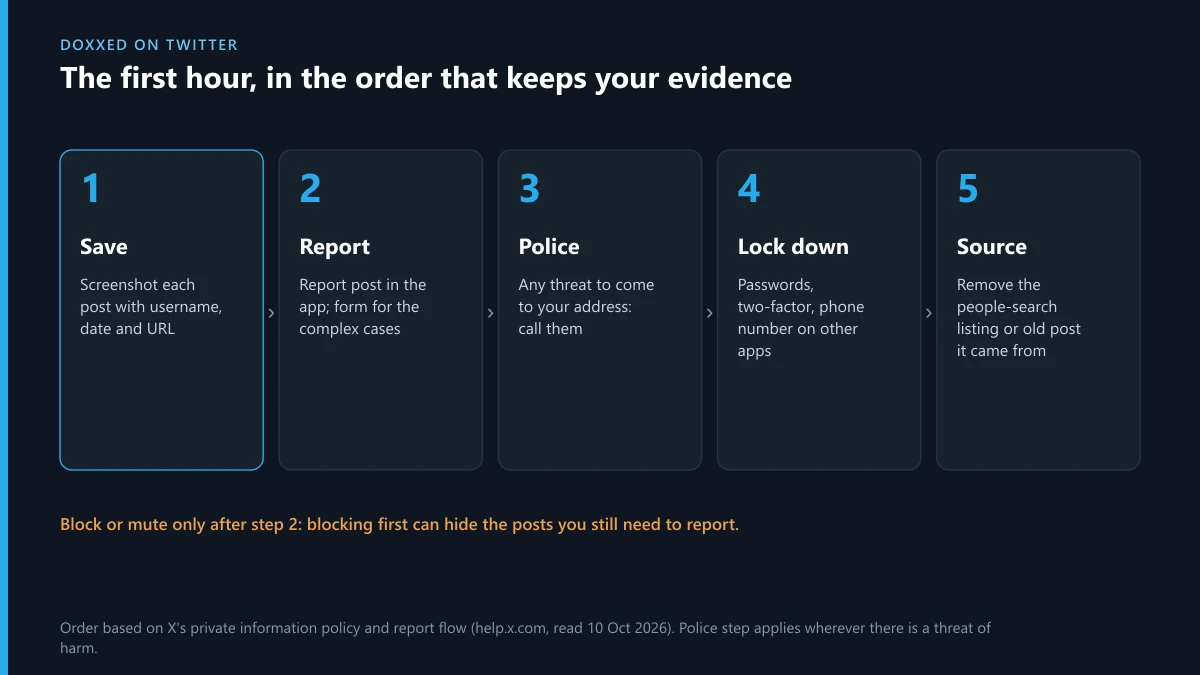
A sextortion Twitter threat often comes with a countdown, because panic is the sender's whole plan. Work in this order, since blocking too early can cost you the thread you need:
- Copy the @username and profile URL as text, then screenshot the profile, the threat and any wallet, gift-card or bank details.
- Report the message: tap and hold it, then Report message. For the whole chat, tap the info icon, then Report @username.
- Report the account from its profile: the more icon, Report, then Myself. X may ask you to pick posts for context.
- Block only now, and keep the chat undeleted for police.
- Tell one person you trust, then use the outside routes below.
Expect some waiting. X's report page says it acknowledges reports within 24 hours, typically resolves them in a few days, and can take thirty.
Which outside routes fit minors, adults and money demands?
If the image was taken before you were 18
Go to NCMEC, even if you are an adult today. Its CyberTipline takes the report, and its call center answers around the clock at 1-800-843-5678. Take It Down creates a hash, a digital fingerprint, on your device, so the image itself is never uploaded. One catch from our check on 3 November 2026: X was not on the Take It Down participant list. Report on X as well, using the child sexual exploitation option in its safety form. A parent or guardian can help. If anyone is in immediate danger, call 911 or local police first.
If you are an adult
StopNCII makes the same kind of fingerprint and shares it with partner platforms, and an X Corp logo was on its partners page when read on 3 November 2026. Its FAQ recommends opening a case even when you have only been threatened. In the US, X also runs a US Take It Down Act Report form, open to you or your authorised representative. Since 19 May 2026, covered platforms must remove valid-request images and known copies within 48 hours, and the FTC tells people to complain at TakeItDown.ftc.gov when that deadline passes.
If there is a money demand or a physical threat
Go to local police; in the US, also the FBI's IC3 or a field office. The same applies to a blackmail Twitter DM about your job or your family rather than images, and reporting blackmail on Instagram follows the same order on Meta's side.
Be wary of paid rescuers. A 2023 FBI warning describes companies charging sextortion victims thousands of dollars for cease-and-desist letters that aren't enforceable, and says police and non-profits help at no charge. Telegram Ban Service doesn't contact blackmailers, delete images or trace anyone, so nothing here replaces those free routes.
What is doxxing on Twitter, under X's own rule?
Doxxing on Twitter means sharing someone's private information without their permission, and X's policy uses that word. The listed categories are home address or private location, government IDs, non-public phone numbers and emails, passwords, bank or card details, medical records and biometrics, and the identity of an anonymous user.
Plenty falls outside it. X doesn't treat names, birthdates, schools, employers, public business addresses, descriptions of appearance, gossip or accusations as private. So "what is doxxing on Twitter" has a narrower answer than most targets expect: someone naming your workplace to embarrass you may be harassment, yet not doxxing.
Reviewers weigh four things: the type of information, who shared it, whether it was already public elsewhere, and why it was posted. A home address can, even if it's public, because X treats physical harm as the main risk. Anyone can report a clearly abusive post; otherwise X may need to hear from you or a representative. The form and tap-by-tap steps live in the step-by-step guide to reporting doxxing on X.
How do people get doxxed on Twitter?
People get doxxed on Twitter through details that already exist: a data broker file, an old profile, a contact list, or someone they trusted. That tells you where to close the gaps.
The FTC's guide to people search sites explains the biggest one. These sites buy from other brokers, collect public social profiles and pull government records such as property and voter files, then sell reports that can include current and past addresses and relatives. Contact lists are another. X says someone holding your email or phone number may find your account after uploading their contacts, which is how a pseudonymous profile can get tied to a real person. Forwarded screenshots are a third, because X permits screenshots of private chats unless they contain private details.
To shrink your exposure:
- Turn off the settings that let people find you by email or phone on X.
- Ask people search sites to stop selling your file; the FTC says most offer a way.
- Delete your address, number and employer from old posts and bios.
- Give an anonymous account its own email and number.
How to report a scammer on X
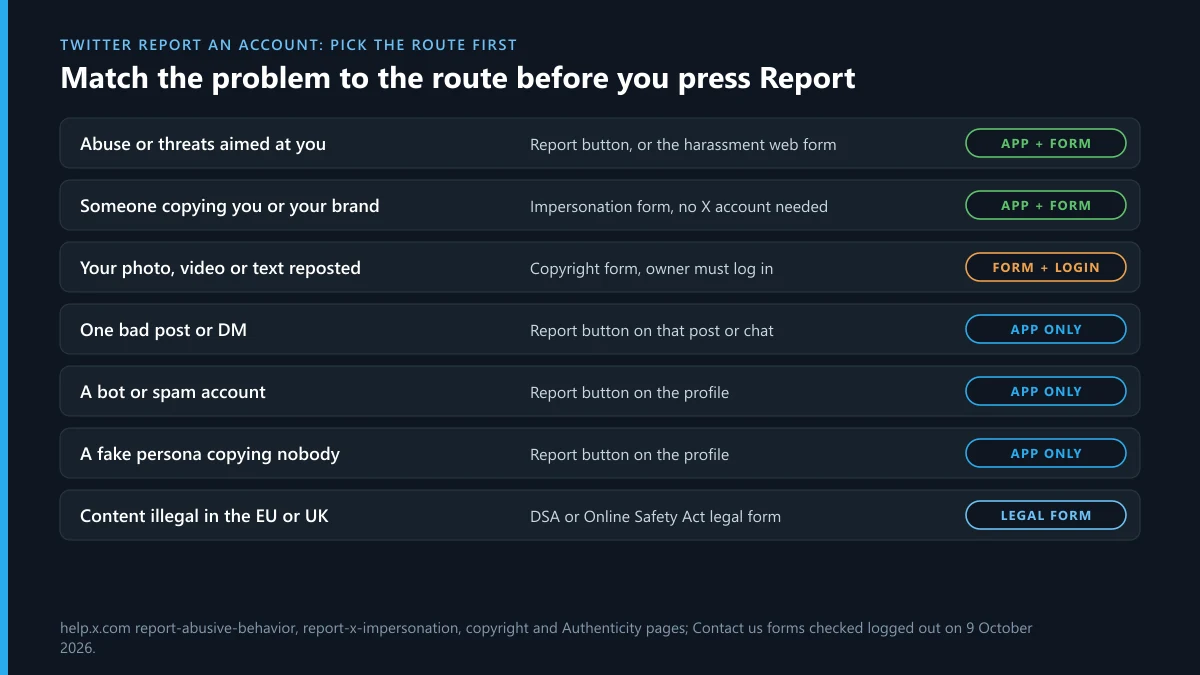
Report the post, DM or profile that carries the pitch, from the more icon. The Twitter report scammer path runs on the Authenticity policy, dated April 2025, which bars using X to obtain "money, property, or private information" through scam tactics: trust-building schemes, money-flipping, fraudulent discounts and phishing.
One line trips up many reports. X says it does not intervene in financial disputes, naming goods sold on X, disputed refunds and poor-quality goods. So "they never shipped my order" can read as a dispute, while "same pitch, new account, fake payment page" reads as deception. Show the deception, and attach the DM carrying the payment request.
X won't return money. Call your bank or card issuer the same day, then file at the FTC's ReportFraud in the US or your national police fraud line elsewhere. For larger or crypto losses, add IC3, whose home page warns that it never contacts victims for money and doesn't work with recovery firms. Anyone claiming otherwise is likely running a second scam, and Telegram Ban Service can't recover money either. The same logic is laid out in the Instagram scammer reporting guide.
How do you report fake Twitter accounts?
To report fake Twitter accounts, first decide whether the fake copies a real identity. If it poses as you, X's impersonation page lets you or an authorised representative file in the Help Center, with no X account needed, and this impersonation walkthrough walks through each filer type. A bystander reports from the profile. X then suspends the account or asks it to change. A brand goes through a trademark infringement complaint on X instead. A made-up persona copying nobody is reported from its profile, as a fake persona. Parody accounts are allowed only with all four markers: the PCF label, a non-identical avatar, and a word such as "parody" or "fan" at the start of the name and in the bio.
Where does Telegram Ban Service fit, and what does it refuse?
Telegram Ban Service acts on one thing: a Telegram channel, bot or group tied to the same person who is threatening you on X. Blackmailers and scammers can move payment or "proof" talk there, or advertise a Telegram link in the X bio. You send the Telegram link and whatever connects the two, such as the matching handle, the bio link or the same wallet. We check it against Telegram's Terms of Service and Community Guidelines, then report it through the Report button, @notoscam and abuse@telegram.org. Telegram makes the final decision, and a restricted channel may then show the "this channel cannot be displayed" notice. If a scammer on X is pitching a "rare" handle as an investment, compare the pitch with how the real Telegram username market works.
What we decline, every time:
- Filing on X for you, or speeding up X's review.
- Receiving intimate images. Never send them to anyone, including us.
- Work involving a minor's images, which belongs with NCMEC.
- Rule-abiding channels, false reports, report bots and guarantees.
- Your password or 2FA code.
X's Authenticity policy treats duplicate or false reports in large numbers as spam, so asking friends to pile on can hurt you. Anyone selling a shortcut deserves the questions in what an X account removal service can actually file, and deleting someone else's Twitter account explains who really can end an account.
What if the same person follows you to Instagram?
Report there too, because X's decision doesn't carry over. Repeated contact after you've blocked them is its own report: see how to report harassment on Instagram. A fake or abusive page goes through an Instagram page report. Worried about retaliation? Read whether an Instagram user learns who reported them, and if you reported the wrong account in a panic, taking back an Instagram report covers what can be undone.
Sources
- X: Private information policy (March 2024)
- X: Non-Consensual Intimate Content policy (October 2026)
- X: Authenticity policy (April 2025)
- X: Report abusive behavior
- NCMEC: 2025 sextortion data (June 2026)
- FTC: Take It Down Act enforcement (May 2026)
- FBI/IC3: sextortion assistance warning (April 2023)
FAQ
Should I pay if someone threatens me with Twitter blackmail?
No. NCMEC's June 2026 sextortion release says paying or cooperating rarely stops blackmail, and a payment tells the sender that you have money and that the threat works. The advice holds for a blackmail Twitter DM about images, your employer or your address. Stop replying without announcing it. Save the username, the profile URL and every demand, then report the message and the account before you block. X's private information policy bans asking for a reward in exchange for not posting someone's details, and its intimate content policy covers threats to share, so you can report before anything is published. If you already paid, you aren't out of options: report anyway, tell your bank or payment provider, and give police the transaction details. Nobody can honestly promise the person will not post. Telegram Ban Service only reports a linked Telegram channel, bot or group, and will never ask for your password.
What should I do about Twitter sextortion if I'm under 18?
Tell an adult you trust and go to NCMEC, because Twitter sextortion against a minor is a crime and you are not in trouble for being targeted. The CyberTipline at report.cybertip.org takes the report, and the call center is open all day and night at 1-800-843-5678. Take It Down makes a digital fingerprint of the image on your own device, without uploading it, for images taken before you turned 18. X was not on its participant list when we read it on 3 November 2026, so also use the child sexual exploitation option in X's safety form. Sextortion Twitter accounts push hard for speed, so don't send more pictures, don't pay and don't delete the chat. Never send the image to a website, a helper or a paid service, including Telegram Ban Service. In immediate danger, call 911 or your local emergency number first. Police and NCMEC don't charge for this help.
What is doxxing on Twitter, and does it cover my name or workplace?
What is doxxing on Twitter comes down to X's private information policy: publishing someone's private details without permission, or threatening to. It lists home address or private location, ID documents, non-public phone numbers and email addresses, passwords, financial account details, health data, and the real identity of an anonymous user. Your name and workplace aren't on that list. X expressly excludes names, birthdates, schools, employers and public business locations, along with rumours and accusations. A post combining your employer with insults may still break the abuse rules, so report it as harassment. Context counts as well. X asks who shared the information, whether it was already public and why it appeared. A home address gets special treatment, since X may act even when it is findable elsewhere, because physical harm is the concern. Report a clearly abusive post yourself; a friend can flag it too, though X may still ask to hear from you.
How do people get doxxed on Twitter if they never posted their address?
Mostly through records outside X. How do people get doxxed on Twitter without posting anything? The FTC explains that people search sites combine data broker files, public social profiles and government records such as property and voter registrations, and sell the result, so a name or phone number can lead to an address. Someone you once trusted can also share what they know, and that risk stays even with perfect settings. An anonymous account has one extra weak spot: X says a person who holds your email or number may find your account by uploading contacts. Close what you can. Turn off discoverability by email and phone, ask people search sites to stop selling your report, and scrub old posts and bios. If your address still appears, report it through X's private information route, keep screenshots, and contact police when the post comes with a threat. Don't try to unmask the poster in return, because that breaks the same rule.
How to report a scammer on X who has already blocked me?
Use whatever you saved, and get help for the part a block hides. The Twitter report scammer flow starts from a post, profile or DM, and X says anyone can report from those places. So report any message still in your inbox. Then ask a friend who can still see the profile to report it and choose Someone else, giving them the URL you copied and your screenshots. To report fake Twitter accounts that pose as you, use X's impersonation report, which X says doesn't need an X account at all. Describe the deception rather than the unpaid order, because X says it does not step into financial disputes between users. Keep the money track separate: call your bank the same day and file with the FTC or your police fraud line. If the scammer also runs a Telegram channel or bot, Telegram Ban Service can report that part, and Telegram decides what happens to it.
Will the person know I reported them on X, and how long does it take?
X's UK Online Safety page says X does not disclose information about the person who submitted a complaint, and its reporting help page says account information is released only as required by valid legal process. The person can still guess from timing, especially when you are the only one being threatened, so keep your evidence and safety plan ready before you report. On timing, X says it acknowledges reports within 24 hours and typically resolves them within a few days, though it can take thirty days. A post may be ordered removed with a spell in read-only mode, while accounts whose sole purpose is posting private information can be suspended. X may tell you little about the outcome. Don't refile the same report in bulk, since X treats duplicate reports in large numbers as spam. Add new evidence instead when new threats arrive, and take any threat of physical harm to police straight away.