November 7, 2026 · Telegram Ban Service · 14 min read
Facebook mass report: what a pile of reports changes for a group, Page or profile
A Facebook mass report doesn't decide anything. Meta's Help Center says the number of times something is reported "doesn't determine whether or not it's removed", and each review uses the same Community Standards. Meta has also removed networks that coordinated reports to silence critics, under its Inauthentic Behavior policy, per its December 2021 Adversarial Threat Report.
The count myth, and the one line Meta wrote about it
Every facebook mass report request rests on one belief: if enough people press Report, Meta has to act. Meta answers that belief directly. Its Help Center article on whether report numbers matter says "The number of times something is reported doesn't determine whether or not it's removed from Facebook," and adds that the same guidelines apply each time a profile is reviewed.
Short version: volume is not the test.
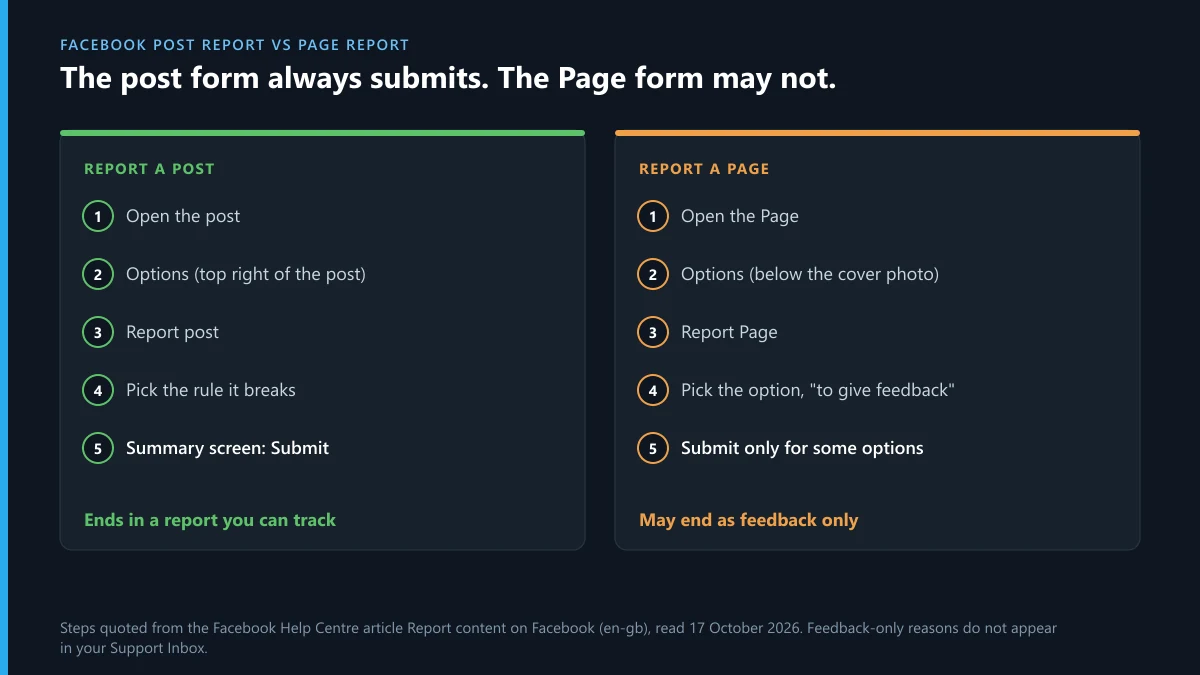
The reporting flow itself shows why. In the Report content on Facebook article, choosing a reason for a Page or profile is described as giving feedback, and "depending on your feedback, you may then be able to submit a report to Meta." For some types of content Meta asks for no report at all and uses the feedback to help its systems learn. So fifty people choosing the same reason feed one check fifty times, and that check asks a single question: does this break the Community Standards? A post that breaks them can come down after one accurate report, while a lawful post that annoys a crowd has nothing in it for the review to find. That is why the plain answer to does mass reporting work on facebook is no, for any post, Page or profile that follows the rules.
Telegram Ban Service is a reporting desk that works only on Telegram, so it meets this keyword from the outside: through the Telegram channels and bots that sell "Facebook ban" packages, and the buyers who lose money to them. What follows explains why the count is the wrong lever and which Facebook route fits a real violation. It does not explain how to coordinate reports, and nothing here will.
Are there mass reportings of groups on Facebook?
Yes, coordinated reporting campaigns exist, and Meta treats the campaign itself as the violation. Its Adversarial Threat Report of December 2021 defined Mass Reporting as people working together "to mass-report an account or content to get it incorrectly taken down." The same report described a network in Vietnam that filed hundreds, and at times thousands, of complaints against activists and government critics, relying mainly on authentic and duplicate accounts. Meta removed that network for violating its Inauthentic Behavior policy against mass reporting.
The rule is still on the books. The current Inauthentic Behavior policy bars creating or using inauthentic accounts, Pages or Groups to "Misuse Meta reporting systems to harass, intimidate or silence others." So facebook mass reporting of groups, or of the people who run them, is a pattern Meta's own threat teams have hunted and published, and it puts the reporters in the frame rather than the target.
What actually happens to a group that breaks the rules
Group enforcement follows what gets posted and approved, not how often the group is flagged. In a September 17, 2020 Groups update, Meta said it had taken down more than 1 million groups over the previous year for policy violations. Admins and moderators of a removed group can't create new groups "for a period of time", and the update gave no length. A member who breaks the rules has every post in that group held for approval for 30 days. If admins or moderators keep approving violating posts, the group itself is removed. Each lever needs a real violation inside the group, which is why a mass report facebook group campaign aimed at a well-run group has nothing to pull. A group running scams or harassment, by contrast, gives a reviewer plenty with one good report. Telegram Ban Service sees the same split on Telegram, where a group is judged by what it hosts.
Reporting a group, a Page or a profile through the buttons Meta built
One accurate report through the matching button is the route, and Meta's help pages spell out each one. Anyone looking up how to mass report on facebook is usually holding a real complaint, and the complaint decides the door.
| What you are looking at | Where the report starts | What Meta's page adds |
|---|---|---|
| A group you belong to | Options below the group's cover photo, then Report group | Meta's article is titled for groups "that you're a member of"; report single posts from the post itself |
| A Page | Options below the Page's cover photo, then Report Page | Some reasons end as feedback only; if you can't access the Page, Meta suggests asking a friend to report it |
| A profile | Options to the right of the profile, then Report profile | Unfriend or block are offered when someone is bothering you |
| A profile or Page pretending to be you | The same buttons, or the impostor contact form | Works even if you have no Facebook account |
| Your copyright or trademark | The intellectual property reporting form | Filed by the rights owner or an authorized agent |
The friend suggestion on the Page row is about access, not numbers. A second report of a Page you can't see adds a pair of eyes, and the same rule still decides it. So the honest answer to how to mass report a facebook page, or how to mass report a facebook account, is that you don't: you send one report that names the rule and lets a reviewer see it. The same goes for how to mass report facebook account holders you suspect of fraud, and for any mass report facebook page plan: the answer is the table above, not a crowd.
Impersonation has its own help page. Meta says profiles and Pages that impersonate other people go against its Community Standards, and people without an account can use the impostor contact form. Rights owners use the intellectual property reporting form, where the report has to come from the owner or someone acting for them. The pattern carries across platforms: an Instagram copycat goes through Instagram's impersonation steps, a counterfeit brand handle on X through the X trademark complaint, and repeated abuse through Instagram's harassment reporting.
Facebook mass report tool, bot, script or service: who carries the risk?
The buyer carries it. Every facebook mass report tool, facebook mass report bot or facebook mass report script runs into the same two lines in Meta's Terms of Service, effective 1 January 2025. One says "You may not access or collect data from our Products using automated means (without our prior permission)." The other says that if Meta determines you have "clearly, seriously or repeatedly breached our Terms or Policies", it may suspend or permanently disable your access and may delete your account.
Three kinds of exposure follow, and none of them lands on the target. Telegram Ban Service lists them because it can act only on the Telegram end of such a sale, never on the Facebook end.
- Your own accounts. A mass report bot facebook listing needs accounts to report from. If they are yours, the automation clause and the reporting-misuse rule point at them; if they are fake, the Inauthentic Behavior policy does.
- Your money. A facebook mass report service charges for an outcome Meta says report volume can't produce. Paid upfront, it leaves nothing to enforce when the target stays online.
- Your login and device. A mass report facebook bot that asks you to "connect" your account is asking for your password and code, and a downloaded script runs with whatever permissions your computer gives it.
The same offer shows up under other logos. Paid takedowns on Instagram are tested in what an Instagram account removal service can actually file, and on X in the limits of a Twitter account removal service and what a Twitter ban service may legally submit. The grudge version, deleting someone else's Twitter account, gets the same honest answer there as mass report facebook requests get here.
Why a confirmed violation, not a report, moves an account toward removal
Meta's penalty system counts strikes, and a strike comes from a confirmed violation, never from a report on its own. The Restricting accounts page in Meta's Transparency Center lays out the ladder for most violations: one strike brings a warning, two to six bring limits on features such as posting in groups, seven bring a one-day block on creating content, eight a three-day block, nine a seven-day block, and ten or more a 30-day block. The most severe violations can disable an account at once.
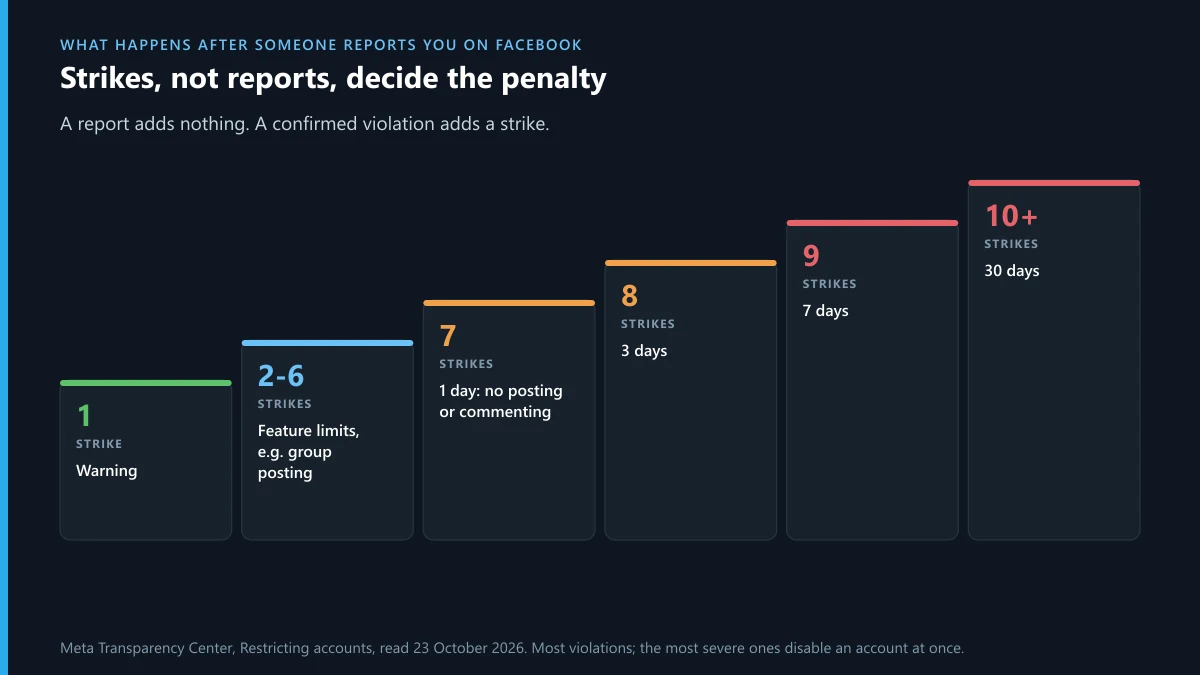
For anyone thinking of a mass report facebook account order, this ladder is the whole argument. Ten thousand reports on a profile that breaks no rule add zero strikes. One report on a profile that posts scams can start the climb, which is why Telegram Ban Service sends people with a real case to the Facebook buttons rather than to a seller.
For anyone who fears being the target, the same logic is the defense: a pile of reports with no violation behind it leaves your Account Status where it was. If a decision does go against you, read the rule it names and use the review option Meta offers rather than paying someone to "counter-report".
When the Facebook ban seller works out of Telegram
Many of these offers are sold through Telegram channels and bots, and that part Telegram Ban Service can act on. A channel that takes payment for a ban it can't deliver, or a bot that asks buyers for their Facebook login, may break Telegram's rules on fraud and phishing. Telegram's spam FAQ says reported messages go "to our team of moderators for review", so the useful input is evidence, not a crowd: the t.me link, the sales posts, the payment trail and any message asking for a code.
Two practical warnings for buyers. A seller's handle proves little, because names change owners on the Telegram username market. And a channel that vanished behind a "This channel cannot be displayed" notice may have been restricted, or may just be blocked in your region, so save screenshots while you still can.
Some people arrive here worried about the opposite problem. A flood of fake followers on X is handled in clearing bot accounts from a Twitter following, a single abusive post in how to report a tweet, a business profile copying yours in reporting an Instagram page, and a report filed by mistake in whether an Instagram report can be taken back.
What Telegram Ban Service turns down, and how a case runs
Telegram Ban Service turns down every Facebook reporting order, whatever the target. It sells no report volume, bots, scripts or fake accounts on any platform, and it will not touch rule-abiding people, critics, competitors or ex-partners. It asks for no password, login code or 2FA code, and it quotes no outcome or deadline.
What it does take is narrow. A Telegram channel, group, bot or account that is genuinely running fraud, impersonation or extortion, including one selling a fake Facebook ban, goes through a plain sequence: you send the links and screenshots; the desk reads them against Telegram's Terms of Service and Community Guidelines; if they show no violation, it tells you so and stops; if they do, it arranges the evidence and files it through Telegram's official routes. Telegram Ban Service files the report, and Telegram makes the final decision. The Facebook side stays with you, through the buttons and forms above, because those forms ask for your own statement.
Sources, read 7 November 2026
- Facebook Help Center: report counts and removal, Report content on Facebook, impersonating profiles and Pages
- Meta: Adversarial Threat Report, December 2021, Groups safety update, September 2020, Inauthentic Behavior policy, Restricting accounts, Terms of Service
- Telegram: spam and reporting FAQ
FAQ
Does mass reporting work on Facebook?
No, not against content or accounts that follow the rules. Meta's Help Center states that the number of times something is reported doesn't determine whether it's removed, and that the same guidelines apply each time a profile is reviewed. A report starts a check against the Community Standards; a hundred identical reports start the same check. That is the short answer to does mass reporting work on facebook. Facebook mass reporting can also count against the people doing it: Meta's Inauthentic Behavior policy bars using inauthentic accounts, Pages or Groups to misuse its reporting systems to harass, intimidate or silence others, and its December 2021 Adversarial Threat Report describes a network removed for exactly that. Meta does get decisions wrong at times, which is why review requests exist, but an error is not something anyone can order, and a seller who claims otherwise is selling a guess.
How do I report a Facebook account that really breaks the rules?
Report it once, from the profile, with the reason that matches what you saw. On a computer, open the profile, click Options to the right, choose Report profile and pick the option that fits; Meta may then let you submit a report, or may use your choice as feedback only. People who search how to mass report a facebook account, or how to mass report facebook account owners they distrust, usually have something specific in mind, and specific routes beat volume. An impostor using your name or photos has its own reporting path, and you can use the contact form even without a Facebook account. Content that copies your work goes through the intellectual property form. Screenshots with dates make the report easier to judge. A mass report facebook account campaign adds no evidence, and the Terms let Meta suspend accounts that seriously or repeatedly break its rules.
Can a Facebook Page be taken down by many reports?
Not by the number of reports alone. A Page is reviewed against the Community Standards like any other content, and Meta's help pages say report counts don't decide removal. So the useful version of how to mass report a facebook page is one accurate report: open the Page, click Options below the cover photo, choose Report Page, then select the reason that describes the problem. Meta notes that for some reasons you won't submit a report, because your choice only helps train its systems, and that if you can't see the Page you can ask a friend to report it. That suggestion is about access, not about adding numbers. A mass report facebook page request sold by a third party usually means fake accounts filing the same reason, which is the conduct Meta's Inauthentic Behavior policy forbids. A Page impersonating you or your brand has stronger routes: the impostor form and the intellectual property form.
Can a Facebook group be taken down by mass reporting?
Coordinated campaigns against groups do happen, which is why people ask are there mass reportings of groups on facebook, but the campaign is not what removes a group. Meta's December 2021 threat report defined mass reporting as people working together to get content "incorrectly taken down" and described removing a network that filed thousands of such complaints. Facebook mass reporting of groups is therefore something Meta investigates as abuse. Groups are removed for what is posted and approved inside them: Meta's 2020 update said more than 1 million groups were taken down in a year for policy violations, that members who break rules face 30 days of post approval, and that a group goes if admins keep approving violating posts. If a group you belong to is running scams, report it once from Options below its cover photo and report the specific posts too. A mass report facebook group order adds nothing to that.
Should I buy or download a Facebook mass report tool?
No. A facebook mass report tool needs to act at scale, and Meta's Terms of Service say you may not access its products using automated means without prior permission. That clause covers any facebook mass report bot or facebook mass report script, and a mass report bot facebook seller cannot waive it for you. If the tool runs on your accounts, they carry the risk, since the Terms allow Meta to suspend or permanently disable access after clear, serious or repeated breaches. If it runs on fake accounts, the Inauthentic Behavior policy applies. The practical risks are blunter: a mass report facebook bot that wants you to log in through it is collecting your password and login code, and a downloaded script runs with your computer's permissions. Nothing on this page links to such software or explains how one works, and the official report buttons cost nothing.
What does a Facebook mass report service actually sell?
Mostly a promise Meta's own documents contradict. A facebook mass report service charges for report volume, yet Meta says volume does not decide removal, so the buyer pays for an input with no threshold on the other side. Questions like how to mass report on facebook or simply mass report facebook tend to lead to these listings, and most ask for payment upfront, with no refund path once the target stays online. Some go further and ask for your Facebook login "to use your account in the campaign", which hands over the account itself. Where the target really breaks a rule, one well-documented report through the matching button or form does what the service claims to do, for free. Where the target breaks no rule, nothing the seller sends changes that. When a seller like this operates through a Telegram channel or bot, that channel can be reported to Telegram as fraud.
Will Telegram Ban Service file Facebook reports for me?
No. Telegram Ban Service does not file, run or sell Facebook reports of any kind, mass or single, and it does not sell report bots or accounts for any platform. It works only on Telegram, handling genuine violations such as fraud, impersonation, phishing and extortion through Telegram's official routes, and Telegram makes the final decision on every report. Where your Facebook problem has a Telegram side, such as a channel that sold you a fake Facebook ban or a bot that asked for your login code, you can send the t.me link and screenshots. The desk checks them against Telegram's Terms of Service and tells you plainly if there is nothing to report. It never asks for a password or 2FA code and never targets accounts that follow the rules. The Facebook report itself stays with you, because Meta's forms ask for your own statement, and those buttons cost nothing to use.