15 November 2026 · Telegram Ban Service · 15 min read
Facebook Post Removal Service: Hiring Help Inside Meta's Rules
A facebook post removal service can't delete anything itself. It picks the Meta route that fits, a Community Standards report, the intellectual property form, an impostor report or a deceased-person request, files or prepares it with evidence, and Meta decides. Meta's Help Center says the number of reports doesn't determine whether something is removed, so the route and the proof matter more than volume.
What does a Facebook post removal service actually do?
It turns a complaint into the exact request Meta accepts, then follows that request until Meta rules on it. Nobody outside Meta has a delete button for another person's post: the Facebook Help Center on deleting posts says you can delete only your own. Everything else is a request, judged against a written rule. Telegram Ban Service, a reporting desk built around Telegram channels, groups and bots, takes Facebook cases on the same footing it uses there: one documented report through the official route that matches the harm, with the platform as the decision-maker. The broader searches work the same way. Whether someone looks for a facebook removal service or a facebook content removal service, the real job is choosing between a Community Standards report, an intellectual property notice, an impostor report and a family request, then attaching proof that the chosen rule was broken, in a form a reviewer can check in minutes.
The difference between help and a scam shows up in that last step.
Volume is not the lever. Meta's own help article on reported content states that the number of times something is reported doesn't decide whether it's removed, so a seller offering fifty reports from fifty accounts is selling noise, and possibly a breach of the rules by the reporters themselves.
Post, profile, Page or group: which removal route fits?
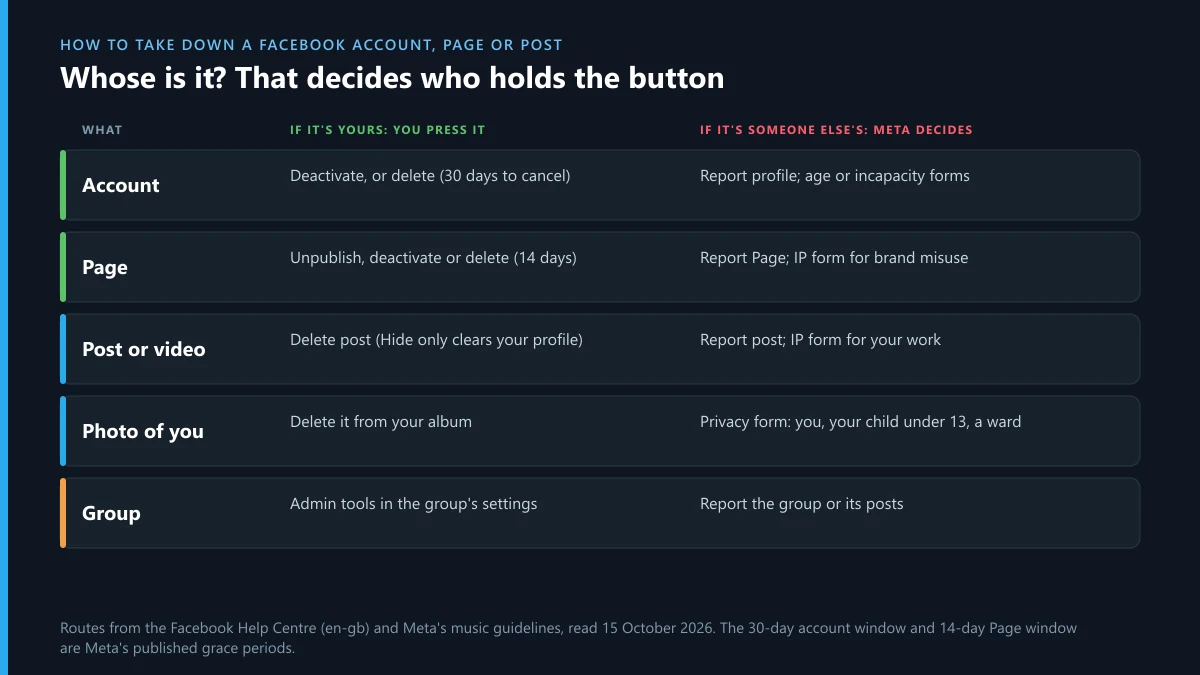
The route depends on what is wrong with the content and who you are to it. Feelings about the content play no part. A photo you took, a brand you own, a face that is yours and a relative who has died each open a different door at Meta, and each door has its own list of people allowed to knock. The table below sorts the common cases, including the one where no service should be involved at all.
| What you want gone | Meta route | Who may file | Can a service file it? |
|---|---|---|---|
| A post that breaks the Community Standards | Report on the post | Any user who can see it | Yes, one accurate report is enough |
| A post reusing your photo, video or music | IP form, copyright branch | Rights owner or authorised agent | Yes, as your named agent |
| A Page trading on your brand name or logo | IP form, trademark branch | Trademark owner or agent | Yes, with your registration details |
| A profile or Page pretending to be you | Report: Pretending to be someone | You, a friend, any user for a public figure | It documents; your own report weighs most |
| A group run for scams or stolen content | Report the group or its posts | Members and viewers | Yes, for what it can see |
| A deceased relative's profile | Memorialization or removal request | Removal: immediate family or executor | No, the family files |
| Your own post, Page or account | Delete it yourself | You | Not needed |
A facebook page takedown service and a facebook group removal service run into the same limit. Meta's intellectual property page says a report can name a single post or an entire profile, Page, group or event, but a whole entity only goes when the entity itself is the problem, for example a Page set up to sell counterfeits. A Page that posted one infringing photo usually loses the photo, not the Page.
Facebook DMCA takedown service and copyright removal: where an agent can file
Intellectual property is the one Facebook route where an outside agent can file in your name. Meta's intellectual property reporting form has separate branches for copyright, trademark and counterfeit, and only the rights owner or someone authorised to act for them may use it. That is the legal footing for any facebook dmca takedown service: without your authorisation, an agent's notice is a false statement. Reports go to a global IP Operations team, and Meta's intellectual property page, read in November 2026, says complete and valid reports are typically actioned "within a day or less." Incomplete ones come back with a request for more detail, which is where most delays start.
Two consequences matter before anyone files a facebook copyright removal request. First, the person whose post comes down is told about the report and the reporting party, and can contest it, including with a DMCA counter-notification. Second, Meta says it may disable the accounts of repeat infringers "in appropriate circumstances," so a single notice rarely ends an account, while a documented pattern can.
What an agent needs from you
Your original file or registration, the exact post URLs, a written authorisation, and the name you are willing to have passed on. A photo of you that someone else took is a privacy matter, not copyright, because the photographer usually owns it.

Large rights holders have extra tools. Meta describes Rights Manager, which matches uploaded video against reference files, and Brand Rights Protection for enrolled trademark owners. If your work also spread to Instagram, the Instagram DMCA takedown process runs through the same Meta IP team, while a DMCA notice to X follows X's own form and counter-notice rules. Telegram Ban Service keeps the step-by-step Facebook screens in a separate guide to filing or answering a Facebook copyright claim.
Facebook fake account removal: impostors, clones and scam Pages
An impostor report works best when the person being copied files it. Facebook's in-app flow sits under Report profile, then Pretending to be someone, then a choice between Me, a friend and a public figure; an account copying nobody real goes under Fake account instead. People without a Facebook login have a separate impostor form, which covers only themselves or a friend. Meta lists accounts that "misrepresent their identity" among the grounds for disabling an account, which is why a clear identity mismatch can end a whole profile rather than one post.

Here a facebook account removal service has a narrower role than its name suggests. Telegram Ban Service can confirm the account really is an impostor rather than a labelled fan page, capture the profile URL, screenshots and the date it appeared, read the Page Transparency panel for a cloned Page's creation date and manager countries, and write the report text. The decisive report is still yours, filed from your own account or the impostor form, because Meta weighs the copied person's word most heavily.
Scam clones move between platforms once the first copy gets reported. When the same face turns up on Instagram or on a Telegram channel asking for payment, each copy needs its own report on its own platform.
Can you delete a deceased person's Facebook account?
Yes, but only verified immediate family or an executor can ask for removal; anyone else can only ask for memorialization. People who search delete deceased person facebook usually need one of these two outcomes, and they run on different forms. A memorialization report keeps the profile visible as a memorial and accepts an obituary, death certificate or memorial card as proof. Removal goes through Meta's special request form for a deceased or medically incapacitated person's account.
For removal, the Facebook Help Center article on removing a deceased family member's account asks for a death certificate. Without one, it accepts proof of authority, such as a power of attorney, a last will, an estate letter or a birth certificate when the deceased was a minor, together with proof of death such as an obituary or memorial card. Names on the documents must match the account. If the account has a legacy contact, only that person can request removal, and Meta never hands out login details to anyone.
Telegram Ban Service does not file these requests and will not pretend to be a relative. The desk can explain which documents fit, and it can report a scammer who clones a dead person's profile to ask friends for money, which is an impostor case, not a family one. Telegram handles accounts differently; its own rules are covered in our guide on how to delete a Telegram account.
How does a removal case move from intake to Meta's decision?
Every case follows the same six stages, and any stage can end in a polite no.
- Intake. Links, screenshots and a sentence on what is wrong. No password, no two-factor code, no access to your account.
- Fit check. Does the content break a named Community Standard, an IP right or the law where you live? If the honest answer is no, the case stops here.
- Route. In-app report, IP form branch, impostor report or legal request, picked from the table above.
- Evidence pack. URLs, capture dates, original files, registration numbers, and for impostors the side-by-side that shows the copy.
- Filing. One accurate report per item, by the person Meta allows to file it.
- Follow-up. Meta's answer lands in the Support Inbox. If a report is rejected, Request another review is usually answered within 24 hours, according to Facebook's Help Center.
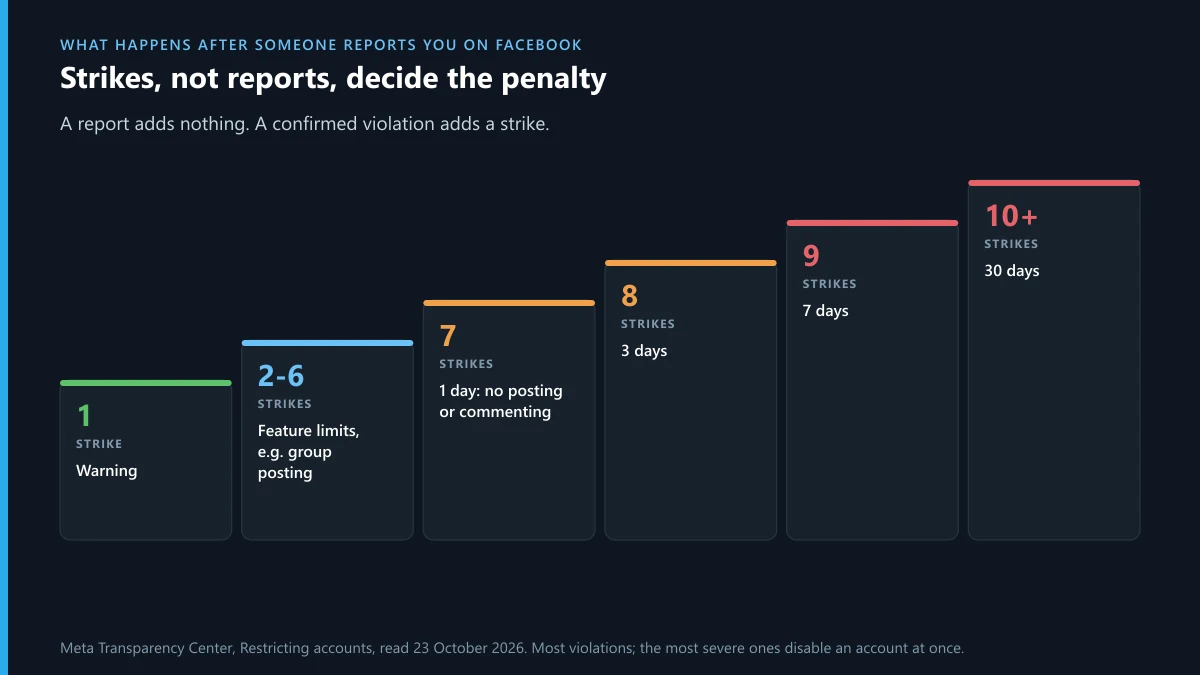
A removed post does not mean a removed account. Meta's Transparency Center page on restricting accounts, read in October 2026, sets out a strike ladder: a warning at one strike, feature limits after that, a one-day posting block at seven strikes and a 30-day block from ten, while the most severe violations disable an account at once. Repeat offenders reach the top of that ladder through confirmed violations, never through report counts.
What we decline, and promises no seller can keep
Telegram Ban Service turns down any Facebook case where the target hasn't broken a rule, however strongly the client feels about it. That covers critics, ex-partners, competitors, honest reviewers and accounts that are merely rude. It also covers the methods: no mass reporting, no report bots, no network of fake accounts, no false IP claims and no posing as a relative on a deceased-account form. Each of those risks the reporter's own account, and a knowingly false copyright notice can create legal liability.
The same answer applies on other platforms. Anyone hoping to delete someone else's Twitter account or asking how you delete someone else's Instagram account gets the honest version: a rule-abiding account stays up, and so it should.
Watch for three sales lines. Any claim that removal is certain, when Meta decides and says so. A fixed deadline, because no Meta page we cite promises one beyond the review-request window. A request for your Facebook login, which no legitimate filing needs. Any facebook content removal service that leads with those lines is selling something other than a report.
When the same impostor or post spreads to Instagram, X or Telegram
Facebook rarely holds the whole problem. An impostor who copied your profile on Facebook may also hold a matching Instagram account when the scam targets your followers, and Meta handles those through Instagram's own tools: see what an Instagram account removal service can and can't do, how an Instagram page report differs from a post report, and the steps to report a single Instagram post. On X, the equivalents are a Twitter account removal service for whole accounts, the limits of any Twitter ban service, and how to report one tweet without reporting the whole profile.
Scams that start in Facebook groups often finish on Telegram, where the payment request arrives, and that part is the daily work of Telegram Ban Service. Telegram's FAQ lists @notoscam and abuse@telegram.org for scam reports. Once Telegram restricts a channel, members see "This channel cannot be displayed" instead of its posts. Impostors also chase look-alike handles, so it helps to know how people buy Telegram usernames and how the Telegram username market on Fragment works before trusting a name that looks official.
Sources
- Meta Transparency Center: How we protect intellectual property rights
- Meta intellectual property reporting form
- Facebook Help Center: reported content and report counts
- Facebook Help Center: request removal of a deceased family member's account
- Facebook: special request for a medically incapacitated or deceased person's account
- Meta Transparency Center: Restricting accounts
- Facebook Help Center: request another review
FAQ
What is a facebook content removal service allowed to do for me?
It can assess the case, choose the right Meta route, gather evidence and, for intellectual property, file as your authorised agent. The same is true of any facebook post removal service. A facebook content removal service has no special access to Meta and no way to delete another person's post directly; only the author can do that, and everything else is a request that Meta reviews against its Community Standards or the law. For copyright and trademark, Meta's reporting form accepts filings from the rights owner or someone authorised to act for them, so an agent can submit with your written consent. For ordinary policy breaches, any user who can see the post may report it, and one accurate report carries the same weight as many. Impostor cases are strongest when the copied person files. A legitimate facebook removal service will also tell you when nothing qualifies, and it never needs your password, your two-factor code or a promise of a result to start.
Can a facebook account removal service delete someone's account?
No. A facebook account removal service can only report an account through Meta's routes, and Meta decides whether to disable it. Whole accounts come down in a few situations: a severe single violation, a run of confirmed violations that climbs Meta's strike ladder, an account that misrepresents its identity, or a repeat infringer under the intellectual property policy. Meta's Transparency Center describes the ladder as a warning at one strike and a 30-day posting block from ten, read in October 2026, with the most severe violations disabling an account at once. None of those outcomes can be bought, and report volume doesn't move them, because Meta's Help Center says the number of reports doesn't determine removal. What a service adds is accuracy: the right report reason, the evidence a reviewer needs, and follow-up through the Support Inbox when a first report is rejected. An account that follows the rules should stay up, and an honest service declines it.
How does a facebook DMCA takedown service file for me?
It files through Meta's intellectual property reporting form as your authorised agent, choosing the copyright branch for your photos, videos, music or text. A facebook dmca takedown service needs your original work or registration details, the exact URLs of every copy, and your written authorisation, because filing without the owner's consent is a false notice. Meta's intellectual property page, read in November 2026, says a global IP Operations team handles these reports and that complete, valid ones are typically actioned within a day or less. The uploader is told about the report and the reporting party and may send a DMCA counter-notification, so expect your name to reach them. Facebook copyright removal covers the infringing post, not necessarily the account; Meta says it may disable repeat infringers in appropriate circumstances. A trademark problem, such as a Page using your logo, takes the trademark branch of the same form instead.
How long does facebook fake account removal take?
No Facebook Help Center page cited here sets a fixed turnaround for impostor reports, so any seller quoting hours is guessing. Facebook fake account removal starts with a report under Pretending to be someone, choosing Me, a friend or a public figure, or with Fake account when the profile copies nobody real. If you have no Facebook login, Meta's impostor form covers you or a friend only. The outcome arrives in the Support Inbox. If Meta keeps the account up, Request another review is usually answered within 24 hours, according to the Help Center, and a second refusal may be eligible for the Oversight Board. Speed depends far more on evidence than on effort. A side-by-side of the real and copied profile, the impostor's URL, the date it appeared and any messages it sent asking for money make a review easy. Reporting the same account from many accounts adds nothing, since Meta says report counts don't decide removal.
Can a facebook page takedown service or a facebook group removal service remove a whole Page or group?
Sometimes, when the Page or group itself breaks the rules. A facebook page takedown service can report a Page that exists to impersonate a brand or person, sell counterfeits or run a scam, and Meta's intellectual property page says a report may name an entire profile, Page, group or event rather than single posts. A facebook group removal service faces the same test for groups: a group organised around fraud, harassment or stolen content is reportable as a whole, while a normal group with a few bad posts usually loses those posts and keeps running. Meta also tracks Page and group quality, so repeated confirmed violations add up over time. What no service can do is remove a Page for criticism, unfavourable reviews or competition. If the Page is yours, you can unpublish, deactivate or delete it yourself, and Meta's Help Center says Page deletion becomes permanent after 14 days.
How do I delete deceased person Facebook accounts if I'm not next of kin?
You can't request removal, but you can ask Meta to memorialize the profile. The delete deceased person facebook route is limited to verified immediate family members or an executor, using Meta's special request form for a deceased or medically incapacitated person's account. Facebook's Help Center asks for a death certificate, or proof of authority such as a power of attorney, a last will or an estate letter together with proof of death such as an obituary. If the account has a legacy contact, only that person can request removal. Friends and colleagues can file a memorialization report instead, which keeps the profile visible as a memorial and accepts an obituary or memorial card as proof. Meta does not give anyone the deceased person's login. If a stranger has cloned the profile to ask friends for money, that clone is an impostor and anyone can report it under Pretending to be someone. No service should file a family request on your behalf.
Will the person whose post is removed know who reported it?
It depends on the route. Ordinary Community Standards reports are not shown to the person reported, so a report of a harassing post doesn't reveal the reporter's name. Intellectual property reports work differently. Meta's intellectual property page says the person whose content is removed is told about the report and the reporting party, and is given a way to contact them or contest the removal, including a DMCA counter-notification. That is why a copyright filing should be made by someone willing to be named, either you or an agent you have authorised. Impostor reports filed by the copied person show Meta who is complaining, which strengthens the case. If a post is removed and the uploader appeals, the item may return, so keep your evidence after the takedown. Telegram Ban Service tells clients which of these routes discloses a name before anything is filed, because the choice of route is also a privacy decision.