November 5, 2026 · Telegram Ban Service · 14 min read
YouTube mass report bot: six seller claims held against what a flag actually sets off
A YouTube mass report bot can't force a removal. YouTube reviews reported content against its policies and says that where reviewers find no violation, "no amount of reporting will change that." In April to June 2026 users filed 82.3 million flags, yet automated systems first detected 98.6% of removed videos, per its Transparency Report.
What does a report on YouTube actually set off?
A report sets off a review against YouTube's rules, and on its own it removes nothing. The reporting help page says it flatly: "When content is reported, it's not automatically taken down." Content that breaks the Community Guidelines comes down, content unsuited to younger viewers may get an age restriction, and the rest stays up. Your chosen reason doesn't narrow the check either: the flags section of the Transparency Report says reviewers assess a video "against all of our Community Guidelines and policies, regardless of why they were originally flagged." Extra flags tend to fold into work already under way. Reporting History explains that a video missing from your list means "many others have already flagged the video, and we're already reviewing the video based on those flags."
Telegram Ban Service is a Telegram reporting desk, not a YouTube vendor, so it has nothing to sell on this keyword. The menus are in the walkthrough on reporting a YouTube channel, video or comment, and what an uploader learns is in whether a reported YouTube creator finds out. The narrower question here: what does the second, tenth or ten-thousandth flag add to what a YouTube mass report bot seller describes?
Six claims from a youtube mass report tool pitch, checked
Nearly every claim in a youtube mass report tool pitch assumes a counter that YouTube says doesn't exist. The pitches are also hard to pin down. A search Telegram Ban Service ran on 5 November 2026 surfaced titles about this kind of bot under a scooter-parts shop's domain and a student association's subdomain, and a plain fetch of the shop's address returned only scooter parts. That suggests spam aimed at search engines rather than a business standing behind a product. So the left column gives the promises in general terms, naming no seller, and the middle column gives what the platform has put in writing.
| The pitch | The documented mechanism | For the buyer |
|---|---|---|
| Enough flags force a removal | "If our review team doesn't find any violations, no amount of reporting will change that" (YouTube Help) | You pay for a number that decides nothing |
| Thousands of reports act as votes | 82,393,855 flags hit 23,484,860 videos in April to June 2026; one video "may be flagged multiple times" (Transparency Report) | Repeats add no evidence about the video |
| Volume brings a harsher review | A heavily flagged video may be "scrutinized more", yet "Flags don't impact the outcome" (Search Engine Journal, May 2021) | Attention isn't a verdict |
| The tool is safe to use | The Terms of Service bar automated access and misuse of any reporting process | The exposure sits on your account |
| Any channel can be taken off | Termination grounds are repeated violations, one case of severe abuse, or dedication to a violation; report counts aren't listed | No path against a rule-abiding channel |
| Insider or priority access | The Priority Flagger program takes government agencies and NGOs, and their reports are "not automatically removed" | Nobody can resell that lane |
Does mass reporting work on YouTube?
No, not as a way to remove content that follows the rules, because no documented step turns flag volume into a decision. Search Engine Journal's May 2021 report on creator liaison Matt Koval's talk with YouTube's trust and safety team put it this way: "There's no system in place on YouTube that will cause a video to get taken down for being reported X-number of times."
Newer numbers point the same way. YouTube's removals data shows 11,159,676 videos removed from April to June 2026. Automated flagging spotted 11,005,420 of them first (98.6%), ordinary users 123,855 and organizations 30,400. Set beside the flag counts, accuracy looks far stronger than volume: users sent 82,300,880 flags, organizations only 92,960. The comparison is rough, not a conversion rate, since first detection and flag totals count different things. The stated reason for prioritizing Priority Flaggers is that their flags "have a higher action rate than the average user".
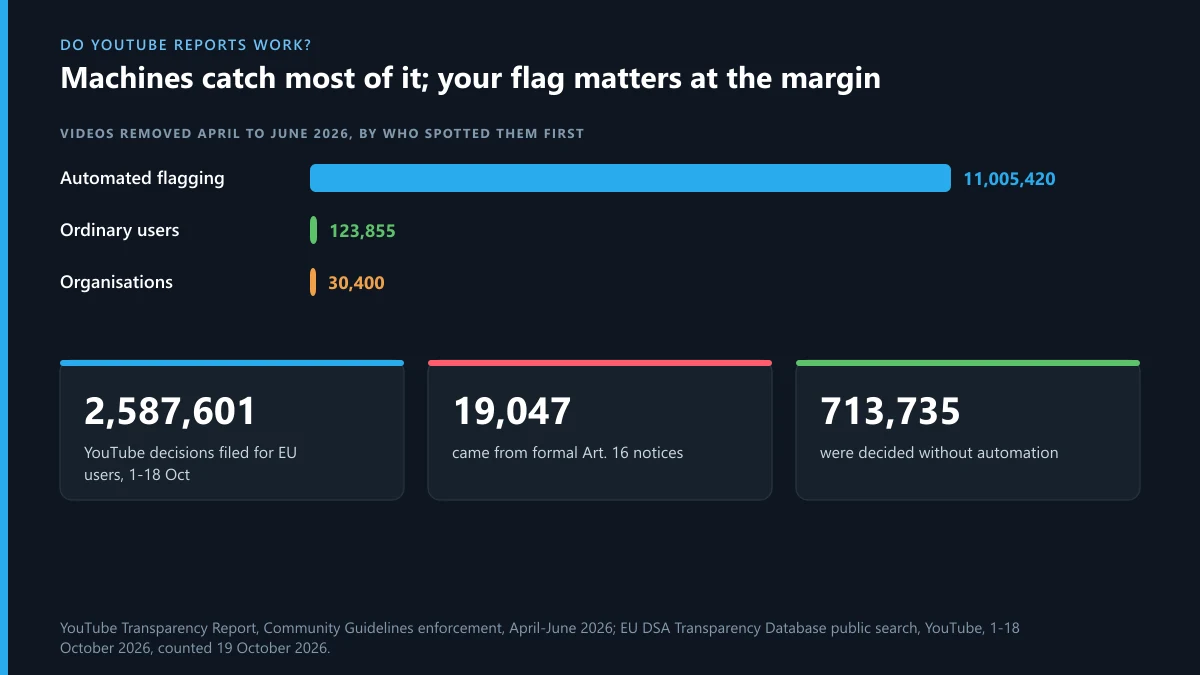
EU records have a similar shape. The DSA Transparency Database lists 5,037,327 YouTube decisions for October 2026 (counted 5 November 2026): 4,942,203 on YouTube's own initiative (98.1%), 79,682 from Article 16 notices, and 0 under the trusted-flagger label. It covers the EU only and counts decisions, not flags.
One honest limit: YouTube makes mistakes, and 87,953 removed videos were reinstated on appeal in that quarter, per its appeals data. So nobody can promise that mass reporting YouTube never coincides with a wrong call. What the record doesn't show is a reliable lever.
How to mass report a YouTube channel: why this page gives no method
There is no legitimate method, so this page gives none. Anyone searching how to mass report a YouTube channel, or how to mass report youtube channel owners they dislike, should know the rule that applies. The YouTube Terms of Service (English version effective December 15, 2023) forbid accessing the service "using any automated means (such as robots, botnets or scrapers)" outside narrow exceptions. They also forbid misusing "any reporting, flagging, complaint, dispute, or appeals process, including by making groundless, vexatious, or frivolous submissions." That second line is the direct hit on any attempt to mass report youtube channel pages, whether software or a coordinated group sends the reports. A mass report youtube channel bot sits under both lines at once, and an order to mass report YouTube video links fares no better.
The fake engagement policy is a related fence, written about views, likes, comments and other metrics. Its wording doesn't mention flags, so it isn't the rule to cite here. Still, 2,310,181 of the 2,732,395 channels removed in April to June 2026 (84.5%) went for spam, deceptive practices and scams, which makes accounts built for automated behavior a shaky thing to rely on. For a real violation, one accurate report with a timestamp gives the reviewer something to check.
What does a buyer of a mass report bot youtube listing risk?
The buyer carries documented risks, while a rule-abiding target has a review on its side. Four kinds of exposure show up.
- Account. YouTube reserves the right to suspend or terminate your Google account for breaching its Terms. After a channel termination, "you are prohibited from using, possessing, or creating any other YouTube channels."
- Device. Check Point Research reported in July 2024 on more than 3,000 fake GitHub accounts spreading password-stealing malware, with lures including tools to grow social media audiences. That research didn't study report bots, but a free download with this name is the same kind of bait.
- Money. Payment for something the platform says can't work leaves nothing to enforce. A public handle proves little, since names change hands on the Telegram username market, and a seller's channel may vanish behind a "this channel cannot be displayed" notice.
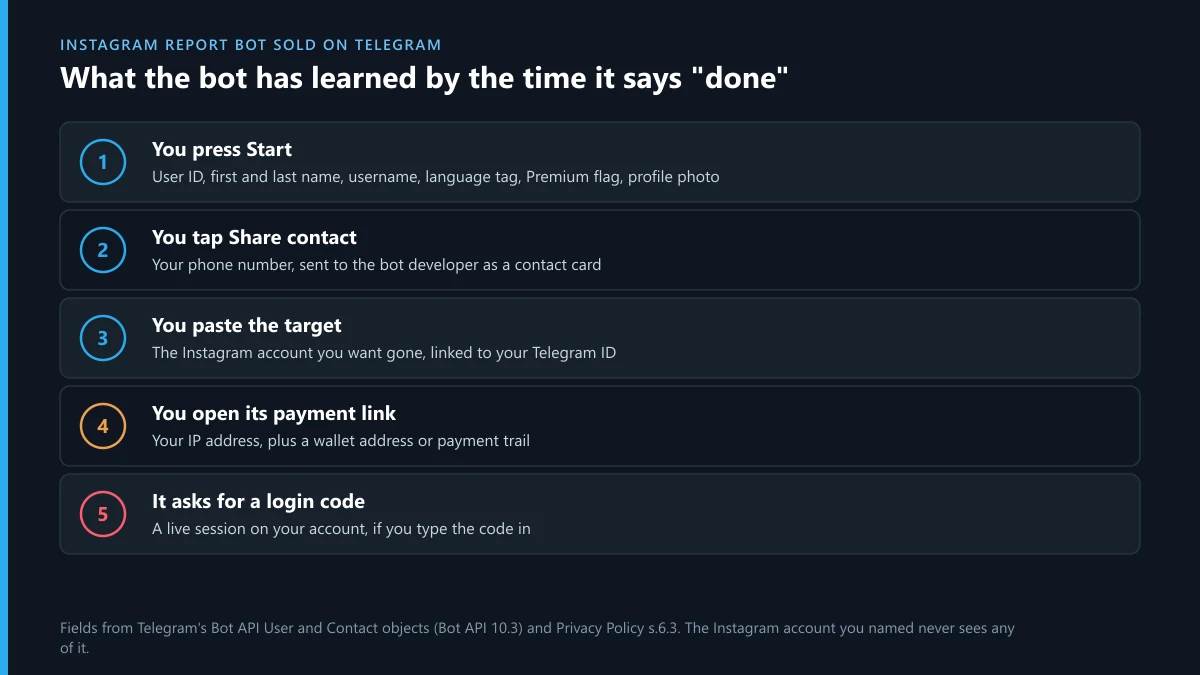
- Login. If a bot asked for a code and you typed it, treat the account as exposed and start with getting a Telegram account back under your control.
What works when a video or channel really breaks a rule?
Five official routes exist, and each takes one accurate submission from someone who can back it up.
- Flag the video. More, then Report, then the reason that fits. People can add comments or timestamps, and those are worth adding.
- Report the channel. On a computer: "…more" in the channel description, then Report user. The spam policy points here when you have "a few videos or comments on the same channel".
- File a privacy complaint. For your own face, voice, name or contact details. Third-party claims are refused outside listed exceptions such as a parent or legal representative, and YouTube says it won't share your name or contact info with the uploader.
- Use the copyright removal request. Only owners or an authorized representative may file, "under penalty of perjury" in the statement. Misuse "may result in the termination of your account or other legal consequences."
- Take the legal route. Under the content or channel: More, Report, Legal issue, then the relevant issue or Other legal issue, then the form. YouTube warns that abusing its legal forms can cost you your Google Account.

The Priority Flagger framing is real but offers individuals no shortcut: only government agencies and NGOs qualify. YouTube's page says "Priority Flagger", not "trusted flagger", and those reports face the same standards as everyone else's. Child safety cases or immediate danger go to local police or a national hotline first.
Your channel is the target of mass reporting: what will you actually see?
You will see an outcome notice if something is enforced. None of the official pages read for this article describes a notice for merely being flagged. The appeals section says creators are notified when a video is removed and get a link to appeal, with 90 days to submit and review by a person. In April to June 2026 it received 1,269,277 video appeals and reinstated 87,953, about 6.9%, a sober number to plan around. Channel terminations run on a different clock: up to one year, with two appeals allowed.
So read the notice, check the named policy against the video, and appeal with specifics. A wave of reports isn't a defense in itself, because the question for the reviewer is whether the video breaks a rule. A stranger offering to "counter-report" for a fee is selling the same myth from the other side. Never hand anyone your Google password or a verification code to fix it.
The same pitch turns up on X, Instagram and Telegram
Only the platform name changes between these offers. On X, the promise is the one Telegram Ban Service pulls apart in deleting someone else's Twitter account and paid Twitter account removal offers. A single bad post has its own route for reporting a tweet, a brand has a trademark infringement form on X, and an annoying swarm is more often a job for clearing bot followers than for any report.
Instagram has the same split between real harm and grudge. Someone copying you belongs in the impersonation steps for Instagram, sustained abuse in how to report harassment there, and a seller who took your money in reporting an Instagram scammer. Two follow-up worries get their own answers: whether an Instagram user learns who reported them and whether a report can be withdrawn.
What does Telegram Ban Service turn down, and what does it take?
Telegram Ban Service turns down every request to run a youtube mass report. It sells no bot, no report quantity and no flagging on any platform. It also refuses rule-abiding channels, critics, competitors, false reports and fake accounts, and it quotes no guarantee or deadline. It won't ask for a password, a login code or a 2FA code under any circumstances.
What it takes is narrower. When a Telegram channel, bot or account is genuinely running a fraud or impersonation, including one cheating buyers with a report-bot pitch, the case runs in a plain order. The desk reads the links and screenshots you send and checks them against Telegram's rules. If they show no violation, it says so and stops. If they do, it arranges the evidence and files through Telegram's official routes. Telegram Ban Service files the report; Telegram makes the final decision. The YouTube side stays with you, in the forms above, because those forms ask for your own statement.
Sources, read 5 November 2026
- YouTube Help: reporting content, Reporting History, channel termination
- YouTube Community Guidelines report, April to June 2026: flags, removals, appeals
- EU DSA Transparency Database, YouTube, October 2026
FAQ
Can mass reporting get a YouTube video removed if it breaks no rule?
No. The short answer to "does mass reporting work on YouTube" is that it does not work against content that follows the rules. A report opens a review, and the review asks whether the content breaks a policy. YouTube's reporting help page says that if the review team finds no violation, "no amount of reporting will change that." A heavily flagged video may draw more attention, as Search Engine Journal reported in May 2021, but the flag count does not set the result. The Transparency Report for April to June 2026 points the same way: automated systems first detected 98.6% of the 11,159,676 videos removed, even with more than 82 million user flags. Mistakes do happen, which is why 87,953 videos were reinstated on appeal that quarter, yet a mistake is not a method anyone can buy.
How to mass report a YouTube channel when the violation is real?
You don't need to, and looking up how to mass report a YouTube channel leads toward a breach of the Terms of Service rather than a removal. One accurate channel report is the official route: on a computer, open the channel, click "…more" in the description, click Report user, then choose the reason and add details. People who search how to mass report youtube channel accounts often have a real grievance, and each kind has a sharper tool: the privacy complaint for your own identity details, the copyright removal request for your own work, the legal form for content unlawful where you live. Asking friends to pile on adds no evidence, and the Terms forbid "groundless, vexatious, or frivolous submissions." Keep the channel URL, video links and timestamps together. YouTube decides the outcome in every case.
Is a YouTube mass report tool allowed?
No. A youtube mass report tool breaks YouTube's Terms of Service on two counts, whichever seller offers it: access through "any automated means (such as robots, botnets or scrapers)" outside narrow exceptions, and misuse of the reporting process. A mass report bot youtube listing asks you to do both with your own account exposed. Whether it also breaks a law depends on your country and on what the software does with other people's accounts, so ask a local lawyer rather than a seller. The practical odds are poor too. Check Point Research documented in July 2024 how more than 3,000 fake GitHub accounts spread password-stealing malware with lures such as social media growth tools. That research did not study report bots, but a free youtube mass report bot download invites the same danger. Nothing on this site links to one or explains how to run one.
Can a mass report youtube channel bot get my own account banned?
Yes, because the Terms of Service apply to the person using the tool. YouTube reserves the right to suspend or terminate a Google account for material or repeated breaches, and a mass report youtube channel bot depends on two banned behaviors: automated access and misuse of reporting. No published figure shows how often report abusers are caught, so treat this as a stated risk rather than a measured one. Consequences get heavier if a form is involved: YouTube warns that abuse of its legal forms may end your Google Account, and a copyright statement is made under penalty of perjury. After a channel termination you are prohibited from using or creating any other YouTube channels, with up to one year and two attempts to appeal. Weigh that against the upside, which is close to nothing when the target follows the rules.
How many reports does it take to remove a YouTube video?
No number exists. Search Engine Journal reported in May 2021, from YouTube's creator liaison, that no system takes a video down for being reported a given number of times, and the current help page still says reported content is "not automatically taken down." So a mass report youtube video order buys a figure with no threshold on the other side. A violating video can come down after one accurate flag, and a compliant one can survive a large pile of them. The Transparency Report shows how far flags and removals sit apart: 82,393,855 flags on 23,484,860 videos in April to June 2026, against 11,159,676 removals, almost all first caught by automated systems. Those totals overlap only partly, so they are not a success rate. Anyone quoting you a required report count has made it up, and that is reason enough to keep your money.
What should I do if someone is mass reporting my channel?
Keep working normally, save what you can, and respond only to what YouTube actually sends you. Mass reporting YouTube creators may draw more review to a video, but the check is still against policy, so a compliant video has a real answer. If a notice arrives, read which policy it names and compare it with the video, then appeal through the link: creators have 90 days for a video removal, and the Transparency Report says appeals go to a person. In April to June 2026 YouTube reinstated 87,953 of 1,269,277 appealed videos, so reversal is possible but not the likely result, and specific arguments matter. Telegram Ban Service does not handle YouTube appeals, and it asks for no password. If someone offers to mass report youtube rivals off your back for a fee, or asks for your login, walk away.
Will Telegram Ban Service run a YouTube mass report for me?
No. Telegram Ban Service does not sell or run a youtube mass report or any other flagging order, on YouTube or anywhere else. It works on Telegram, handling genuine violations such as fraud, impersonation and extortion through Telegram's official routes, and Telegram makes the final decision. It can help when the problem has a Telegram side, such as a channel selling a fake report bot. You send the links and screenshots, the desk checks them against Telegram's published rules, and it tells you plainly if there is no violation to report. It never asks for your password or login code, and it never targets accounts that follow the rules. The YouTube side stays with you, because privacy and copyright forms require your own statement, and those forms and the report buttons cost nothing. No outcome or date is promised for any case.