November 12, 2026 · Telegram Ban Service · 13 min read
Anti Doxxing Starts With Doxxing Yourself, Then Knowing Who Can Help
Anti doxxing means finding and shrinking the personal details a stranger could stitch together about you, before someone posts them. Start by doxxing yourself: search your names, numbers, photos and usernames as a harasser would, then opt out of data brokers by hand, which the EFF's August 2026 guide calls the most effective way to get records removed.
What is anti doxxing, and how is it different from data removal?
Anti doxxing is finding the personal details someone could assemble about you and shrinking that pile before anyone posts it to harm you.
The harm part matters. Google's help page on removing personal information describes doxxing as people sharing your private information to harm you, and says Google may delist results that pair your contact details with threats or calls for harassment, or that pile up personal data without a valid reason. A home address on a county property register is not doxxing by itself. The same address posted under a photo of your front door, with a line telling followers to visit, is.
So what is anti doxxing beyond scrubbing data brokers? Brokers are one source. The others are your own old accounts, photos that carry your face or your street, usernames you reused for a decade, breach dumps, and the people around you who post about you. A broker opt-out handles the first. The rest needs a search you run yourself, which is why most guides start with doxxing yourself and only then sell you a subscription.
Telegram Ban Service is a reporting desk for Telegram channels, groups and bots that break the platform's rules, and it meets doxxing at the far end of this chain: after the details are already compiled and pushed into a public channel.
A guide to doxxing yourself on the internet, in five passes
Doxxing yourself means running the searches a harasser would run, in a fixed order, and logging every hit before you delete or request anything.
Order matters because each pass feeds the next. A forgotten username found in pass one often leads to the email address that unlocks pass two.
- Names and handles. Search your full name in quotes, then add your city, employer and school. Run every username you have ever used through WhatsMyName or Namechk; the EFF's doxxing safety guide of 31 August 2026 suggests both for finding forgotten accounts and spotting impersonators.
- Contact details. Search each email and phone number in quotes, in several formats. Check the email on Have I Been Pwned, which the same EFF guide names for breach lookups.
- Records and brokers. Look yourself up on people-search sites and on public voter, property and business registers. The EFF points to Yael Grauer's BADBOOL list as the place to start with the worst brokers.
- Photos. Reverse-search your profile pictures. Facial recognition engines such as PimEyes or Lenso find more, at a price: you upload your face to them.
- Messaging apps. Search inside Telegram and other apps directly, because web search sees only a thin slice of them. The Telegram pass has its own section below.
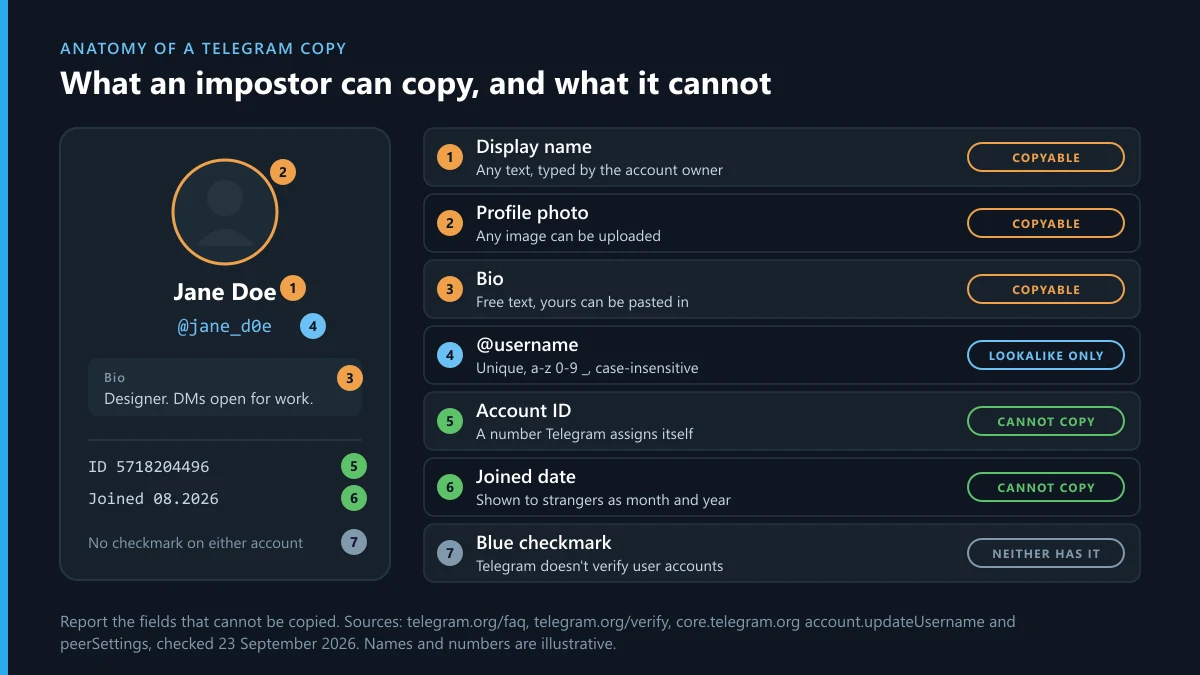
Keep the log boring. One row per hit, with the URL, what it exposes, how you found it, the date, and what you plan to do. That sheet is the whole output of the exercise, and it is what any removal service, lawyer or platform reviewer will ask for later.
Is self doxxing safe, and what should doxxing myself leave out?
Self doxxing is safe when you avoid handing fresh data to the very sites you are auditing.
The risks are specific. People-search sites often invite you to "claim" or "unlock" your full report, and anything you type there can enrich the listing you wanted gone; use their opt-out page instead. A facial recognition upload stores your photo with a company you probably had no relationship with before, which the EFF flags plainly. Breach checkers need an email or a phone number, never a password, so any tool asking for one is the threat rather than the cure. Telegram Ban Service works the same way: it asks for links and screenshots, nothing that opens an account.
Two more lines worth holding while doxxing myself, or a family member with their consent. Do not message or confront anyone you find. A reply tells a harasser which account is really yours, and it can turn a stale listing into an active target.
And keep the log off shared drives and group chats. A spreadsheet that maps your address, numbers and old handles in one place is, by definition, the dossier a doxxer would want. Store it locally, or on paper, until the cleanup is done.
What do anti doxxing services actually do?
Most anti doxxing services are data-broker removal subscriptions: they file opt-out requests on your behalf and repeat them when listings come back.
That repetition is the product, since brokers rebuild profiles from public records. The EFF guide reports that testers found paid removal services less effective than filing requests by hand, and recommends manual requests as the most effective route, with a service as the fallback when time is the problem. Other categories cover different ground.
| Type of help | What it reaches | What it cannot reach |
|---|---|---|
| Broker removal subscription | Opt-outs at the brokers on its list, repeated on a schedule | Court and property records, social posts, Telegram channels |
| Google's removal request (you file it) | Search results that expose contact details or doxxing content | The page itself, which stays on the host site |
| Public-figure protection programs | Monitoring, broker removal, sometimes physical security advice | Any platform's moderation decision |
| Platform reporting desk | Prepared reports on content that breaks that platform's rules | Private chats, lawful posts, a promised result |
Verdict: for most people, a manual broker sweep plus Google's form covers more ground than any single subscription. Telegram Ban Service belongs in the last row only, and only for Telegram. Pay when the hours are the obstacle, and read what the contract excludes before you hand over the personal details the service needs to do its job.
Where does Telegram fit into a doxxing check?
Telegram matters because lookup bots and leak channels there can return or post personal data that never surfaces in Google.
The best-documented case is the "Eye of God" bot, which answered queries with phone numbers, addresses and other records. Russia's regulator ordered Telegram to block it in March 2021, and a Moscow court banned the bot in July 2021, yet mirrors kept it running. The pattern has not gone away. In February 2026 Roskomnadzor told RBC that Telegram removes up to 100 such data-search services a week and about 8,400 since 2022, as The Moscow Times reported; those are the regulator's figures, not Telegram's.
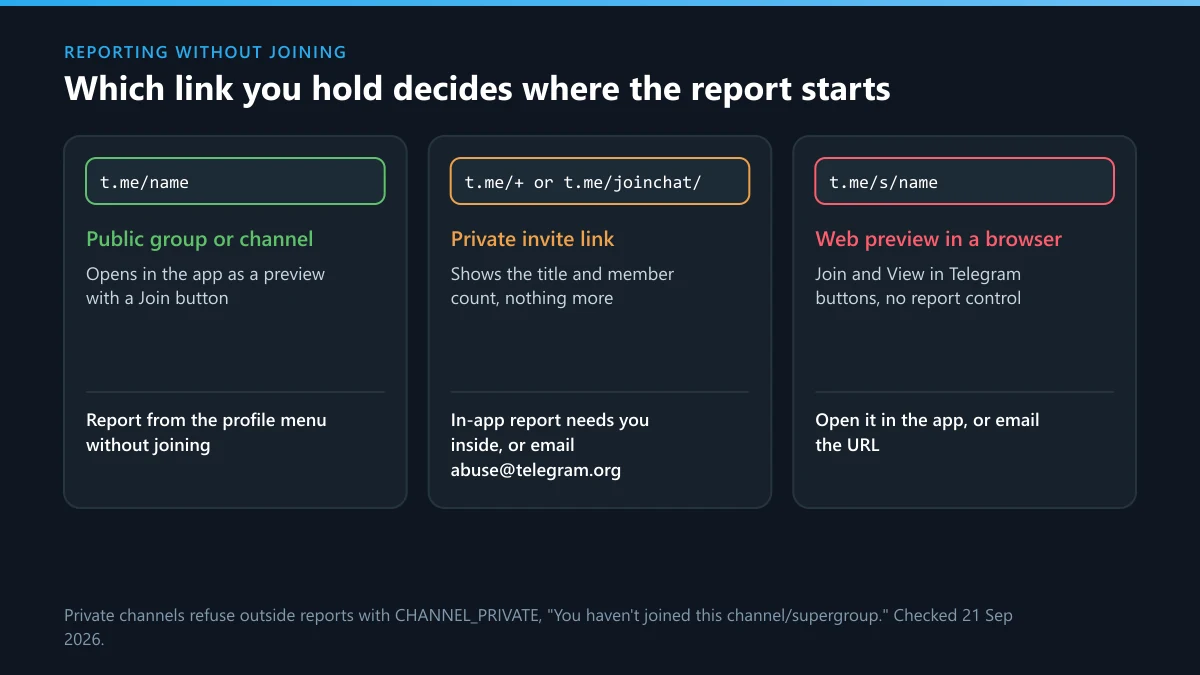
For your own check, open the app's global search and type your name, each username, your phone number and your business name. Open any public channel or group that matches and use its in-chat search for your email and street. A t.me link found on the web is worth noting even if you cannot open it, because the kind of link decides where a report can start.
How does Telegram handle a report of posted private information?
Telegram reviews public content flagged with the in-app Report button or emailed to abuse@telegram.org with the t.me link attached.
The Telegram FAQ says every app has Report buttons for moderators, asks emailed complaints to include t.me or @ links, and points impersonation victims to @NoToScam. It also states that private groups and chats are private among their participants and that Telegram does not process requests about them. The Terms of Service never use the word doxxing. A report therefore has to hang on what the terms do name: promoting violence on public channels and bots, scams, activities illegal in most countries, and the ban on data scraping.
In practice a case at Telegram Ban Service runs in four steps. The desk reads every post you send and drops anything lawful. It matches each remaining post to a named clause, quoting the line. It gathers the t.me links, dates and screenshots into one file. Then it files through the in-app report and the abuse address. Telegram Ban Service files the report; Telegram makes the final call, on its own timeline.
A channel that is restricted can be recreated, so the log from your self-audit stays useful afterwards. For what each enforcement level looks like, see the ways Telegram restricts or bans a channel, and for the platform's broader record, Telegram's own safety record.
What this desk will not take on
An audit sometimes surfaces a person rather than a leak: an ex, a critic, a rival who posted nothing private. That is not a case, and Telegram Ban Service will not file one.
The desk declines lawful channels and accounts, false or inflated reports, coordinated report waves, bots, and any request that comes with a password or a 2FA code. It offers no guarantee and no deadline. Volume does not move moderators, and it can rebound on whoever orders it, which is the common finding in what a TikTok report bot looks like to moderators, YouTube report bot offers, mass reporting on Snapchat and why piling reports onto a Facebook group changes little.
The same limit applies to requests to make an account vanish. Getting another person's Facebook profile removed, removing someone else's Snapchat, a Snapchat account takedown, requests to erase another person's TikTok and what a TikTok ban service can lawfully file each come back to one rule: the account has to break the platform's terms. If you are the one being reported, the receiving end of a Facebook report explains what happens next.
When the exposure sits on another platform
Each platform has its own door, and a doxxing report filed at the wrong one usually stalls.
If someone threatens to publish your details unless you pay, treat it as extortion first and privacy second: doxxing threats used as leverage on X and blackmail attempts that start on Facebook cover the evidence to keep before you contact police. Repeated abusive posts fit harassment reports on Facebook, and invented claims about you belong under false claims about you on Facebook. A seller trading on your identity calls for reporting a Marketplace seller who uses your details or the evidence each TikTok Shop report route asks for.
Copies of you are their own category. A fake TikTok profile wearing your photos and a TikTok scammer who reuses your identity are impersonation; on Instagram, start with Instagram's separate report forms. Videos that show your face or home go through YouTube's privacy and takedown routes for a video, or filing a copyright strike on YouTube when the footage is yours, with a DMCA notice on TikTok as the equivalent there. And if your number turned up on bulk-message lists, the way Telegram mass DM campaigns collect numbers explains where such lists tend to come from.
Sources
- Google Search Help: Remove personal information from Google
- EFF: Doxxing Safety Pt I, Prevention and Footprint Management (31 August 2026)
- Telegram FAQ
- Telegram Terms of Service
- Meduza: Moscow court bans Telegram bot Eye of God (July 2021)
- The Moscow Times: Roskomnadzor on Telegram data-search bots (February 2026)
FAQ
What is anti doxxing in plain terms?
Anti doxxing is the work of finding what a stranger could learn about you and cutting it down before someone posts it to hurt you. It has two halves. The first is an audit: searching your names, usernames, numbers, email addresses and photos the way a harasser would, and logging every result. The second is cleanup: opting out of data brokers, closing old accounts, tightening privacy settings and, where details are already posted with threats, reporting the post to the platform or asking Google to delist it. Google's own help page describes doxxing as sharing private information to harm someone, so a public record alone is not the target; the target is exposure that can be combined and used against you. Most of the work is free. Paid help saves time on the broker half, but no service can see inside every app or decide how a platform will rule.
Is doxxing yourself legal, and can it backfire?
Doxxing yourself is legal almost everywhere, because you are searching for your own information and publishing none of it. It can backfire in small, predictable ways. Typing extra details into a people-search site to unlock a report may feed the very listing you want removed, so use the site's opt-out page instead. Uploading your face to a facial recognition engine gives that company a copy of your photo, a trade-off the EFF's August 2026 guide names openly. Breach checkers such as Have I Been Pwned need an email or phone number and never a password; a tool that asks for a password is the attack. The last risk is social. If you find a hostile account, do not reply or confront it, since a reply confirms which profile is really yours. Write it down, take a dated screenshot, and decide on a report later.
How long does doxxing myself take the first time?
Plan on one long, unhurried sitting for the first round of doxxing myself, then shorter repeats. The first pass is slow because you are building the log from nothing: every username you have used, every email, every old phone number, and the people-search listings tied to each. Opting out of brokers by hand adds more time, since each site has its own form and some ask you to confirm by email. The EFF still recommends doing those requests manually because they work better than automated ones. After that, a quarterly repeat mostly compares new results against the existing sheet, which goes much faster. Add an extra check after events that tend to create fresh pages, such as a move, a public dispute or a breach notice. On Telegram, repeat the in-app search for your name, numbers and handles in the same session, because web search misses most of the app.
Are anti doxxing services worth paying for?
Anti doxxing services are worth it when time, not knowledge, is what stops you. Most of them are broker-removal subscriptions that send opt-out requests to a list of people-search sites and resend them when profiles reappear, which they do, because brokers rebuild listings from public records. The EFF reported in August 2026 that testers found these services less effective than filing the same requests by hand. So the honest comparison is your hours against their fee. Before signing up, check which brokers the plan covers, whether it handles public records such as property or voter files, and what it does with the personal details you must give it. None of them can remove a post from a Telegram channel, a social profile or a video site; those need a report under that platform's rules. Telegram Ban Service handles only that Telegram reporting piece, never broker removal.
What does self doxxing usually miss?
Self doxxing usually misses whatever web search cannot see. Messaging apps are the largest gap: Telegram channels, groups and bots appear in Google only as scattered previews, and private groups not at all, so the search has to happen inside the app. Lookup bots are a second gap, because they answer queries from leaked databases rather than from indexed pages, so nothing about you shows up until someone asks the bot. Photos are a third. A name search will not find a picture of you posted under another name, which is why a reverse image pass belongs in every audit. Finally, people close to you leak details you never posted yourself, such as a tagged location, a wedding page or a school newsletter. Ask family members, with their agreement, to run the same checks on their own accounts, because privacy works better when the people around you take part.
Can Telegram remove a lookup bot that shows my phone number?
Telegram can remove a public bot, and it has removed data-search bots at scale, but it decides case by case. Report the bot in the app from its profile menu and email abuse@telegram.org with the @username or t.me link, as Telegram's FAQ asks. Explain what the bot returns and attach a screenshot of the reply showing your data. Telegram's Terms of Service do not mention doxxing by name, so the strongest reports point to what they do cover, including scraping of user data and activity illegal in most countries. Russia's regulator said in February 2026 that Telegram removes up to 100 such services a week, though that is the regulator's figure. Expect clones: a removed bot can return under a new name. Telegram Ban Service can prepare and file that report from your evidence, without your login, and the decision stays with Telegram.
Is there a guide to doxxing yourself on the internet that is not a sales page?
Yes. Many results for a guide to doxxing yourself on the internet come from data-removal companies, and their steps are often sound, but each one ends in a subscription pitch. A non-commercial option is the Electronic Frontier Foundation's Doxxing Safety series, whose first part was published on 31 August 2026. It covers manual broker opt-outs, starting with the BADBOOL list, breach checks, public-record removal forms, address confidentiality programs in some US states, username searches through WhatsMyName or Namechk, and the trade-offs of facial recognition searches. It also notes that specific tools change, so the habits matter more than any product. Pair it with Google's personal information removal page for search results and with each platform's own help center for posts. Use vendor guides for their checklists if you like, and skip their claims about how much they remove.