14 November 2026 · Telegram Ban Service · 16 min read
How to Fix Negative Reviews: Repair, Ask, Flag, Outweigh
To fix negative reviews, repair the problem the customer hit, reply once in public, then ask that customer, with no reward attached, whether they would update what they wrote. Flag only reviews that break a platform rule and outweigh the rest with steady, genuine new ones. Google's Maps content policy bans incentives for revising or removing a negative review.
A one-star review just landed. What does fixing it actually mean?
Fixing a negative review means changing what a future customer learns from your profile, not making a sentence vanish. That outcome has four levers, and only one of them involves removal.
The first lever is the business itself: whatever broke for this customer will break for the next one. The second is the reviewer, who alone can edit or delete what they posted. The third is the platform, which takes a review down only when it breaks a written rule. The fourth is volume over time, because a single complaint reads very differently among forty recent, specific reviews than it does among six old ones. Telegram Ban Service is a reporting desk for Telegram channels, groups and bots, so most of this playbook is work an owner does alone, and the page says plainly where an outside party adds nothing.
Short version, if you want to fix negative reviews for good: repair, reply, ask, flag, outweigh. In that order.
How to fix bad reviews in the order that works
- Find the cause. Match the review to an order, booking or visit, and check whether others reported the same thing.
- Reply once, in public. Name the fix you made, keep it short, and leave out the customer's private details.
- Follow up in private. If the problem is solved, ask whether the review still reflects their experience.
- Flag what breaks a rule. Fake, off-topic, hateful or conflict-of-interest posts go to the platform's own form.
- Keep reviews coming from everyone. Ask every customer the same way, happy or not.
Owners who fix bad reviews by skipping straight to step four usually stall there, because platforms leave honest criticism up.
Why fix the cause before you touch the review?
A review is a symptom, and platforms are built to protect symptoms that are true. If a dental office gets three reviews in a month about surprise fees, flagging them as "unfair" will fail; the reviews describe something that happened. Changing the fee disclosure on the booking page will not delete them either, but it changes what the next patient experiences, and it gives you something concrete to say in your reply.
That reply matters more than most owners think. Google's own Business Profile help on improving local ranking says positive reviews and helpful replies can help a business stand out. A reply is read by every later visitor, while the original reviewer reads it once. Write it for the stranger who is deciding whether to book: what went wrong, what changed, how to reach you. The craft of that public answer has its own guide, on replying to negative reviews on Google and other sites.
Only after the fix is real does the private follow-up make sense. Asking first, while the problem still exists, tends to read as pressure, and pressure is where the rules start to bite.
How to ask a customer to remove a bad review without breaking the rules
You can ask; you cannot pay, pressure or threaten. The FTC's staff questions and answers on its Consumer Reviews and Testimonials Rule say the rule does not bar contacting customers to resolve the issues they raised, or asking satisfied customers to update their reviews. Google's Maps prohibited and restricted content policy draws the line at incentives: merchants may not offer payment, discounts or free goods or services in exchange for a review "or revision or removal of a negative review".
So, how to ask a customer to remove a bad review in practice? Ask for an update, not a deletion. A customer whose refund arrived may happily add a line saying so; asking them to erase their experience feels like censorship and often hardens it. Yelp is stricter still about solicitation: its content guidelines say businesses should never ask customers to write reviews, so on Yelp keep the message to the fix itself and let the customer decide whether to revise.
A message that stays inside every rule looks something like this: "Thanks for telling us about the late delivery. We refunded the fee on 3 November and changed couriers for your area. If the review no longer reflects what happened, you are welcome to update it; either way, we appreciate the feedback." No coupon, no deadline, no hint of consequences. Telegram Ban Service plays no part in this exchange, and no outside firm should; the request carries weight only because it comes from the business that fixed the problem.
| Platform | Asking for an update | Offering a reward | Where the line sits |
|---|---|---|---|
| Google Maps | Allowed if no reward is attached | Banned for posting, revising or removing | Maps content policy, Fake engagement |
| Yelp | Keep it to the fix; never solicit a review | Not allowed | Yelp content guidelines |
| Any US business | Allowed after resolving the issue | Paying to remove truthful negative reviews may violate the FTC Act | FTC rule Q&A, 2024 |
How to ask someone to remove a bad review they wrote in anger
Wait until the issue is closed, send one message through the platform's own reply tool or the contact details they gave you, and never send a second if they stay silent. The same goes for how to ask customer to remove negative review content on a marketplace: one polite note, no reward, then leave it alone.
Which negative reviews can you flag for removal?
You can flag a review that breaks a published content rule, and nothing else. Google's policy lists categories such as fake engagement, off-topic posts, conflicts of interest, harassment, hate speech and personal information, and its Business Profile help on removing reviews routes owners through the Reviews Management Tool to report one and track the result. A review that is harsh, unfair-sounding or one-sided but true does not fit any of those boxes.
Where flags do work is in patterns. A dozen one-star posts in two days from empty profiles, with matching phrasing and no customer record behind them, is evidence a reviewer cannot argue with.

Google added a separate route in October 2025 for one specific attack: reporting negative review extortion scams, where someone floods a profile with one-star ratings and then demands money to stop. That report goes through its own form, not the ordinary flag. The wider question of what each platform keeps up is covered in which bad reviews platforms will actually remove, and the limits of Google-only work in what a Google reviews removal service can really qualify for. For the mechanics of your own posts versus someone else's, see removing a review you wrote or one you did not.
Can you push down negative reviews with fresh, genuine ones?
Yes, and for most businesses this is the lever that moves the needle. To push down negative reviews honestly, you raise the number of recent, detailed reviews from real customers, so the complaint stops being the first and loudest thing a visitor sees.
The rule that governs this is about fairness of asking, not quantity. Google's policy forbids merchants to "discourage or prohibit negative reviews, or selectively solicit positive reviews from customers", which kills the old trick of sending a happy-face survey and only pointing smiling customers to Google. That practice is called review gating. The compliant version is dull: every customer gets the same request at the same point, such as a receipt footer, a follow-up email or a card at checkout. Some will be unhappy, and you answer those too.
For anyone trying to manage negative reviews on a deadline, buying reviews to bury criticism is the shortcut that ends badly. The FTC's final rule banning fake reviews and testimonials, announced in August 2024 and in force since 21 October 2024, covers writing, buying and selling fake reviews, and the FTC says courts can impose civil penalties for knowing violations.

Does removing negative reviews actually improve local search rankings?
Only a little, and indirectly. Google says local results depend on three factors, relevance, distance and prominence, and that more reviews and positive ratings can help a business's local ranking. It publishes no weight for any single review, and nothing in its help pages says deleting one lifts a listing.
The arithmetic is modest. Take a profile with 100 reviews averaging 4.50 stars, one of them a one-star post. Removing that review leaves 99 reviews averaging about 4.54. Searchers might notice; a ranking system blending relevance and distance probably barely does. Adding twenty new genuine reviews moves both the count and the recency of your profile, which is why owners asking does removing negative reviews actually improve local search rankings usually get the same answer from practitioners: the removal itself matters less than what the profile looks like afterward.
There is one case where removal does matter. A coordinated wave of fake one-star reviews can drag a small profile's average down hard, and getting that wave taken out restores a rating that was manipulated in the first place.
That is a cleanup of fraud, not a ranking tactic. When such a wave is bought in a Telegram channel, Telegram Ban Service can report the channel; the review site still decides on the reviews.
What does online reputation management add, and what do we decline?
Online reputation management is the paid version of the same five steps, plus reporting, monitoring and reply drafting across many sites. Searches such as "how to remove negative review online reputation management" tend to lead to firms that promise removal; the legitimate ones describe managing or removing online reviews only within platform rules, and they cannot remove an honest review any more than you can.
Telegram Ban Service works on one slice of this: the Telegram channels, groups and bots where fake ratings are sold, review attacks are organized and "removal" scams are advertised. It reports those through Telegram's own routes; Telegram decides whether anything is restricted or banned.
What we decline
- Writing, buying or arranging fake positive reviews, or fake negative ones about a competitor.
- Paying for, or brokering, the removal of a genuine customer's review.
- Finding, contacting, suing or threatening a reviewer to make a post disappear; the FTC rule names unfounded legal threats and intimidation as review suppression.
- Reporting a reviewer's social accounts in bulk to punish them, on any platform.
- Any request for a password, login code or account access.
Bulk reporting fails on its own terms, too. Moderation weighs the content, not the count, as what TikTok moderation sees from a report bot, what counts when groups and Pages are mass reported on Facebook, the truth about YouTube mass report bots and why a Snapchat mass report rarely works each show. The same goes for paid "ban" offers like a TikTok account ban service, and for the receiving side, described in what happens when someone reports you on Facebook.
When the review attack is organized on Telegram
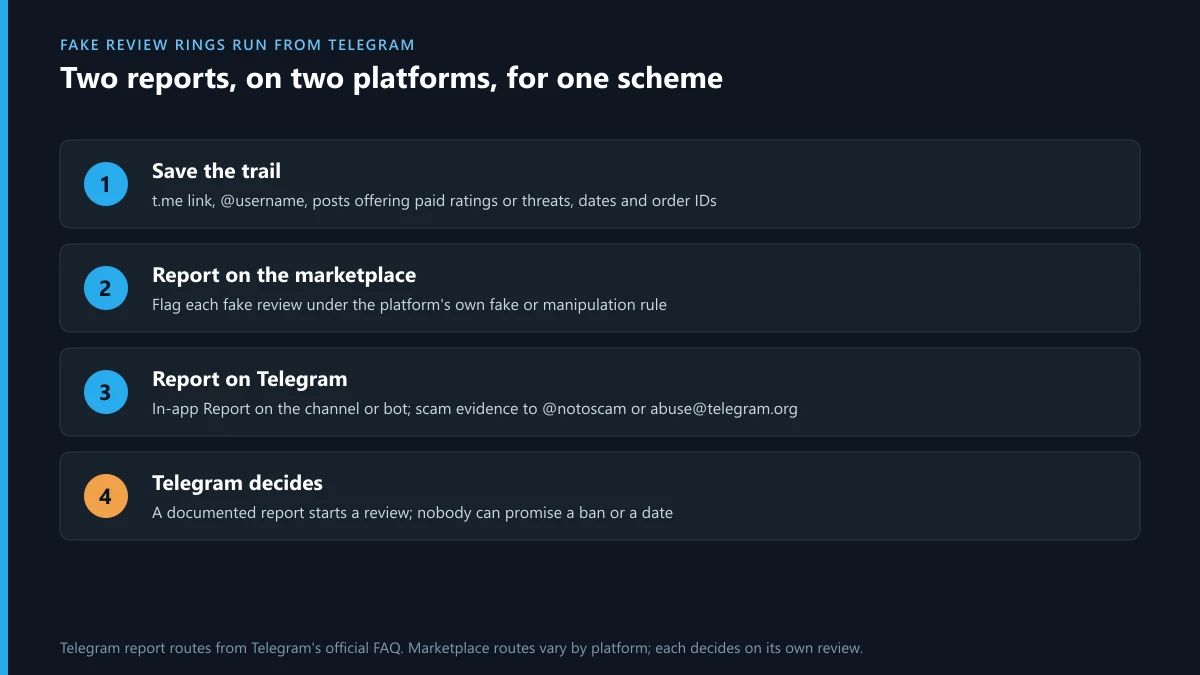
Some one-star waves are planned in public Telegram channels that sell ratings by the hundred, or in bots that take orders against named listings. A case there is handled in a fixed order. The owner sends the channel or bot link, screenshots of posts that name the listing, and any payment demand. The desk checks the material against Telegram's Terms of Service, then files one documented report through the in-app Report button and, for scams, through the routes Telegram lists in its official FAQ. In parallel, the owner flags the fake reviews on the review site itself, because a Telegram report never removes a Google review.
How Telegram treats reported channels is explained in how a Telegram ban actually happens, and whether the app itself is the risk in is Telegram a scam. Review sellers often cold-message owners in bulk; how Telegram mass DM services price and run campaigns shows what that machinery looks like.
Review attacks also spill onto social accounts. A seller who threatens your listing may move to blackmail patterns common on Facebook or sextortion and doxxing threats on X. Abusive posts about staff fit reporting harassment on Facebook, while false factual claims may belong in libel on Facebook and when it becomes a legal matter. If the attackers run fake storefronts, use the Marketplace seller report or what each TikTok Shop seller report route needs; impersonators fit the fake TikTok account report and the Instagram report forms for impersonation and abuse.
Copied product videos have their own routes: a TikTok copyright infringement report, how a YouTube copyright strike is filed and the grounds YouTube accepts for removing a video. Account-level requests follow the same logic. Nobody removes an account because of an angry review, which taking down a Facebook account, why you cannot delete someone else's Facebook account, taking down a Snapchat account, deleting someone's Snapchat account and deleting someone else's TikTok account each explain from the rule side.
Sources
- Google Maps User Generated Content Policy Help: Prohibited and restricted content
- Google Business Profile Help: Tips to improve your local ranking on Google
- Google Business Profile Help: Remove reviews from your Business Profile
- Google Business Profile Help: Report negative review extortion scams
- FTC: The Consumer Reviews and Testimonials Rule, Questions and Answers
- FTC press release, August 2024: final rule banning fake reviews and testimonials
- Yelp content guidelines
- Telegram FAQ: reporting channels, bots and scams
FAQ
How do I ask a customer to remove a negative review?
Ask for an update after the problem is fixed, not a deletion before it. Whether you are searching how to ask customer to remove negative review content, how to ask a customer to remove a bad review, or how to ask someone to remove a bad review a client wrote in anger, an edited review usually helps more than a missing one. Send one short note through the platform's reply tool or the contact details the customer gave you. Say what you fixed and when, then say they are welcome to revise the review if it no longer reflects what happened. Attach no discount or deadline, because Google's Maps policy bans incentives for revising or removing a negative review. On Yelp, keep the note to the fix itself, since Yelp says businesses should never ask customers to write reviews. If the customer stays silent, do not follow up again. A second or third message tends to read as pressure, and the FTC's 2024 rule treats intimidation aimed at removing reviews as review suppression.
Is it legal to offer a refund or discount for changing a bad review?
It is risky, and on Google it breaks the rules outright. Google's prohibited content policy says merchants may not offer payment, discounts, free goods or services in exchange for posting a review or for revising or removing a negative one, and violations can lead to removed reviews or restrictions on the profile. The FTC's staff guidance adds a legal layer for US businesses: its Consumer Reviews and Testimonials Rule does not itself ban paying someone to change a review, but the FTC warns that paying consumers to change or remove truthful negative reviews may violate the FTC Act because it distorts what other buyers see. The clean separation is simple. Refund the customer because the service failed, with no strings, and keep any question about the review in a separate later message with no reward attached. If the refund and the review request arrive in one email, it reads as a trade, whatever you intended.
Can I push down negative reviews instead of removing them?
Yes, and it is usually the more reliable route. You push down negative reviews by earning a steady flow of recent, genuine reviews, so one complaint stops dominating the profile. The method has to be even-handed. Google's policy forbids merchants to discourage negative reviews or selectively solicit positive ones, so a survey that sends only happy customers to Google, known as review gating, breaks the rules. Ask every customer the same way at the same moment: a line on the receipt, a follow-up email a day after service, or a card at checkout. Expect some critical reviews in the mix and reply to them, because replies are part of what later visitors read. What you cannot do is buy volume. Fake reviews are banned by Google and by the FTC rule in force since 21 October 2024, and a burst of thin five-star posts from new accounts is exactly the pattern platforms filter out.
Will deleting a bad review lift my local search ranking?
Not by much on its own. The question people type is 'does removing negative reviews actually improve local search rankings', and Google's answer is indirect: it says local results weigh relevance, distance and prominence, and that more reviews and positive ratings can help a business's local ranking, but it publishes no weight for a single review and never says that deleting one lifts a listing. A profile with 100 reviews averaging 4.50 stars that loses one one-star review moves to roughly 4.54, a change customers may notice but a ranking system blending several signals likely barely registers. Fresh reviews change more: they raise the count and keep the profile current. The real exception is fraud. When a coordinated wave of fake one-star reviews hits a small profile, the average can drop sharply, and getting those posts removed through Google's reporting tools restores a rating that was manipulated. Treat removal as cleanup of rule-breaking content and treat new genuine reviews as the actual growth lever.
Should I hire a firm for managing or removing online reviews?
Hire one only for work you cannot do yourself, such as monitoring many locations or drafting replies at volume. Managing or removing online reviews through an agency follows the same platform rules you face: a firm can report policy-breaking reviews and help you respond, but it has no back door to delete honest ones. Many people searching how to remove negative review online reputation management land on sellers promising guaranteed removal, and that promise is the main warning sign. Ask any firm to name the policy each removal would rely on, how it reports through the platform's own tools, and whether it ever contacts reviewers. Walk away if it asks for your Google or Yelp login, offers to post positive reviews for you, or charges per deleted review. Those practices can put your profile at risk under Google's policies and the FTC's 2024 rule. A legitimate firm describes process and limits, and it will say plainly that the platform decides.
How do I manage negative reviews across Google, Yelp and Facebook?
Use one routine for every platform and adjust only the asking rules. To manage negative reviews well, check new reviews on a fixed schedule, match each complaint to a real order or visit, fix the cause, and reply publicly within a few days in a calm, specific tone. Keep a simple log of the issue, the fix and the reply so patterns show up, for example several complaints about the same staff shift. Then apply each platform's own rules. On Google you may ask a satisfied customer to update a review as long as no incentive is attached. On Yelp, avoid soliciting reviews at all and keep any message to the fix. On Facebook, recommendations can be reported only when they break the platform's standards. Flag only posts that break a written rule, using each platform's official report option, and never ask friends or staff to write reviews, which every major platform treats as a conflict of interest.
How to fix bad reviews that came from a Telegram review farm?
Work on two platforms at once. On the review site, flag each fake review under its fake engagement or manipulation rule, and if someone demands money to stop, use Google's separate form for negative review extortion scams. Do not pay; paying rarely ends the demands. On Telegram, save the channel or bot link, the post naming your listing, price lists and any payment request before they are deleted. Telegram Ban Service can take that evidence, check it against Telegram's Terms of Service and report a genuine violation once through Telegram's official channels, but it cannot remove the reviews themselves, and Telegram alone decides on any ban. To fix bad reviews from a farm for good, keep your normal review requests running for every customer, so genuine feedback outweighs the attack once it is cleaned up. Nobody involved will ask for your password or a login code; anyone who does is part of the problem.