14 November 2026 · Telegram Ban Service · 14 min read
How to Remove a Review on Airbnb as a Guest, and When You Can't
How to remove a review on Airbnb as a guest: you can't delete a host's review yourself, but you can ask Airbnb to take it down when it breaks the Reviews Policy, for example as irrelevant, extorted or retaliatory. Airbnb's Help Center says a decision usually arrives by email in about 48 hours, with two requests allowed per review.
Who controls a host's review of you: the guest or Airbnb?
Airbnb does. A host review is the host's written account of your stay, published to your guest profile, and the only person who can delete it unaided is the host who wrote it, within a limited window. Everyone else, you included, can only ask. That shapes the whole answer to how to remove airbnb review as a guest: you are not deleting anything, you are filing a request that Airbnb accepts or refuses against its written policy. Telegram Ban Service, a reporting desk that files documented violations through Telegram's official channels, reads every review question in that same frame, because the platform that hosts the content is the one that rules on it. The request needs a named policy reason rather than a complaint about fairness, and when Airbnb does take a review down, it emails the reviewer to explain why, so the host will know a removal happened.
So can a guest remove a review on Airbnb? Only one kind. Airbnb's policy page, Authentic and trustworthy reviews, says you can remove a review you wrote within 30 days of its publication. A review written about you is different: Remove or dispute a review lets the guest who booked the reservation ask for removal at any time, provided the review breaks the policy.
Disagreeing is not enough.
If the bigger question is any review, on any site, the author-versus-platform split for every kind of review covers the general rule. This page stays on Airbnb and on the guest's side of it.
Which host reviews break Airbnb's Reviews Policy?
Six categories, as of November 2026. Airbnb's Help Center article 2673 lists them: irrelevant reviews that describe something other than the stay or come from someone with no first-hand experience; fake reviews not tied to a real reservation; biased, deceptive, extorted, incentivized or pressured reviews; reviews harmful to competition, written by a rival or an affiliated account; retaliatory reviews; and reviews that break the Content Policy with explicit, discriminatory, harmful or illegal content. The same page names three things that are not grounds for removal: disagreeing with a rating, mentions of factors outside the host's control, and subjective opinions about the stay. When a review does break the policy, Airbnb may remove it together with its ratings, and it can also restrict or suspend the account behind it. Telegram Ban Service reads the list as a filter to apply before any request goes in: if no category fits, the request will most likely fail.

Two categories carry most guest disputes, and both are narrower than they sound.
Retaliation means a reported breach came first
Airbnb's definition of a retaliatory review applies only when the reviewer broke a policy, was notified, and then wrote a biased review after being reported. If you reported a host for something Airbnb then acted on, and the host's review followed, that sequence is your evidence. A host who simply disliked you and wrote so is not retaliating in Airbnb's sense.
Extortion is a review used as a lever
Reviews may not be provided or withheld in exchange for something of value, and threatening a negative review to get compensation is prohibited. A host message saying, in effect, pay this off-platform or I'll review you badly is exactly the record Airbnb needs. Keep it inside Airbnb's message thread; screenshots of a conversation that moved elsewhere carry less weight.
I got a bad review on Airbnb as a guest is a common search, and most of the reviews behind it fall into none of these six boxes. A host saying you left the kitchen messy is an opinion about the stay, even if you remember a spotless counter.
How to remove host review on Airbnb: the request itself
The route is the Remove or dispute a review form, opened from Airbnb's Help Center article 3582 with the Get started link. Article 2673 adds that guests and hosts can also dispute a review through the Resolution Center or by contacting Airbnb directly. On desktop the form runs in four moves:
- Find the review. Search with words from the review text; the help article says the reviewer's name works less well.
- Pick one reason. Choose the policy category the review breaks, not the one that sounds strongest.
- Explain and attach. Quote the sentence that breaks the rule, give the reservation dates, and upload the message thread, a demand, or Airbnb's earlier notice to the host. Leave out government IDs, health data, details about children and criminal history; Airbnb says it won't consider them.
- Submit and wait. Airbnb typically emails a decision within about 48 hours. If the review complies, it stays. If not, it comes down and the host is emailed the reason, and the host can contest it.
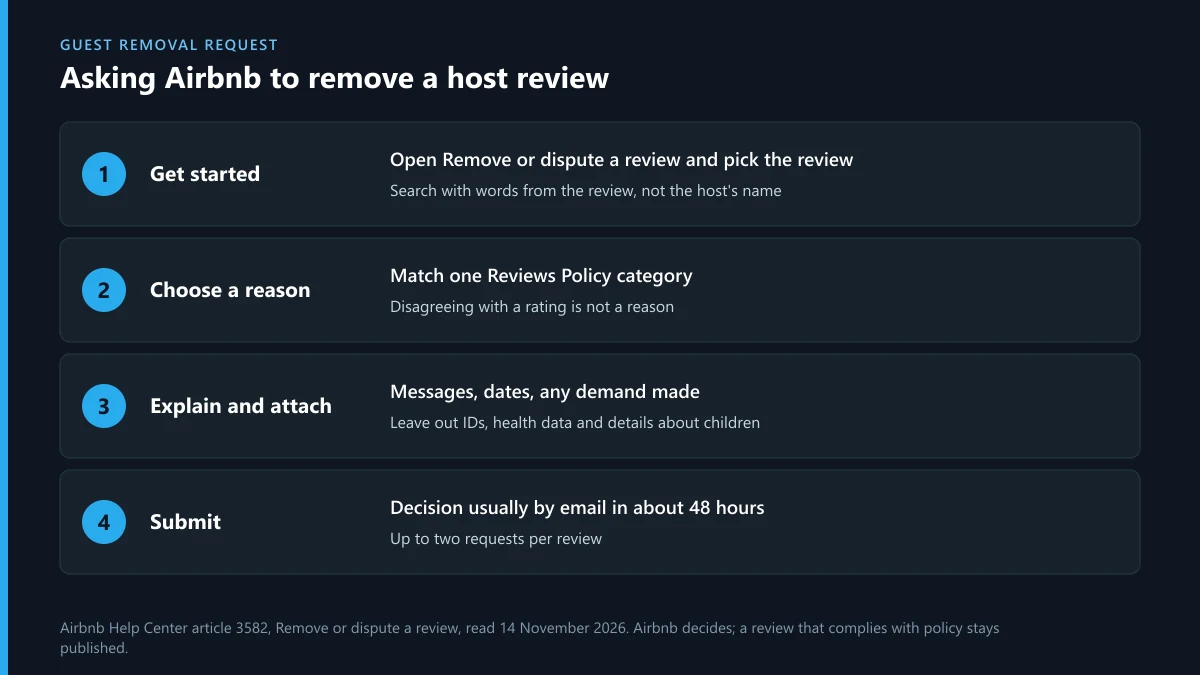
Each review can be put through this form twice, and a pending request blocks a second one. That limit makes the first submission the one to get right: one clear category, one quoted line, documents that prove the sequence. A request that argues the stars were unfair uses up an attempt and changes nothing, because accuracy disputes are, in Airbnb's own words, not something it generally mediates. When the evidence is thin, a public response usually does more than a rejected request. In practice, how to remove a review on Airbnb as a guest is a documentation task: the guest who can show a dated demand, a prior report or a stay that never happened has a case, and the guest who can only show hurt feelings does not. Telegram Ban Service has no access to this form and cannot speed it up; the request belongs to you and the decision to Airbnb.
Does the 14-day window still give you options?
Yes, but only before the reveal. Airbnb's article Reviews for homes says both sides are prompted on checkout day and have 14 days after checkout to submit. Reviews are posted only after both parties have submitted, or when the window closes, which is why each side writes without seeing the other's text. Until your own review is published you can edit it, and the help center says so in as many words.

Three practical points follow. A guest who expects a hard review cannot see it early, so there is no pre-emptive dispute; the request only exists once the host's review is live. Your own review should describe the stay, not the review you fear, because a review written as a counter-attack can itself look biased. And public star ratings for a home appear only after it has three reviews, while subcategory ratings and private notes go to the host and Airbnb alone, so the private note is the place for a fixable complaint you don't need the world to read. Hosts can see that note; future guests cannot. A guest who uses it for the dripping tap and keeps the public review for the stay as a whole gives the host less reason to answer in kind.
Once both reviews are public, the clock that matters is the 30-day limit on removing a review you wrote yourself, a window Telegram Ban Service points out because guests who regret a heated review often notice it too late.
Can you respond to a bad review on Airbnb?
Yes, once, in public. Airbnb's article Responding to a review gives the guest path on desktop: Profile, then Reviews, then Reviews about you, find the review, select Leave public response, write it and Submit. The response is posted immediately, and future hosts see it next to the original review. The article describes no edit step, so treat the first version as the final one.
| Your situation | Best route | Who decides |
|---|---|---|
| Review is harsh but about the stay | Leave public response, short and factual | Future hosts reading both |
| Host demanded money for a better review | Removal request: extorted or pressured | Airbnb, usually in about 48 hours |
| Review followed your report of the host | Removal request: retaliatory, with the notice | Airbnb |
| Review prints your phone or slurs you | Removal request: Content Policy | Airbnb |
| You regret your own review | Remove it yourself within 30 days | You |
How to respond to a bad Airbnb host review without making it worse
Write for the next host, not the last one. A reader deciding whether to accept your booking wants to know whether the problem will repeat, so how to respond to a bad Airbnb host review comes down to three sentences at most: acknowledge the specific point, give the fact the host left out (you messaged about the broken heater on day one, or checkout was at the agreed time), and state what you do on every stay. Skip insults, guesses about the host's motives, and personal details about anyone. The general patterns in a reply strategy for negative reviews on Google and elsewhere apply here as well. A reply that sounds wounded tends to confirm the review; one that sounds like a careful traveller tends to outweigh it. Telegram Ban Service never writes or posts these responses for anyone, because a reply has to come from the guest who stayed.
How to respond to a bad review on Airbnb is mostly a test of restraint, since your reply sits beside the review for as long as it stays up. How to respond to a bad airbnb review that contains a false accusation, such as damage you didn't cause, is different: file the removal request first if a rule is broken, and reply only after the decision, so the reply doesn't contradict what you told Airbnb.
When does an Airbnb dispute move to Telegram or social media?
Sometimes the review is the smaller problem. A host who wants leverage, or a stranger who spotted the dispute, can move it to other platforms, and each of those has its own rules and its own reporting route. Telegram Ban Service only works on the Telegram part, but the patterns are worth knowing because they repeat.
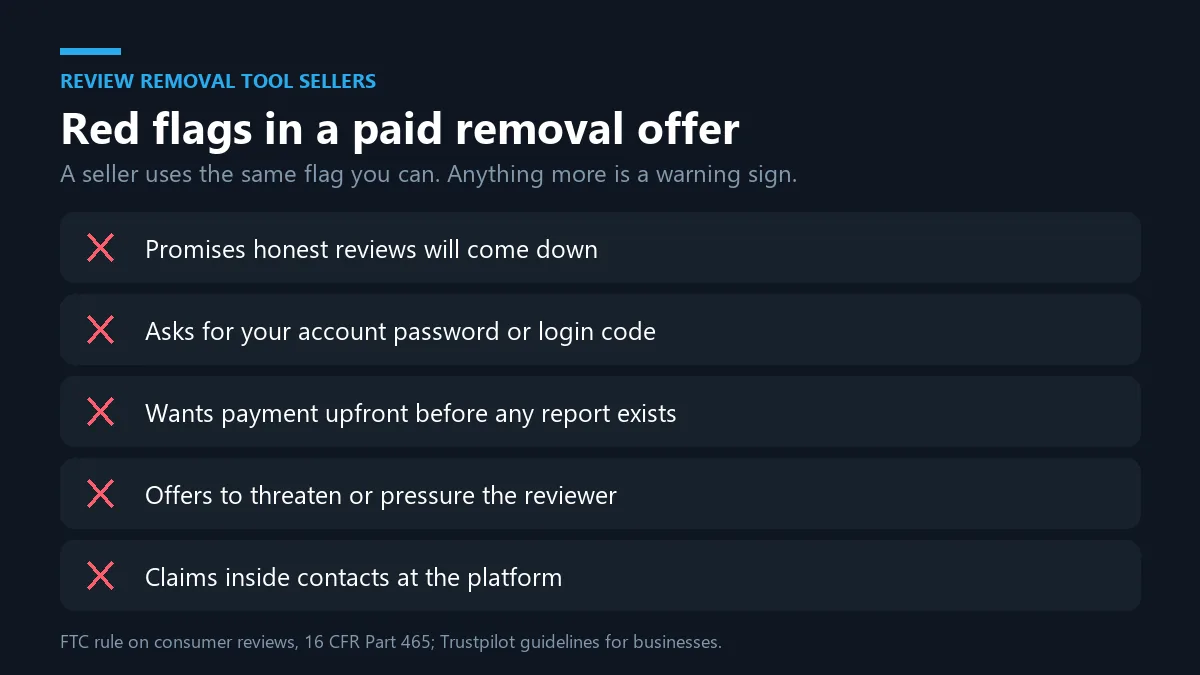
- Review-removal sellers. Telegram channels and bots advertise "Airbnb review removal" or packs of fake five-star stays. Fake reviews break Airbnb's policy outright, and in the US the FTC's final rule on fake reviews and testimonials, in force since 21 October 2024, bans buying them and suppressing reviews through threats. The same offers often arrive unprompted, much like the bulk-DM campaigns sold on Telegram.
- Pay-or-we-post threats. A message demanding money to stop a review, a post or a leak follows the script described in the Facebook blackmail playbook and in sextortion and doxxing threats on X. Don't pay; save the trail.
- Spill-over onto social accounts. If your name and booking photos turn up in a public post, see when a Facebook post about you counts as libel, Facebook's harassment reporting route, Instagram's specialised report forms and reporting an impersonation profile on TikTok. Video uploads have privacy and harassment grounds for a YouTube takedown, and your own photos reposted without permission can go through a copyright claim against a YouTube upload or a TikTok copyright report.
- Listings and ads that sell the scam. Fake rentals promoted elsewhere can be flagged as a Facebook Marketplace seller report, a TikTok Shop seller complaint or a report on a deceptive YouTube ad.
For the Telegram side, use Report on the channel, group or bot, and send scam evidence to @notoscam or abuse@telegram.org, the addresses listed in Telegram's official FAQ. How Telegram restricts and bans channels explains what happens next, and whether the app itself is trustworthy separates the platform from the people misusing it.
What we decline
Telegram Ban Service files the report; Telegram makes the final decision, and Airbnb alone decides about any review on Airbnb. The desk declines four requests that come up around review fights: writing fake counter-reviews or buying stays to bury a host, harassing or mass-reporting the host's other accounts, promising that any review will be removed for a fee, and asking anyone for a password or login code. Volume does not move moderators, as the view from TikTok's moderation queue, the YouTube report-bot sales pitch, Snapchat's response to mass reporting and how Facebook weighs reports on groups and pages each show, and a report filed against you on Facebook works the same way in reverse. Offers to make a host disappear deserve the same doubt: compare what a paid TikTok ban offer actually delivers, the limits on erasing another person's TikTok, why a stranger's Facebook account can't simply be deleted, the facts about deleting someone's Snapchat and the cases where Snapchat removes an account.
An honest host review that hurts is still an honest review. The request form exists for the ones that break a rule, and the public reply exists for everything else.
Sources
- Airbnb Help Center: Authentic and trustworthy reviews (article 2673)
- Airbnb Help Center: Remove or dispute a review (article 3582)
- Airbnb Help Center: Reviews for homes (article 13)
- Airbnb Help Center: Responding to a review (article 32)
- Telegram FAQ
- FTC: final rule banning fake reviews and testimonials
FAQ
Can a guest remove a review on Airbnb, theirs or the host's?
Only a review the guest wrote, and only for a limited time. Airbnb's policy page on authentic and trustworthy reviews says you can remove a review you wrote within 30 days of its publication, for example if it no longer reflects your experience. A review a host wrote about you is a different case: you can't delete it, but as the guest who booked the reservation you can ask Airbnb to remove it at any time through Remove or dispute a review. Airbnb removes it only if it breaks the Reviews Policy, as an irrelevant, fake, biased or extorted, competitive, retaliatory or Content Policy review. If Airbnb removes a review you wrote, you can't write a new one for that reservation, so think before you withdraw a fair one. Nothing in this process needs a third party, and no outside service can delete an Airbnb review for you.
How to remove airbnb review as a guest when the host demanded money?
File a removal request and choose the extorted or pressured category. Airbnb's Reviews Policy says reviews may not be provided or withheld in exchange for something of value, and that threatening a negative review to get compensation is prohibited. A host who asks for payment outside Airbnb, or for a five-star review in return for dropping a damage claim, is doing exactly that. Gather the messages from the Airbnb thread, the reservation dates and any payment request, then submit them through the Remove or dispute a review form. Airbnb's help article says it usually emails a decision within about 48 hours and allows up to two requests per review, so send the full record the first time. Don't pay off-platform and don't negotiate over a review. If the threat arrives through a Telegram account rather than Airbnb's messages, that account can also be reported on Telegram.
I got a bad review on Airbnb as a guest. What should I do first?
Read it against the six policy categories before you react. Most bad guest reviews are honest opinions about cleanliness, noise or communication, and Airbnb keeps those up even when you disagree. If one category clearly fits, such as a review that names a stay you never made, mentions your phone number, or follows your report of the host, file the removal request with that category and your evidence. If none fits, write one calm public response that adds the missing fact, because the next host reads your reply beside the review. Then keep booking normally; a profile with many reviews puts one bad review in context over time. Avoid messaging the host to demand a change, since pressure around reviews is itself against the policy, and never buy fake stays to bury it.
How to respond to a bad Airbnb host review the right way?
Open Profile, then Reviews, then Reviews about you, and choose Leave public response on the review. Airbnb's help article on responding to a review says the response posts immediately and that future hosts and guests can see it next to the original, and the article lists no way to edit it, so draft it somewhere else first. Whether you search how to respond to a bad Airbnb review or how to respond to a bad review on Airbnb, the answer is short: two or three sentences. Acknowledge the point the host made, add the fact they left out with a date, and close with what you do on every stay, such as reporting problems on day one. Leave out insults, the host's motives and anyone's personal details. A reply that reads as calm and specific tells a future host more than the review does. If the review breaks a rule, request removal before replying, so the two don't contradict each other.
Can you respond to a bad review on Airbnb more than once?
Plan for one response. Airbnb's guest instructions describe a single Leave public response button and a response that is posted immediately, with no editing step in the article, so the first version is what readers will see. That is why the wording matters more than the speed. If new facts appear later, for instance Airbnb rules on a damage claim in your favour, the better route is a removal request that points to that outcome rather than a second reply. Hosts are in the same position when they respond to reviews about their listings, which is why short, factual replies are standard on both sides. Avoid quoting private messages in full, because a response is public and still has to follow the Reviews Policy and Content Policy like any review.
How to remove host review on Airbnb if it is retaliation?
Show the order of events. Airbnb's Reviews Policy treats a review as retaliatory only when the reviewer committed a violation, was notified of it, and then left a biased review after being reported. For a guest, that usually means you reported the host for a policy breach, Airbnb acted or contacted the host, and the host's review came afterwards. Put the dates in a short timeline: your report, Airbnb's reply, the review's publication. Attach the confirmation email or case message and quote the line in the review that reflects the dispute rather than the stay. Submit it through Remove or dispute a review under the retaliatory reason. A host who was never reported, or whose review only describes your stay unkindly, falls outside this category, and Airbnb will usually leave the review up.
Is a Telegram channel offering Airbnb review removal legitimate?
Treat it as a scam or a policy breach. Only Airbnb removes a review on Airbnb, and it does so through its own request form against its written policy, so a seller has no button you lack. Channels that promise removal for a fee usually want payment upfront, ask for your login, or sell fake stays and fake ratings, which break Airbnb's Reviews Policy and, in the US, the FTC rule on fake reviews in force since October 2024. Some of these channels also threaten bad reviews unless you pay. Save the t.me link, the price list and any threat, then use Report on the channel and send scam evidence to @notoscam or abuse@telegram.org. Telegram Ban Service can check that evidence and report genuine Terms of Service breaches once through official routes; whether the channel is banned is Telegram's call.